Transcript
This episode contains graphic descriptions that some audiences may find disturbing. Listener discretion is advised.
It’s August 9, 1945 and 13 men sit sweating inside a B-29 Superfortress named Bockscar, flying over the city of Kokura in southern Japan. The four-engine, high-altitude bomber is a technological marvel and the largest aircraft used by the American military, but even it had to be stripped of armor and weaponry and retrofitted to carry this mission’s payload.
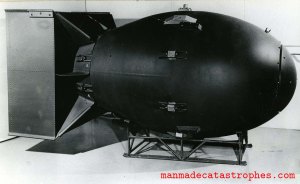
That payload is the deadliest device ever created – a nearly 11,000-pound plutonium bomb, which has aptly been given the code name Fat Man.
Three days earlier, a fellow B-29, the Enola Gay, dropped its brother bomb, Little Boy, over Hiroshima. That bomb represented mankind’s first ever nuclear attack, and it brought horrific devastation, virtually flattening the city and killing some 70,000 people in the first day. From an operational standpoint though, the mission had gone off without a hitch.
Today, the Bockscar’s objective is to drop the second atomic bomb on Kokura, an industrial center and home to a critical weapons factory. But so far, almost nothing has gone according to plan.
The mission had originally been scheduled for two days later, August 11, but an ominous weather forecast for the coming week condensed that timeline.
So at 2:15am on the morning of the 9th, the crew boarded Bockscar on the Tinian Naval Base in the Northern Mariana Islands. But while doing the final pre-flight inspection, they found that a pump malfunction had rendered the plane’s 640-gallon tank of reserve fuel inaccessible. So the men all shuffled out, unsure what to do next. This would normally mean the mission had to be delayed or scrapped, but these were very special circumstances.
The crew looked to Colonel Paul Tibbets, one of the men overseeing the mission and the pilot who’d flown the Enola Gay over Hiroshima three days earlier. He stressed that they were quickly losing their weather window, and that the Hiroshima mission had gone smoothly, flying from the same base without ever needing to dip into the reserve fuel. “I say go,” he proclaimed.
So Bockscar took off at 3:47am without access to its reserve fuel, and worse still, that fuel couldn’t be extracted…it would just have to be 4,000 pounds of dead weight.
Over the Philippine Sea three hours later, the weaponeer in charge of the bomb itself, Frederick Ashworth, was shaken awake from a nap by his terrified assistant. “Hey, we got something wrong here. We got a red light going off like the bomb is going to explode right now. Armed, it’s armed. Fully armed, look at this. Can you take a look, what is going on with this?!”
The red light started blinking faster, and the two men frantically pulled out the bomb’s blueprints. They thought maybe a change in altitude had prematurely armed it. After taking off the bomb’s casing and inspecting its switchboard, they realized two of the switches had been mistakenly swapped. They flipped them to their correct positions and the light went off…no doubt prompting a big sigh of relief.
At 9am, Bockscar arrived over the southern tip of Japan, where it planned to rendezvous with two other B-29s, the Great Artiste and the Big Stink. The former was to take measurements of the bomb blast, and the latter would take photos. The Great Artiste showed up 10 minutes after Bockscar, but Big Stink was nowhere to be found. So the two planes waited, and waited…and waited.
Despite instructions to wait no more than 15 minutes, the planes circled for more than 45 excruciating minutes, burning up very precious fuel. Unbeknownst to them, Big Stink was also circling, but out of sight some 9,000 feet above.
Confused, the pilot of Big Stink broke radio silence, asking those back at base, “Is Bockscar down?” But a spotty transmission resulted in those at Tinian hearing only “Bockscar down.” The base commander reportedly heard the news and ran outside to vomit. For the next several hours, many would go on believing Bockscar had crashed.
But in fact, it had moved on with the mission with only the Great Artiste, unable to wait any longer. The Enola Gay, which was running weather reconnaissance that day, radioed from above Kokura that the skies were clear enough to proceed with the attack.
 But when Bockscar arrived at 10:45am, the city was blanketed with smoke and ground haze. The weapons plant was to be the bomb’s direct target, and the crew had been given strict orders to confirm it visually in the crosshairs, not by radar. If they dropped the bomb way off target, much of its explosive force could be wasted, and a demonstration of its power was one of the primary objectives. Radar was too prone to error to be relied on in this situation.
But conditions thwarted visual targeting. There are differing theories as to why visibility had been reduced so significantly in the short time since Enola Gay’s go-ahead message. Some think it was a simple change in weather, some believe it was smoke from the firebombing of a nearby city the day before. Then there’s the possibility that people on the ground, alerted by the earlier presence of the Enola Gay earllier, had purposely created steam and smoke to obscure the city.
Whatever the cause, Bockscar’s bombardier, Kermit Beahan, couldn’t find his target. As the plane completed its first unsuccessful pass over the city, flak from anti-aircraft fire began bursting nearby. The plane turned to make a second pass, and tension began to mount among the crew. They were becoming seriously concerned about their fuel, but Bockscar flew over Kokura once more, again without finding its target and flying through an even thicker field of flak.
Commander Charles Sweeney, who was piloting the plane, decided to make a third pass. But yet again, Beahan was unable to get a visual on the target. By now, the increasing flak was getting very close and radar showed that Japanese fighter planes had taken off.
The three unsuccessful passes over Kokura at low altitude had taken nearly an hour, and consumed a lot of fuel. There wasn’t enough for another pass and the skies were becoming too dangerous anyways. By now, the plane had no hope of making it back to the Tinian base as planned. It could possibly make it Okinawa, the nearest friendly landing strip, but only if it was unburdened of its 11,000-pound payload. So, the decision was made to move on to the backup target: Nagasaki, a port city and home to a quarter million people.
Bockscar banked South, nearly colliding with The Great Artiste in the process. En route to Nagasaki, several of the crew were resigning themselves to the possibility that they weren’t going to make it home…or at the very least, they wouldn’t be landing smoothly on a runway. One of the pilots wrote in his mission diary, “Less than two hours of fuel left. Wonder if the Pacific will be cold.”
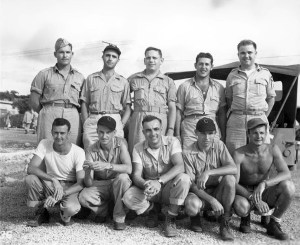
Staff Sergeant Ed Buckly, Master Sergeant John Kuharek, Sergeant Raymond Gallagher, Staff Sergeant Albert Dehart, Sergeant Abe Spitzer
Twenty minutes later, they approached the city. This time, they would only get one chance. If they failed to drop the bomb on the first and only pass, they would have to ditch it in the ocean to have any chance of making it to Okinawa. After already making several questionable decisions, it couldn’t have been an enticing prospect to tell superiors that they’d not only failed the mission but also lost the $2 billion atomic bomb — currently the only one left in the US arsenal.
So, it was especially disheartening when they arrived to Nagasaki and saw that it too was obscured by cloud cover. Nevertheless, the bomb bay doors were opened. Ashworth decided that if a visual couldn’t be made on the target, radar would have to suffice. They flew for several minutes and still saw nothing but clouds below. But then, toward the end of the pass, bombardier Beahan shouted “I see it! I see it! I got it!”
A small hole in the clouds had apparently emerged just enough to see his target…and just in the nick of time. Whether or not this was true would later come into doubt. But regardless, less than a minute later, he yelled “bombs away!” Fat man was released, Boxcar banked hard and accelerated full throttle.
The bomb fell for 43 seconds, and when it was 1,600 feet from the ground, the nuclear chain reaction was initiated and Fat Man became an astounding ball of light. Co-pilot Frederick J. Olivi later recounted: “Suddenly, the light of a thousand suns illuminated the cockpit. Even with my dark welder’s goggles, I winced and shut my eyes for a couple of seconds. I guessed we were about seven miles from ground zero and headed directly away from the target, yet the light blinded me for an instant. I’ve never seen anything like it. Biggest explosion I’ve ever seen.”
In fact, it was the biggest explosion anyone had ever seen – the biggest man had ever created. And the crew feared it was catching up to them. Commander Sweeney had also been present at the Hiroshima bombing in the Great Artiste, which had also served as the instrument plane on that mission too. He said the Nagasaki mushroom cloud was rising faster than that at Hiroshima. “It seemed more intense, more angry,” he later recounted. “It was a mesmerizing sight, at once breathtaking and ominous.”
Unbelievably, after they’d made the pass and dropped the bomb, Sweeny decided to spend even more time and fuel to circle back and get a better look at the explosion. As the plane neared though, someone yelled from the back of the plane that the mushroom cloud was coming toward them, gaining on them every second. Sweeny banked away and steered downward, trying to gain speed to put distance between the plane and the expanding mushroom cloud. For several minutes, the crew couldn’t tell whether or not they were outrunning it. Eventually, it began to recede behind them as they made a bee line toward Okinawa.
They were now critically low on fuel. Ashworth told the crew to put on their lifejackets and say their goodbyes to one another. An ocean landing was likely, and a subsequent rescue was not.
Miraculously though, the Bockscar made it the 450 miles to Okinawa. Having showed up unannounced, the crew desperately tried radioing for clearance to land, and when they got no response, they fired distress flares to warn the ground. As Bockscar descended toward the runway, one engine died from fuel exhaustion. It touched down hard, going 30 miles per hour faster than normal, then bounced back up 25 feet in the air. It landed again, then swerved, narrowly avoiding a row of parked B-24 bombers.
Finally, the plane slowed, just as a second engine died. They had made it by the very thinnest of margins. There was probably no more than a minute’s worth of fuel left for the remaining two engines. As fire trucks and jeeps pulled up, Sweeney reportedly instructed his crew not to tell anyone what had happened on the mission. And indeed, there would be conflicting accounts in the years ahead. For now though, the crew was exhausted but relieved to be alive.
However, tens of thousands of men, women and children back in Nagasaki were not. Despite bombardier Beahan’s insistence that he had a visual confirmation on the munitions plant, the bomb ended up going off nearly a mile and a half off target – an unsurprising margin of error for radar identification, but pretty surprising if it had been from a visual ID by one of the Army’s most skilled bombardiers.
The result was that instead of ground zero being a critical military target, it was an almost entirely civilian area of Nagasaki — full of homes, schools, churches and hospitals. As Bockscar’s crew had a meal, refueled and flew back to Tinian later that night, Nagasaki was in agony. Many residents had been completely vaporized, and many more were in the process of dying gruesome agonizing deaths that would take hours, days, even months. Others would ultimately survive, but live out their lives scarred, disfigured, sick, traumatized and made pariahs in their own country.
Naturally, the question soon arose: was it worth it?

The atomic bombs attacks on Japan were controversial from the moment they happened. Some believe they constitute an unconscionable war crime. On the other end of the spectrum, some think that, regardless of the military significance, they were just retribution for a nation that had attacked Pearl Harbor unprovoked and committed crimes against humanity on a massive scale throughout Asia.
Most though probably fall somewhere in the middle. They acknowledge the horrific devastation wrought upon a mostly civilian population that included many innocent children, but also recognize the stubborn position of the Japanese leadership, who refused to surrender and seemed hell bent on fighting to the very last person, obliterating millions more Japanese and Allied lives in the process.
But the atomic bombings remain poorly understood. Hiroshima and Nagasaki tend to be remembered together as two parts of the same event, with Nagasaki simply being the less momentous second installment. But the two were separate events with different circumstances and implications. Some historians who defend the bombing of Hiroshima have a much harder time with Nagasaki.
The bungled Bockscar flight was just the cherry on top the cake of miscalculations, rushed decision making, and revised history surrounding the second and, knock on wood, last use of a nuclear weapon in combat…on this episode of manmade catastrophes.
[Theme music]
On April 12, 1945, Vice-President Harry Truman was wrapping up a long day presiding over the Senate, and planning to meet the Speaker of the House for a drink. But then he got word that he needed to come to the White House “as quickly and as quietly” as possible. When he arrived, First Lady Eleanor Roosevelt greeted him, placed her hands on his shoulders and calmly said, “Harry, the president is dead.”
With the full gravity yet to sink in, Truman tried to console her, asking if there was anything he could do for her. “Is there anything we can do for you?” Mrs. Roosevelt replied. “You’re the one in trouble now.”
Truman had only been Roosevelt’s vice-president for 83 days, and the men hadn’t been especially close. So there was a lot that Truman wasn’t up to speed on regarding the war effort he had just assumed command of. Chief among them was the Manhattan Project, the Top-Secret program to develop a nuclear weapon.
Two years earlier, then-Senator Harry Truman had been looking into wasteful war-production expenditures and began raising questions about a suspicious plant in Minneapolis, which was secretly connected with the Manhattan Project. Secretary of War Harry Stimson gave Truman a stern phone call, warning him to drop the matter. Now, just minutes after being sworn in as president, Secretary Stimson pulled him aside to tell him that a new weapon was being developed with “almost unbelievable destructive power.”
It was the first inkling Truman ever had of the bomb, and he later recalled being somewhat puzzled by the news. But twelve days later, he was fully briefed on the Manhattan Project by Stimson and the project’s leader, General Leslie Groves. But contrary to the popular belief that Truman had a set of pros and cons placed before him and a big decision to make about whether to use the bomb or not, he actually had very minimal involvement going forward. The project had already been in the works for years without him, and as General Groves would later put it, Truman’s role was quote “one of noninterference — basically a decision not to upset the existing plans.”
For his part though, Truman didn’t seem to have any reservations about using a weapon that could potentially end the war. The writing had been on the wall since the previous year that Japan had virtually no hope of prevailing. American forces had begun taking territory within B-29 striking range of Tokyo and most of mainland Japan. And in recent months, they had been relentlessly firebombing dozens of Japanese cities. In March of 1945, a bombing raid on Tokyo killed as many as 100,000 people in a single night. But still, Japan refused to surrender.
As Nazi Germany surrendered on May 7, US plans were being laid for a full-scale land invasion of mainland Japan, and Japanese plans were simultaneously being hatched to defend against it at all costs. Desperate Kamikaze attacks were already wreaking havoc on American Naval forces, and some 28 million Japanese civilians between the ages of 15 and 60 were conscripted to resist the coming invasion with weapons as simple as bamboo spears, batons and Molotov cocktails. They, too, were expected to carry out suicide attacks on an enormous scale to slow the American advance.
Truman would later claim he was advised that the invasion would result in between 250,000 and 1 million American casualties. These numbers were later called into question, but by all estimates, the invasion would have been devastating to both Japan and American forces.
By the time Truman was brought into the nuclear fold, there didn’t seem to be much question as to if atomic bombs would be used — it was just a matter of when and where.
That spring, a target committee consisting of scientists and military personnel had been formed to decide how the bombs would be used, and there were several possibilities considered. They could be used to supplement the planned land invasion, essentially clearing a path for the US ground forces. Or a bomb could first be detonated in an unpopulated area in front of Japanese observers as a non-deadly demonstration of its destructive power. Or, they could be used on purely military targets in secluded areas. And finally, they could be used on large cities – either with or without forewarning to Japan and the cities’ inhabitants.
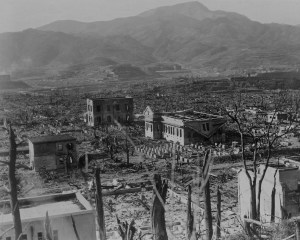
The possibility of detonating the bomb as a demonstration was eliminated early on. It was feared that if the bomb was a dud, this could backfire and just embolden the Japanese to keep fighting. The possibility of dropping the bomb on a city but with forewarning was also ruled out, with the reasoning that it could increase the likelihood of the plane being shot down, or Japan moving American prisoners of war into that city. There was also concern that the “shock value” of the bomb would be lost if there was a warning.
In the end, it was decided that the bomb should be used on a dual target – essentially, a city that also had military installations. This would allow the bomb’s incredible destructive power to be fully demonstrated, but also achieve practical military objectives…though critics might see the military component as mere justification.
From this point, it seems clear that maximizing casualties – both military and civilian – was a paramount goal of the atomic bomb, which in committee discussions was referred to as ‘the gadget’. In later memoirs, General Groves, who was on the target committee, recalled:
“I had set as the governing factors that the targets chosen should be places of bombing of which will aversely affect the will of the Japanese people to continue the war. Beyond that, they should be military in nature, consisting either of important headquarters or troop concentrations, or centers of production of military equipment and supplies. To enable us to assess accurately the effects of the bomb, the targets should not have been previously damaged by air raids. It was also desirable that the first targets be of such size that the damage would be confined within it so that we could more definitely determine the power of the bomb.”
The committee ultimately recommended, in writing, that:
“Psychological factors in the target selection were of great importance. Two aspects of this are, one, obtaining the greatest psychological effect against Japan and, two, making the initial use sufficiently spectacular for the importance of the weapon to be internationally recognized when publicity on it is released.”
So ideally, the cities targeted would be large urban areas at least three miles wide in diameter with flat terrain so the full power of the bomb could be illustrated – and they should be targets that have been left relatively unscathed from firebombing and other American attacks thus far, so that the extent of the damage can be accurately measured.
The committee suggested five cities that met this criteria, including Hiroshima and Kokura. Another city on that list was Kyoto, the ancient capital of Japan, which now also had many universities. The committee reasoned that:
“This target is an urban industrial area with a population of 1 million. It is the former capital of Japan and many people and industries are now being moved there as other areas are being destroyed. From the psychological point of view, there is the advantage that Kyoto is an intellectual center for Japan and the people there are more apt to appreciate the significance of such a weapon as the gadget.”
It shouldn’t be surprising that by this point, the atomic bombs were largely seen by military figures as potential instruments of terror. The American firebombing campaigns that had laid ruin to Tokyo and dozens of other cities had made little pretense of having strictly military objectives. They had sought to destroy the Japanese public’s morale and will to continue the war. Civilian deaths were a feature, not a bug. Now, the A-bombs had the potential to amplify this terror. After the war, Secretary of War Stimson would write that “the atomic bomb was more than a weapon of terrible destruction; it was a psychological weapon.”
Stimson had his limits though. He asked Truman to take Kyoto off the target list. The ancient Japanese capital had major cultural, religious and historical significance, and Stimson was apparently personally fond of it. He worried that destroying the city could cause particular bitterness among the Japanese, and complicate post-war reconciliation. In persuading Truman, he reportedly contrasted the civilian importance of Kyoto with the military installations Hiroshima had. Truman agreed to take Kyoto off the list, but the conversation with Stimson apparently left him with an exaggerated perception of Hiroshima’s military significance.
On July 25th, he wrote in his diary: “This weapon is to be used against Japan between now and August 10th. I have told the Secretary of War, Mr. Stimson, to use it so that military objectives and soldiers and sailors are the target, and not women and children. Even if the Japs are savages, ruthless, merciless and fanatic, we as the leader of the world for the common welfare cannot drop that terrible bomb on the old capital or the new. He and I are in accord. The target will be a purely military one and we will issue a warning statement asking the Japs to surrender and save lives. I’m sure they will not do that, but we will have given them the chance.”
Taking Kyoto off the target list was one of the few direct interventions Truman actually made regarding the bombs’ use. But from that point all the way through both atomic attacks, Truman’s diary and public statements seem to suggest he didn’t really comprehend how many civilians would be killed.
Nagasaki wasn’t on the initial list of five recommended targets. Compared to the other cities, it did appear a poor choice, with its hilly terrain, POW camp housing Allied prisoners, and the fact that it had already been subject to multiple conventional bombing raids. Years later, General Groves would admit that in retrospect, he really had no idea how or when Nagasaki had been brought into the picture. In late April, it was on a very early list of 17 possible cities. But it was soon eliminated and it wouldn’t show up again as a potential target until after Truman agreed to remove Kyoto at the end of July. It was a little more than two weeks before Nagasaki would ultimately be reduced to rubble.
* * *
The decision to use the atomic bombs on urban areas had essentially been sealed by early June. Then, on July 16th, it was no longer a theoretical plan. That day, the Trinity test in the New Mexico desert became the world’s first ever nuclear detonation. The United States now knew, without a doubt, it had a city-erasing weapon.
At the time, Truman was in Soviet-occupied Germany to attend the Potsdam conference with British Prime Minister Winston Churchill and Soviet leader Joseph Stalin to discuss the future of post-war Germany and the still unfolding war with Japan.
Truman was told of the successful test and briefed Churchill, his close ally, in detail. To Stalin though, he was more guarded, telling him simply that the US now possessed a “new weapon of unusual destructive force.” Stalin had little to say on the matter, coyly telling Truman to make good use of it on the Japanese. In fact, thanks to espionage, Stalin had known about the Manhattan Project long before Truman ever learned of it.
Stalin also offered Truman some good news, saying that the Soviet Union still planned to break the neutrality pact it had signed with Japan in early 1941, and enter the Pacific War within three months of Germany’s defeat. It intended to begin its attack on Japan in occupied Northern China on August 15.
One widely held belief posits that dropping the atomic bombs actually had more to do with the Soviet Union than Japan. According to this theory, the US hoped to end the war before the Soviet Union could get involved so as to minimize its role in a post-war Asia and prevent the sort of partitioning of Japan that ultimately befell Germany and Korea. But historians have challenged this view.

Truman never gave any indication that he didn’t want the Soviet Union to join the Pacific War. It was far from certain that the atomic bombs alone would force Japan’s surrender. In fact, given that nonstop firebombing hadn’t broken Japan’s will, there was little to suggest atomic bombs would. An American land invasion was still being planned, and the Soviet Union opening another front would only help that in that effort and mitigate American losses.
To wit, in a letter to his wife from Potsdam, Truman wrote: “I’ve gotten what I came for. Stalin goes to war August 15th with no strings on it. I’ll say that we’ll end the war a year sooner now, and think of the kids who won’t be killed. That is the important thing.”
If the US truly didn’t want the Soviet Union getting involved, it had ample opportunity to try to dissuade it. And it would have made little sense to inform Stalin, even in vague terms, about the atomic bombs’ existence at Potsdam. If keeping him out of East Asia was the goal, that would have risked pushing him to expedite the invasion plans…something he did in fact end up doing.
Sidelining Stalin was undoubtedly a thought in the minds of some US military and political leaders. But while the atomic bombs may ultimately have had the effect of preempting Soviet influence in post-war Asia, there’s little evidence that this was a significant motivation in their use. By most accounts, Truman and the top US leadership wanted the war to end as soon as possible. Atomic bombs AND a Soviet invasion were both seen as means to this end.
Potsdam concluded with an ultimatum to Japan to surrender unconditionally or face “prompt and utter destruction,” though the exact nature of that destruction wasn’t specified. The declaration also made clear that Japan would have to accept democracy, Japanese war criminals would be prosecuted, and those leaders who’d pushed the country to military conquest would be removed from authority. Some of Truman’s advisers recommended including a clause that guaranteed the retention of the emperor after surrender, but it didn’t make the final cut. Had that bit been included, history could have been very different.
So for all Japan’s leaders knew, surrendering could mean their own prosecution and execution, all the way up to the emperor himself. Japan’s six-man Supreme Council for the Direction of the War would have the final say on surrender, and there had to be unanimous consent. Some members were eager to end the war, but a hawkish faction was determined to fight to the end. Unable to reach a consensus, the Potsdam conditions and call for surrender were rejected.
The ultimatum was signed only by the United States, UK and China. The Soviet Union was not included, as it had yet to formally break the neutrality pact and declare war on Japan. Some Japanese leaders in fact hoped they could get Stalin to mediate a surrender with the other Allied powers, with conditions more favorable to Japan…like keeping the imperial system, avoiding war crime trials, keeping US occupation forces out of mainland Japan, and maybe even keeping some conquered territory. They thought it might be in Stalin’s interest to push for concessions that would mitigate the American post-war footprint in Asia. So in June and July, top Japanese leaders made overtures to the Soviets to this effect, but to no avail. Unbeknownst to them, the Soviet Union was already planning an invasion.
While still at Potsdam in late July, Truman gave final authorization for the military to use the atomic bombs as soon as they were ready, but not before August 2nd. From that point on, he had no input as to exactly when and where the bombs would be dropped. The final military order instructed that the first bomb could be dropped as soon as weather allowed for visual bombing after about the 3rd of August 1945, and that any other available bombs could be used “as soon as made ready by the project staff.” There were currently two bombs ready, and another two nearing completion.
Again, it’s worth emphasizing that there was little dissent about using the bombs on Japanese cities. It was basically seen as the logical continuation of the fire-bombing campaign amid total war. The two bombs at hand would be used, and in all likelihood, the next two also would as soon as possible.
After a weather delay pushed plans back three days, the first bomb was dropped on Hiroshima on August 6 and the world would never be the same.
 [Hiroshima newsreel] “Hiroshima, seen from the air after the atomic bomb blast that virtually erased this city of 340,000 people from the Earth. As far as the eye can see stretched scenes of desolation and ruin – four square miles leveled by one bomb – the product of a live science and a climatic answer to the terror and aggression let loose on the world by Japan.”
But the Hiroshima bombing didn’t spark a crisis among Japan’s top leadership. While top officials would learn the day of the bombing that Hiroshima had been hit by some sort of new bomb, it would take two days for a group of scientists to enter the city to begin investigating it, and another few days after that to confirm that the attack had indeed been nuclear. The scientists’ report wouldn’t reach the leadership in Tokyo until August 11th.
But even if these leaders were fully aware of what had gone down in Hiroshima, it still probably wouldn’t have been considered a game changer. They had been receiving reports almost daily of Japanese cities being completely devastated by conventional attacks. The firebombing of Tokyo in March had left more than 100,000 dead in a single night – more than Hiroshima. And in just the previous few weeks, the leadership was routinely getting reports of other cities being 50 percent, 80 percent, even 99 percent destroyed in air raids. If you compared Hiroshima to cities conventionally bombed before it that year, it was second highest in terms of lives lost, fourth in terms of square miles destroyed, and 17th in terms of the percentage of the city destroyed. So it’s maybe not surprising that the Hiroshima bombing didn’t make Japan’s leadership leap from their seats.
It did however, get Stalin’s attention. Seeing that the bombing didn’t immediately prompt a surrender, he moved up his invasion plans. Instead of the originally planned August 15th, the Soviet Union declared war on Japan on August 8th at 11pm. An hour later, its ground troops advanced into Japanese occupied Northern China.
That did make Japan’s leadership perk up. With the Soviet declaration of war, two of the last remaining pathways to favorable surrender terms all but closed. Stalin’s invasion obviously meant he would not be playing the role of mediator, so the diplomatic route was gone. And his opening of another front in the war virtually ended any possible military route. Japan was hoping that relentless suicide attacks and a fierce resistance to the American invasion would inflict losses so great that the US might be willing to come to the bargaining table.
But the Soviet invasion upended that calculus. Instead of just an American invasion from the South, which wasn’t expected for another three months, another great power was invading, possibly reaching mainland Japan much sooner, and from the North, which was far less fortified. And if his war with Germany was any indication, Stalin seemed less bothered by high casualties than the Americans.
The Soviet invasion also presented the frightening prospect of a post-war Soviet occupation. The Soviet Union’s rigid communism likely had no room for the Japanese emperor to remain in place, even as a figurehead. And the country would likely impose dramatic social and ideological changes on Japanese society. The Americans, on the other hand, were viewed as more pragmatic, less likely to enforce sweeping societal changes, and more willing to help Japan rebuild. Basically, it was the lesser of two evils.
Just hours after learning of the Soviet invasion on the morning of August 9th, the Supreme Council called an emergency meeting in Tokyo. Prior to the meeting, the Prime Minister and council member Kantaro Suzuki spoke with Emperor Hirohito, and received his blessing to go ahead with unconditional surrender in accordance with the Potsdam terms, if that’s what the Council decided on.
When the meeting began, there was reportedly a very somber mood. Japan’s position had gone from bad to hopeless, literally overnight. Suzuki informed the Council that the emperor wanted to end the war quickly. One member advocated surrendering with the sole condition that the emperor be preserved, but the hardline faction insisted on additional terms that were certain to be rejected by the Allies. The council remained deadlocked three to three. As they continued their heated debate throughout the morning, the Bockscar closed in on Nagasaki.
* * *
When Fat Man dropped, few of the people on the ground in Nagasaki were sheltered. Several recent air raid siren warnings had been false alarms, including that very morning. So when two B-29s approached Nagasaki, they either weren’t noticed or weren’t considered threatening enough to yet again send the city’s residents scrambling for shelter.
Some children playing on the street noticed three parachutes gently descending from the clouds – measuring devices dropped by the Great Artiste. Seconds later, a blinding light several times brighter than the sun blanketed the city, followed immediately by an ungodly explosion that packed the force of 21,000 tons of TNT.
The center of the blast was hotter than the sun, and the ground below reached as hot as 7,000 degrees Fahrenheit – about four times hotter than cremation temperatures. It reduced any living thing in the immediate vicinity to ash. Some people even had their shadows permanently burned into the ground beneath where they stood at that moment.
The explosive force of the bomb barreled through the city at two-and-a-half times the speed of a category five hurricane, blowing away anything or anyone standing in its way. Nearly everything within half a mile, including huge concrete and brick structures, was destroyed, and virtually all homes within a mile and a half disappeared. Even some structures more than four miles away collapsed.
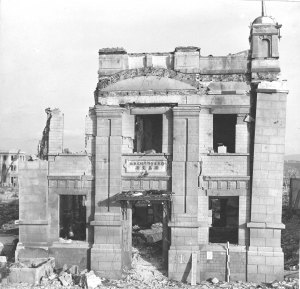 If people were far enough from the hypocenter to avoid being incinerated or carbonized, they were thrown violently through the air hundreds of feet into the side of buildings or back down against the searing hot ground. As buildings like the Nagasaki Medical College or Shiroyma Elementary School burned or began to crumble, people leapt out the windows to try escaping…usually in vain.
A mile from ground zero, clothing ignited, deadly flash burns seared into people’s exposed skin and glass shards and other debris shot through their bodies. At two miles, people still suffered terrible burns and often became stuck in the scorching hot rubble of collapsed buildings. Even five miles away, microscopic flying debris ripped into people’s skin, and windows as far as 11 miles away shattered.
As the fireball from the blast ascended upward, it created a suction effect, sucking much of the debris and dust back toward it. This dealt the final death blow to many buildings that were still standing, and those still alive heard collapses all around them as they were dealt a second punch of flying debris.
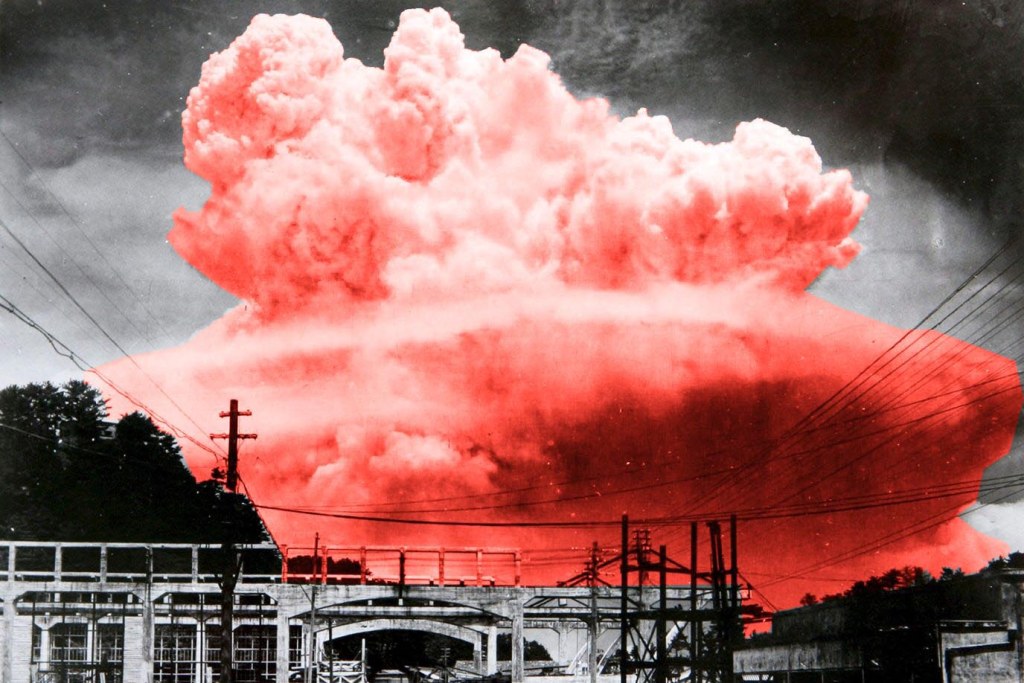
The mushroom cloud continued rising upward to more than 11 miles at its peak, blocking out the sun. As the hurricane of fire finally settled, many of those who’d survived began pulling themselves from the rubble. They stood to see what had been a bustling city just minutes ago, now a charred wasteland blanketed overhead by a heavy cloud of smoke and dust. Mounds of blackened rubble, still smoking, were all that remained of the neighborhoods. Nearby hillsides that had been lush with green summer vegetation were now scorched and desolate.
Some people just beyond ground zero remained laying down, burned so badly they couldn’t move. Others stood, only to limp a few feet before dropping dead. Twenty minutes after the explosion, ash that had been seeded in the clouds by the blast began to fall as an oily black rain.
Those who could, were now moving seeking help. Witnesses would later recount scenes straight out of a horror movie. Some people looked as if they had tattered clothing hanging down from their bodies, but in fact, it was their melted, drooping skin. Some tried touching what they thought to be their clothing, only to find bare, blackened, slimy skin peeling away.
Others were missing body parts, or had eyeballs dangling out from their sockets. One woman who had used her hands to shield her eyes from the blast found that her face was now melted into her palms. Survivors would later describe these burn victims as “unlike humans” or “no longer of this world.”
Those who were able staggered through the still intense heat, passing charred, dismembered bodies on their way, as well as those moaning through their last breaths, begging for help, water, or simply reciting their names and addresses in hopes that someone could relay word of their fate to their families.
A grim parade of bloody, mutilated survivors lurched toward streams and other water sources, seeking relief from heat, burns and dehydration. Some waded in and cupped water into their mouths, only to fall dead within minutes. The Uragami River that ran through town drew thousands, but quickly became a scene of floating mass death.
One survivor named Shigeko Matsumoto, who was just half a mile from ground zero, had been lucky enough to be at a bomb shelter when the bomb hit. In an interview with TIME Magazine, she recounted being knocked off her feet by the blast: “We had no idea what had happened. As we sat there shell-shocked and confused, heavily injured burn victims came stumbling into the bomb shelter en masse. Their skin had peeled off their bodies and faces and hung limply down on the ground, in ribbons. Their hair was burnt down to a few measly centimeters from the scalp. Many of the victims collapsed as soon as they reached the bomb shelter entrance, forming a massive pile of contorted bodies. The stench and heat were unbearable. Finally, my grandfather found us and we made our way back to our home. I will never forget the hellscape that awaited us. Half burnt bodies lay stiff on the ground, eyeballs gleaming from their sockets. Cattle lay dead along the side of the road, their abdomens grotesquely large and swollen. Thousands of bodies bopped up and down the river, bloated and purplish from soaking up the water.”
Electricity, waterlines, hospitals, bandages and medicine had been mostly wiped out, leaving immediate medical relief in very short supply. More than 300 doctors and medical students had been killed just at the Nagasaki Medical College, and most other medical workers, facilities and clinics had been within a half mile of ground zero. After the blast, there were no more than a few dozen people with medical training still alive and able-bodied enough to render any emergency care to the tens of thousands of people who desperately needed it.
Nagasaki’s prefectural governor had been in an air raid shelter on the opposite side of the mountains from ground zero when the bomb hit. He received word of the massive burst of light and subsequent explosion, and feared it might be the new type of weapon he’d heard had leveled Hiroshima. But when he went outside to investigate, he saw nothing worse than shattered windows. Police stations from around town he was in contact with similarly reported minimal damage. So he sent telegrams to other government departments, reporting that while it may have been a smaller version of the sort of bomb that hit Hiroshima, it had not caused significant damage or casualties.
He wouldn’t learn for another hour that he hadn’t received word from the worst-hit parts of town because phone lines were down and most of the police there were dead. But his early report of minimal damage is what made its way to the Supreme Council in Tokyo. Hours into their meeting, they received this downplayed account while they were still heatedly debating the prospect of surrendering, and it didn’t seem to have any influence on them whatsoever. The council was deadlocked three to three before the news, and it remained so after. They would continue debating for another 15 hours, and the atomic bombing of Nagasaki reportedly wasn’t ever mentioned again.
That afternoon, Nagasaki continued to burn, with small fires converging into larger ones and presenting yet another danger for survivors to contend with. Many still buried in collapsed buildings burned to death, and at one point, a gunpowder store ignited, creating another large explosion. Some who were able-bodied enough fled to the hills, fearing that a second attack was underway.
Some who hadn’t been in the blast area when the bomb exploded tried making their way into it in search of missing family members. Some were so desperate that they waded through the countless corpses in the Uragami River to get there. But even several hours later, the hypocenter area remained scorching hot, with the ground too searing to walk on and an invisible wall of heat holding anyone back.
Chief among those searching for loved ones were parents of young children. Several schools sat within a mile of the hypocenter, and they were all devastated. Some mothers and fathers couldn’t contain their joy when they managed to find their child alive against all odds, but most weren’t so lucky.
About 93 percent of the 1,500 students at the Shiroyama Elementary School were presumed killed, as were some 82 percent of the nearly 1,600 students at the Yamazato National Elementary School. Some parents were burdened with the horrific task of combing through deceased children, burned beyond recognition, so they could identify their child by the ID on their school uniforms. But many would never find their child at all.
As the sun went down that night, fires were still raging around the city, enveloping more and more incapacitated survivors. Aid workers reached the city with food and supplies, but far less than what was needed.
Terrified of what might befall them if they stayed outside, many descended into packed air raid shelters that reeked of rotting flesh and were made insufferable by mosquitoes and cries of agony from the dying. Others moved to the nearby pumpkin fields and hills away from the fires to rest for the night and do the only thing they could…wait for help. The badly injured and bleeding tried to stay awake as long as they could, fearing they would die if they fell asleep…as many ultimately did.
At one point that night, more US B-29s flew over Nagasaki. But this time, they weren’t dropping bombs, they were dropping leaflets. After the Hiroshima attack, the atomic bomb was no longer a secret, and the Army decided to incorporate it into an ongoing psychological warfare campaign that utilized airdropped leaflets. A new leaflet was drawn up that featured a picture of the Hiroshima mushroom cloud and warned Japanese about the power of the atomic bomb. It urged them to evacuate cities, cease military resistance and petition the emperor for peace. But this leaflet mission wasn’t at all coordinated with the actual bombing missions. So, in what must have felt like a cruel joke, nearly a day after the city was devastated by a nuclear attack, pieces of paper fluttered down on the reeling people of Nagasaki warning them of the attack.
Most wouldn’t see the leaflets until morning, but the sound of more B-29 engines sent many survivors scrambling to the already overrun bomb shelters, terrified that another attack was underway.
Back in Tokyo, the Supreme Council was still deadlocked. Brief word of Nagasaki had come and gone that morning without changing a thing. Debate among the Supreme Council and the wider cabinet went on late into the night, still with no consensus. Finally, in hopes of breaking the deadlock, Prime Minister Suzuki took the unprecedented step of calling for conference with the emperor himself.
Just after midnight on August 10th, Emperor Hirohito met the council and listened to their arguments for two hours, then did something he’d rarely done throughout the war: spoke his mind. He said that after giving serious thought to the situation, he’d concluded that continuing war could only mean destruction, and that he couldn’t bear to see his people suffering any more. Japan simply no longer had the military capability to repel the invading forces.
“It goes without saying that it is unbearable for me to see the brave and loyal fighting men of Japan disarmed. It is equally unbearable that others who have rendered me devoted service should now be punished as instigators of the war. Nevertheless, the time has come to bear the unbearable. I swallow my tears and give my sanction to the proposal to accept the Allied proclamation.”
After the emperor’s remarks, the cabinet and Supreme Council conceded to his will and in the early morning hours of August 10th, the wheels were set in motion for Japan’s official surrender. The Foreign Ministry began sending telegrams to the Allied Powers, declaring that it would accept the Potsdam Declaration surrender terms, so long as the emperor would remain in power and his prerogative would not be prejudiced. It would take some 15 hours for this message to reach Washington.
During that lag, President Truman gave a scheduled radio address that mostly focused on takeaways from the Potsdam Conference. But he made a brief segue into the atomic bomb.
“The British, Chinese, and United States governments have given the Japanese people adequate warning of what is in store for them. We have laid down the general terms on which they can surrender. Our warning went unheeded; our terms were rejected. Since then, the Japanese have seen what our atomic bomb can do. They can foresee what it will do in the future. The world will note that the first atomic bomb was dropped on Hiroshima, a military base. That was because we wished in this first attack to avoid, insofar as possible, the killing of civilians. But that attack is only a warning of things to come. If Japan does not surrender, bombs will have to be dropped on her war industries and, unfortunately, thousands of civilian lives will be lost. I urge Japanese civilians to leave industrial cities immediately, and save themselves from destruction.”
Two things stood out from these remarks. The first was that they made no mention of Nagasaki. It was some 24 hours after it had been bombed, yet his wording suggested that Hiroshima had so far been the only atomic attack. It doesn’t appear he was at all up to speed.
And the second thing that stood out was him referencing Hiroshima as a military base, and stressing that it was attacked in order to avoid civilian deaths. Characterizing a full city of more than 300,000 as a mere military base was of course very misleading, and the claim that the attack had sought to avoid civilian deaths was patently untrue. But Truman probably wasn’t being deceptive – it was likely what he actually believed based on his earlier conversation with Stimson about Hiroshima versus Kyoto as a target.
The nuclear historian Alex Wellerstein has written that Stimson probably didn’t purposely mislead Truman. “Rather, I think the root of Truman’s misunderstanding was that he was a very incurious man when it came to nuclear matters,” Wellerstein wrote on his blog in 2014. “He liked the idea of the bomb as a source of political power, but he didn’t really get into the details of how it was made or used, not in the way Roosevelt did, and not in the way Eisenhower would. He rarely questioned his advisors, rarely analyzed the issues with independent judgment, and he never grappled with the big ideas. There are many other examples of this from later in his presidency as well.”
By August 10th US time, word of Japan’s desire to surrender had reached Washington and Truman also seems to have been disabused of any notion that Hiroshima and Nagasaki had been purely military bases. He had been briefed on the devastation at Hiroshima, and newspapers started to hit stands declaring, albeit incorrectly, that 200,000 had been wiped out in that attack. After hearing of the Nagasaki bombing, Truman was reportedly surprised that it had come so soon after Hiroshima…and he was disturbed by the extent of civilian deaths in both attacks.
Truman decided to continue conventional bombing raids over Japanese cities until the surrender terms were finalized, but that day, he reportedly informed his cabinet that he had given orders to stop atomic bombings because “the thought of wiping out another 100,000 people was too horrible” and he didn’t like the idea of killing “all those kids.”
After removing Kyoto from the target list, this would be Truman’s second direct intervention with respect to the atomic bombs. He took their use out of the military’s sole discretion, and mandated that his authorization would be required for any future nuclear attacks.
Truman would, however, never indicate that he hadn’t been fully informed about the bombing targets beforehand. Nor did he ever express regret about the attacks. After the bombings, a prominent Protestant clergyman had written to Truman imploring him to cease the “indiscriminate destructive” atomic bombings until Japan had had time to understand their effects and reconsider surrender.
On August 11th, Truman replied: “Nobody is more disturbed over the use of atomic bombs than I am, but I was greatly disturbed over the unwarranted attack by the Japanese on Pearl Harbor and their murder of our prisoners of war. The only language they seem to understand is the one we have been using to bombard them. When you have to deal with a beast, you have to treat him as a beast. It is most regrettable but nevertheless true.”
Japan’s offer of surrender came with the sole stipulation that the emperor remain in power, and the Allies responded somewhat ambiguously, saying that the “authority of the Emperor and the Japanese government to rule the state shall be subject to the Supreme Commander of the Allied powers” and “the ultimate form of government of Japan shall, in accordance with the Potsdam Declaration, be established by the freely expressed will of the Japanese people.”
After discussion within the Japanese cabinet about what this message actually meant, and more debate about whether it should be accepted, it came to the conclusion that there wouldn’t ever be better terms. Despite resistance and even a coup attempt, Japan accepted the terms of surrender on August 15th, and the emperor took the unprecedented step making a radio address to inform his people…most of whom were hearing his voice for the first time.
[Emperor speech]: “The situation has developed not necessarily to Japan’s advantage, while the general trends of the world have all turned against her interest. Moreover, the enemy has begun to employ a new and most cruel bomb, the power of which to do damage is indeed incalculable, taking the toll of many innocent lives.”
This speech has been cited as proof that the atomic bomb attacks were indeed what pushed Japan to surrender, but it’s also been argued that attributing the surrender to the bombs would be in the Emperor’s interest, even if it wasn’t true. Doing so essentially credited the United States with prompting the surrender, which is consistent with the desire to avoid post-war Soviet influence in Japan.
Furthermore, it helped the Japanese leadership save face. It wasn’t a botched war effort on their part, it could be interpreted, or fear of a large but wholly conventional and predictable invasion by the Soviet Union. No, it was only because of a terrible new technology that nobody saw coming that the leadership’s hands are tied. Invoking the bombs’ destruction also served the purpose of framing Japan internationally as a victim, rather than the aggressor.
By early September, fighting had ceased and Japanese officials formally surrendered aboard the USS Missouri battleship.
[Newsreel]: “Newsmen rushed to nearby telephones with the electrifying story. A hurricane of unrestrained joy sweeps through every part of the war-sick world, from the rice paddies of China to the streets of every city throughout the Americans. Manilla: The Japs are instructed by General Douglas MacArthur, Allied Supreme Commander, to send a delegation to him for his first orders for Emperor Hirohito.”
But as these political maneuvers were unfolding and the war was formally coming to an end, Nagasaki remained in despair. In the days after the bombing, many died slow painful deaths from their injuries before help could ever reach them. Many remained sprawled out in the rubble or fields for days, too weak to resist as maggots and other insects overwhelmed them and fed on their wounds.
Others had stood up after the bombing thinking they’d managed to escape it relatively unscathed, but then they began to get sick. Hair began to fall out. Faces and limbs swelled. Purple spots began appearing on people’s bodies. They started to vomit and cough up blood. Skin began to rot and hemorrhage. Infections spread unchecked, with white blood cells no longer able to fight off bacteria. People who’d seemed more or less okay after the blast were now dropping dead – especially those who’d been close to the hypocenter or had drank the black rain.
The scientists who’d developed the bombs knew there would be radiation, but even they were blindsided by how extensive and long lasting its effects would be. In the years ahead, bomb survivors would develop leukemia and all manner of cancers at far higher rates than the general public.
Eventually, these survivors would come to be known as Hibakusha – literally translating to “person affected by exposure.” For the rest of their lives, they – and even their children – would experience discrimination, even if they had no visible scars or marks from the bombing. To this day, there are still widely held beliefs that the radiation effects are contagious or hereditary. Hibakusha would forever encounter difficulty finding work and romantic partners. For those permanently left with scars, burns or disfigurement, it was even worse.
But much of the devastation in Hiroshima and Nagasaki would stay hidden for years. As reports first started to trickle out of Japan of terrible radiation-inflicted illnesses, US military officials, including General Leslie Groves, dismissed them as Japanese propaganda. In a later Senate testimony, Groves even went so far as to claim that death from radiation exposure is “without undue suffering” and actually “a very pleasant way to die.”
The Japanese media was initially led to believe General Dougles MacArthur, now the Supreme Commander of the US occupation forces in Japan, was a champion of press freedom. But instead, he quickly instituted strict censorship that banned criticism of the Allies and US occupation forces. Newspapers had to submit all articles to the occupation censorship office for approval. Books, film, radio, telegraphs and other materials were closely monitored by a staff of nearly 9,000 censorship personnel, making sure nothing was distributed within Japan, or sent in or out of the country, that didn’t meet guidelines. This extended even to scientific studies by Japanese scientists of the bomb effects. And any mention that this censorship was happening was itself censored.
So, photos, accounts and studies of the destruction and ongoing devastation at Hiroshima and Nagasaki were suppressed for years. And this censorship didn’t just apply within Japan. A month after the bombings, the US War Department sent a secret memo to American media outlets requesting that any reports about the atomic bombs be submitted to the department for approval before publication. As was common practice at the time, most outlets complied.
Some foreign journalists though managed to elude occupation barriers and make their way to the bombed cities. Australian journalist Wilfred Burchett made it to Hiroshima and published reports confirming what he called an “atomic plague.”
An American reporter for the Chicago Daily News named George Weller also evaded occupation forces to become, as he described it, the first “free westerner” to enter Nagasaki. He described horribly burned survivors and wrote vivid accounts of children suffering from a terrible and mysterious “Disease X.” Nearly a month after the bombing, he wrote that men, woman and children with no outward marks of injury were dying daily in hospitals, some after having walked around three or four weeks thinking they had escaped. “But they are dead,” he wrote. “…dead of the atomic bomb. And nobody knows why.”
He added that Japanese had repeatedly asked him if Americans would soon be coming with a cure to Disease X.
But most of Weller’s reports would remain unpublished for more than 60 years. US censors in Tokyo blocked tens of thousands of words from his dispatches and dozens of his photos. These censored reports wouldn’t see the light of day until Weller’s son published them in 2005.
Though the US-drafted Japanese constitution that took effect in 1947 guaranteed freedom of speech and press, censorship would remain the reality for the duration of the US occupation until 1952.
While it was suppressing negative coverage of the atomic bombings, the US military was pushing its own narrative about them. In a lengthy 1947 article published in Harper’s Magazine, Secretary Stimson recounted the decision-making process that led to the bombings, and asserted with complete conviction that they had been necessary to end the war and that they had saved potentially millions of lives.
Nowhere mention were the horrific, unstudied effects of radiation, the enormous number of children killed, an admission that civilian deaths were an explicit goal, or any acknowledgement of mistakes that were made, like the off-target bombing in Nagasaki. There was no mention of the Soviet invasion and any effect it might have had on surrender, or any explanation as to why the Nagasaki bombing had come just three days after Hiroshima. There was no indication that Truman perhaps didn’t fully understand what he had signed off on.
For his part, Truman would only harden in his stance that the bombings had been the right move, though he did note that his decision had been based on Stimson’s recommendations. Nearly 20 years after the war, long after he’d left office, Truman addressed criticism of the bombings: “Now there are a lot of crybabies around about what I ought of done, have a demonstration in Japan before we killed all those people, but I had the authority of the best man in the business and that is Henry L. Stimson that the only operation that the Japanese would understand would be one that would show them what it was, and that’s what happened and it stopped the war. And I don’t care what the crybabies say now because they didn’t have to make the decision.”
Though more comprehensive accounts of the bombings would come out in the decades after the war, this narrative would largely become cemented in Americans’ historical memory. The atomic bombs alone had ended the war, and they saved millions of lives.
This narrative was not without substantial dissent though, even within the US military. A month after the bombings, Commander of the US Pacific Fleet Chester Nimitz said, “The Japanese had, in fact, already sued for peace. The atomic bomb played no decisive part, from a purely military point of view, in the defeat of Japan.”
Fleet Admiral and Chief of Staff to President Truman William Leahy would say in 1950 that: “The use of [the atomic bombs] at Hiroshima and Nagasaki was of no material assistance in our war against Japan. The Japanese were already defeated and ready to surrender because of the effective sea blockade and the successful bombing with conventional weapons. The lethal possibilities of atomic warfare in the future are frightening. My own feeling was that in being the first to use it, we had adopted an ethical standard common to the barbarians of the Dark Ages. I was not taught to make war in that fashion, and wars cannot be won by destroying women and children.”
Dwight D. Eisenhower, the Supreme Commander of Allied forces in Europe and eventual US president, would later recall in his memoirs: “In 1945, Secretary of War Stimson, visiting my headquarters in Germany, informed me that our government was preparing to drop an atomic bomb on Japan. I was one of those who felt that there were a number of cogent reasons to question the wisdom of such an act. During his recitation of the relevant facts, I had been conscious of a feeling of depression and so I voiced to him my grave misgivings, first on the basis of my belief that Japan was already defeated and that dropping the bomb was completely unnecessary, and secondly, because I thought that our country should avoid shocking world opinion by the use of a weapon whose employment was, I thought, no longer mandatory as a measure to save American lives.”
By the end of 1945, some 70,000 people had died in Nagasaki from the atomic bombing, on top of the 140,000 in Hiroshima. And countless more would die prematurely or otherwise suffer in the years that followed.
In the nearly eight decades since the atomic bomb attacks, they’ve become perhaps the most relitigated acts of war in history. With historical records being far from comprehensive and morality being subjective and evolving, there won’t likely ever be a consensus on the righteousness, or lack thereof, of the attacks. And of course, American leaders responsible for the bombings didn’t have access to all the information and deliberations of Japanese leaders that we do now. For those opining on the events today, however, hindsight is 20/20.
But still, those looking back at Nagasaki often have a very incomplete picture of it — one that omits the bungled bombing mission and botched targeting…and the fact that its choice as a target was rather half-baked to begin with.
Popular perception usually underplays, or neglects entirely the Soviet Invasion, and how Nagasaki didn’t appear to cause any change in the thinking of Japan’s Supreme Council. It often forgets that civilian death on a massive scale was the intent, not a side effect — and that only about 150 of those killed in Nagasaki were soldiers — about a fifth of 1 percent of the total casualties. Far more were killed in schools, hospitals, churches and homes than were in any facility that aided in the war effort.
It’s also easy to forget that only three days elapsed after the Hiroshima bombing before a second catastrophic weapon, that had yet to be carefully studied, was unleashed — not enough time for Japan’s scientists to even confirm that the first attack was nuclear and report back to Tokyo. And that timeline wasn’t part of some careful strategy crafted in Washington. It was essentially made on the fly by low-level military personnel based on the weather.
And finally, it’s worth asking: if there was such moral certitude about the atomic bombs, why did American military leaders go to such great lengths to hide their effects from the Japanese and American people?
We’ll never know all the dynamics that were in play, and reasonable minds will probably forever remain split on the necessity of the atomic bombs. But what we do know seems to suggest that while the Hiroshima bombing did affect the Japanese leadership’s calculus to an extent, or at least give them an offramp to make surrender more palatable, the Nagasaki attack probably had very little, if any influence. It’s highly likely that the surrender terms and timeline would not have been the least bit affected without it.
But as the nuclear historian Alex Wellerstein put it, it’s maybe not as historically significant to ask why US leaders bombed Nagasaki. Instead, we should ask, “Why did they stop with Nagasaki?”
Indeed, a very different history could have unfolded after Nagasaki — one where even more atomic bombs were dropped in the days and years ahead. Nuclear weapons could have become just another routine weapon of war at the military’s discretion.
The devastation at Nagasaki reportedly had a big impact on Truman. And his subsequent order to stop the atomic bombings and place nuclear attacks under his purview was probably one of the most consequential decisions of the nuclear age. It removed these weapons as just another military tool and placed them in a special category requiring the highest authority to be used.
That may well have ensured that Nagasaki wasn’t just the second nuclear attack, but — again, knock on wood — the last nuclear attack.
[Music]
This episode was based on numerous sources. Some of the most notable were features in the Bulletin of Atomic Sciences, the New Yorker, and Foreign Policy, as well as blogs by nuclear historian Alex Wellerstein and the book Nagasaki: Life After Nuclear War, by Susan Southard. For links to these and other sources, go to our website at manmadecatastrophes.com. And if you enjoyed this episode, please subscribe wherever you listen to podcasts and leave us a rating and review. It really helps us out. Thanks for listening.
Sources
- Southard, Susan. Nagasaki: Life After Nuclear War. Souvenir Press, 2017. (Link)
- Kort, Michael. “Racing the Enemy: A Critical Look.” Historically Speaking7, no. 3 (2006), 22-24. doi:10.1353/hsp.2006.0088.(Link)
- Cox, Samuel J. “H-053-2: The Surrender of Japan.” Naval History and Heritage Command. Last modified September 2020. (Link)
- Wellerstein, Alex. “The Kyoto Misconception.” Restricted Data: The Nuclear Secrecy Blog. Last modified August 8, 2014. (Link)
- Wellerstein, Alex. “A ‘purely Military’ Target? Truman’s Changing Language About Hiroshima.” Restricted Data: The Nuclear Secrecy Blog. Last modified January 19, 2018. (Link)
- Wellerstein, Alex. “What Journalists Should Know About the Atomic Bombings.” Restricted Data: The Nuclear Secrecy Blog. Last modified June 9, 2020. (Link)
- Wellerstein, Alex. “What About Nagasaki?” The New Yorker. Last modified August 7, 2015. (Link)
- Mitchell, Greg. “The Hiroshima Cover-Up Began in the Nuclear Era’s First Hours.” The Daily Beast. Last modified August 2, 2020. (Link)
- Rothman, Lily. “Survivors of the Atomic Bomb Share Their Stories.” TIME. Last modified August 5, 2017. (Link)
- Stimson, Henry. “The Harper’s Magazine Article from 1947, ‘The Decision to Use the Atomic Bomb’ by Henry Stimson.” Association for Asian Studies. Last modified October 12, 2022. (Link)
- McKinney, Katherine E., Scott D. Sagan, and Allen S. Weiner. “Why the atomic bombing of Hiroshima would be illegal today.” Bulletin of the Atomic Scientists76, no. 4 (2020), 157-165. (Link)
- Mecklin, John. “The Harrowing Story of the Nagasaki Bombing Mission.” Bulletin of the Atomic Scientists. Last modified July 25, 2022. (Link)
- Wilson, Ward. “The Bomb Didn’t Beat Japan. Stalin Did.” Foreign Policy. Last modified May 30, 2013. (Link)
- Harry S Truman Library. “MP2002-359 Former President Truman Discusses Using the Atomic Bomb to Stop the War.” YouTube. Last modified April 30, 2020. (Link)


 Manmade Catastrophes