Transcript
This episode contains graphic descriptions that some audiences may find disturbing. Listener discretion is advised.
It’s a sunny and festive day nearly 2,000 years ago in the year 27 AD. You’re in a town called Fidenae about five miles North of Rome, walking with a large crowd toward a massive wooden structure in the distance.
It’s been 71 years since the death of Julius Caesar, when the Roman Republic began shifting to Imperial Rome. The Roman Empire is now 13 years into the reign of its second emperor, Tiberius, and it’s on the ascent.
Western Europe from modern day Spain all the way across to Turkey, as well as parts of Northern Africa, are under its control, and it’s still got another century before it reaches its peak. It’s also right around this time that in one far-flung corner of the empire, an obscure figure named Jesus is just beginning to preach.
For the people of the empire, especially in its capital, architectural and technological marvels are sprouting up all around, providing some of the most awe-inspiring sites man has ever laid eyes on. A sophisticated society has emerged, with an abundance of opportunities for entertainment and social interaction. It’s an incredible time and place to be alive.
On this day, tens of thousands of Roman men and women of all ages are particularly excited. For centuries, the practice of gladiators engaging in violent combat against each other and exotic animals has been a very popular public spectacle. So popular in fact, that nearly a century earlier, Romans constructed the first known amphitheater to accommodate the masses clamoring to witness the blood sport. And they just kept building from there.
But in contrast to many of his predecessors and successors, Emperor Tiberius finds gladiatorial games distasteful. He reportedly refuses to attend them, and under his rule, they’ve become exceedingly rare and all but banned.
But after the death of his son four years ago in the year 23, Tiberius started to become withdrawn and disinterested in the day-to-day ruling of his empire. He began spending more and more time outside of Rome, delegated more responsibilities to underlings, and earlier this year, he seemed to pretty much throw in the towel. At the age of 67, he left Rome and has embraced what basically seems to be retirement on the island of Capri, leaving a close confidant in charge of running the empire.
Now, in Tiberius’s absence, the freeze on gladiatorial games has been thawed and the masses are very eager to witness them again after a long moratorium. To their delight, a huge new amphitheater has just been completed walking distance from Rome, and its opening day of gladiatorial games is expected to draw a massive crowd.
That day has now come. As you approach with the throngs of people making the trek from the big city, the stadium comes into view, and you can’t help but be impressed. Many amphitheaters with stadium seating are built into the side of hills or dug into the ground, but this is a nearly 120-foot-tall free-standing structure. It’s not among the very largest of its kind of the time, but still pretty impressive given that it’s still more than 50 years before the famous Roman Colosseum will be built.
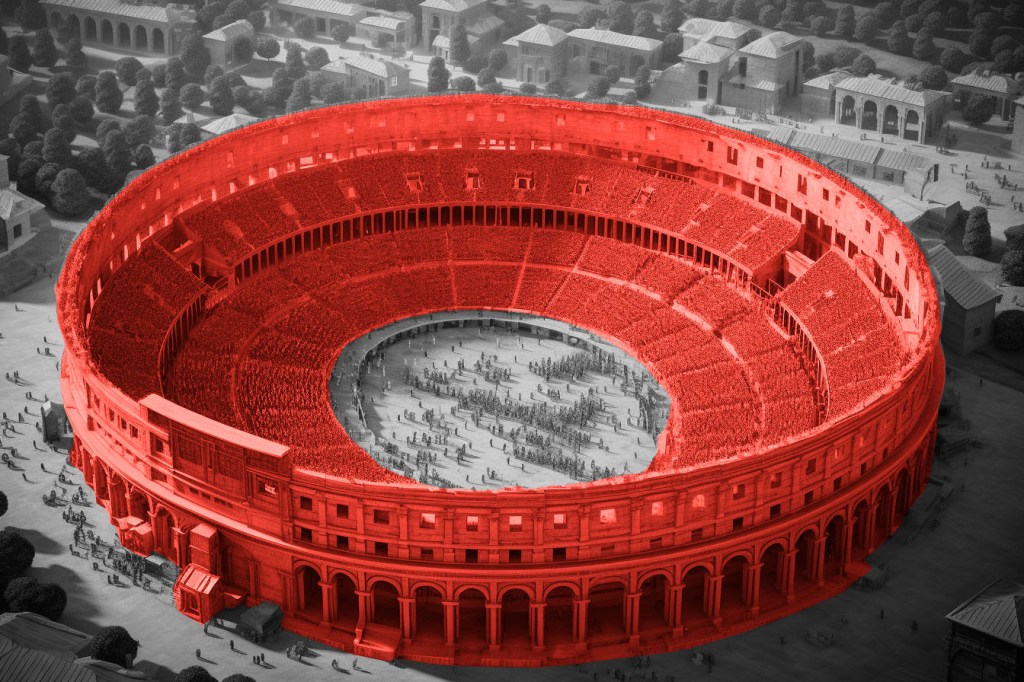
If you’ve ever seen the Colosseum, particularly renderings of how it probably looked in its heyday, the Fidenae Amphitheater has a similar look — an elliptical shape featuring arched entryways and straight flat walls on the outside, with three tiers of bleachers on the interior sloping down to the pitch in the center. There’s probably capacity for around 37,000 spectators, putting it on par with the modern-day Fenway Park, home of the Boston Red Sox.
That’s a little more than half the average capacity that the Colosseum will ultimately have. And the other big difference between the two structures is that the Colosseum was made of concrete, limestone, rock and marble, whereas the Fidenae Amphitheater is made almost entirely of wood – a much cheaper and easier material to work with.
A 3D rendering of what the Fidenae Amphitheater may have looked like. By Rebecca Napolitano
As you get closer, the momentum of the crowd toward the stadium slows. “Bummer,” you think. It’s filling up and you’re probably not going to make it in. There’s just too many people. You and thousands of others will have to make do with the shopping and other activities around the periphery of the stadium. Resigned to the fact that your bloodlust won’t be satisfied today, you walk back away from the crowds so you can do a lap around the amphitheater from a distance to get a good 360-degree look at it, and see what other activities are going on outside.
But then, you hear a terrible cracking noise. Before you can even start to contemplate what it could have been, you hear a horrific cacophony of screams as you see the stadium both falling inwards at the top, and collapsing down on the lower section like a waterfall, enveloping the crowds you were just standing in.
You jump to the ground and cover your head as the piercing sound of hundreds of snapping wood beams works its way around the entire stadium. After a few seconds, it stops, and for a brief fleeting moment, there’s silence. You pull your arms from your head and look up. Where the huge edifice was standing just a minute ago, there’s now just a plume of dust and the unobstructed horizon behind it. Then you look down to a gigantic, mangled pile of splintered wood, debris and human bodies. A chorus of screams tears through the silence, joined by the most terrible and overwhelming sounds of moaning and wailing you’ve ever heard.
Tens of thousands of people joyfully came to witness a bloody spectacle, but instead they’ve become part of one — one that will go down as by far the deadliest sporting disaster of all time, as well as one of the most catastrophic engineering blunders in human history.
It’ll also be one of the earliest documented versions of a story that will be repeated throughout the millennia—a story of greed, hubris and a lack of scruples regarding the safety of fellow human beings that’s now caused unbearable death and suffering, on this episode of Manmade Catastrophes.
[Theme music]
Before we get any deeper into the story of the Fidenae Amphitheater collapse, it bears mentioning that there’s very little that’s definitively known about the event. As you might imagine, surviving records from that time are less than comprehensive. In fact, there’s only two known accounts of the disaster that have survived—both of which were written nearly a century after the fact. And when combined, those two accounts comprise less than a single page of text.
Outside those scant records, we have to rely on educated conjecture to try to piece together what happened. But if we take a cross-disciplinary approach that incorporates historic texts, an understanding of architecture of the time, along with our modern understanding of physics and engineering principles, we can come to what’s probably a reasonable approximation of what went down in 27 AD and what it looked like.
For this episode, we’ll spare you most of the technical minutia and complicated calculations that went into making that approximation. But if that’s your thing, I highly recommend a 2015 paper titled “Failure at Fidenae: Visualization and Analysis of the Largest Structural Disaster in the Roman World,” by Connecticut College researcher Rebecca Napolitano. We’ll put a link to that in the description, as well as on our website, manmadecatastrophes.com. There, we’ve also embedded a video with Napolitano’s 3D model of what the amphitheater probably looked like.
Now, the more thorough of the two historical accounts of the disaster comes from The Annals by Tacitus, a Roman Senator and historian, which was published around 115 AD. Regarded as one of the period’s great historians, Tacitus wrote extensively on Roman history in the first century, and perhaps most famously, he was one of the first non-Christian sources to write about Jesus.
Even though the events he wrote about happened decades before his birth, his writings are generally considered pretty reliable. As a public official, he had access to resources most people of the time wouldn’t have, like extensive government archives and internal Senate records that stretched back centuries—records that were banned from public dissemination at the time and were ultimately lost to history.
The second account comes from the historian Suetonius in his work The Twelve Caesars – a more sensational and gossip-laden historical work that was published in 121 AD. Though he has a less stellar reputation than Tacitus, Suetonius also had access to important government archives, and his works are generally considered one of the most important windows into Rome of that period.
According to Tacitus, the story of the Fidenae disaster starts with Atilius, the man behind the construction of the amphitheater. We don’t know much about who Atilius was, except that he was of the freedman class.
Rome at this time was a very stratified society, with distinct social classes basically decided at birth. At the top were the Patricians – the elite upper class who held most of the wealth, owned the best land and could hold high political office. Below them were the Plebeians, the commoners who were merchants, laborers, farmers and a raft of other ordinary jobs. Then at the bottom of this hierarchy were slaves, mostly people from territories captured by Roman conquest and considered property of their mostly Patrician owners.
Somewhere in between Plebians and slaves were freedmen – those who had been freed from slavery, whether it be by consent of their master, political intervention, or by purchasing their own freedom. Once they were free, they were considered Roman citizens, albeit ones with certain limits both by law and informal stigma. But their low social status didn’t necessarily equate to poverty; quite the opposite in many cases.
Patricians at the top largely inherited their wealth and status. They would have thumbed their noses down at engaging in any sort of entrepreneurship, regarding it as unbecoming of nobility. Everyday plebians wouldn’t have had these hangups, but counterintuitively, freedmen could have some important advantages over the higher-status Plebians in becoming successful entrepreneurs.
Their time in slavery may have taught them some key skills that would later prove useful in starting their own businesses. Their time under the ownership of Patricians may also have given them exposure to and connections with that upper crust of society that ordinary Plebians wouldn’t have had, which could also prove useful to an entrepreneur. And then the extra stigma freedmen were saddled with compared to Plebians may have made finding ordinary employment more difficult, giving them a greater incentive to strike out on their own. So some Roman freedmen in fact ended up becoming quite wealthy and influential—something that could be easier to achieve outside the city limits of Rome and its stricter social hierarchies.
So it isn’t surprising that a freedman would have had the means to build the Fidenae Amphitheater, and that the project appeared to be an entrepreneurial pursuit. Many gladiator events in Ancient Rome were free to the public – funded by government or other influential figures seeking to gain favor with the masses. But many events did charge for admission, which was presumably the case with the Fidenae event. It isn’t known what the original source of wealth was for Atilius that allowed him to bankroll the amphitheater, but according to Tacitus, his wealth wasn’t really enough to pull off a project of this magnitude.
Tacitus: “Atilius was the kind of man who undertook the work neither with an abundance of money, nor with the ambition of someone aspiring to make a name for themselves by public service. Rather, he undertook that work for unsavory reward.”
The day of the event, the crowd probably would have been separated in the stadium by social class – the Patricians in the best seats on the lower tier, all the way up to the freedmen and slaves in the nosebleed sections. According to Tacitus, it was a full house that day.
Tacitus: “Those eager for such entertainments had been held at a distance from the enjoyments of shows in the command of Tiberius. A crowd of men and women of all ages flocked more freely on account of the proximity of the site to the city of Rome. On account of the number of people, the destruction was more grave. A great mass of people had been brought together, and then was torn apart.”
Now, we don’t know precisely what the amphitheater looked like, what its seating capacity was, or how exactly it was built. But Tacitus and Suetonious’s accounts give us some clues to go off of. The first is the scale of the devastation they describe, which the two historians recount differently, but not necessarily in contradiction to one another. Suetonious says that 20,000 people were killed in the disaster, whereas Tacitus says 50,000 were killed or maimed.
It’s not clear where they got those figures—whether they were rough guesstimates that ended up in the archives or the result of a more rigorous official counting of the dead and wounded. But Tacitus’s figure of 50,000 killed or wounded could be perfectly compatible with Suetonius’s figure of simply 20,000 killed, leaving the possibility of another 30,000 injured. But it’s very likely that in both cases, those nice round numbers were no more than very rough estimates.
It’s not likely that the stadium would have actually held 50,000 people inside, as that would have put it on par with the legendary Coliseum built half a century later. But there wouldn’t have necessarily needed to be 50,000 inside the stadium in order for that many to be killed or wounded. It was common for there to be all sorts of shops, stalls and other activities directly outside gladiatorial amphitheaters right up against their walls. So if the crowds outside were thick, as they appear likely to have been, many outside the amphitheater could also have been killed if there were an especially spectacular outward collapse; which indeed, Tacitus recounts is what occurred.
In her paper, Napolitano estimated 37,400 to be a plausible seating capacity for the amphitheater, based on the written accounts, what’s known about other similar structures of the time, and other complicated calculations, which again, I’d encourage you to check out at that link below if you want to get into the nitty gritty of those figures.
But no matter which way you look at it, the death toll must have been staggering, and well into the tens of thousands, or as Tacitus described it in another way:
Tacitus: “An unforeseen catastrophe unfolded, matching in both similarity and scale, the death toll of great wars. The beginning and the end of this disaster happened at the same time.”
That line that the beginning and end of the disaster happened at the same time could also be translated as “No sooner had it begun, it ended” or “it ended in a moment.” It seems to be stressing that the collapse happened very quickly and without warning. And Tacitus gives some other clues as to how exactly it unfolded.
Tacitus: “Atilius, a certain man of the freedmen class, had begun building an amphitheater in which he might celebrate a show of gladiators. He neither placed the foundations under the structure through to solid ground, nor did he build the wooden framework with strong joints.
The building was densely crowded; then came a violent shock as it fell inwards or poured outwards. It drags headlong and buries an immense force of people, including both those having been attentive to the spectacle and those who were standing around the building.”
So it seems there were likely two big, interconnected problems. The main support beams didn’t reach all the way to the bedrock, and the wooden joints that held the stadium together weren’t up for the task.
If you’re building a structure of this magnitude expected to support the weight of tens of thousands of people, making sure the main vertical supports go into the ground, completely through the soil layer, all the way down to the bedrock below, and probably then drilled down further into that bedrock, is a no-brainer. Leaving these support beams to rest on unsturdy soil is just asking for trouble, but it is one way to save time and money during construction. And it appears that’s exactly what Atilius did.
According to Napolitano’s calculations based on the probable audience size, the type of wood most likely used in construction, and the soil composition, it’s likely the support beams were placed a few feet deep into the soil—deep enough that the amphitheater would have seemed pretty sturdy when completed, and would have held together long enough for people to fill it. But as it filled toward capacity, the support beams would have started to move and deviate.
As the crowds entered the stadium and plodded up the stairs, they may have already begun to hear discernable creaking noises. If you’ve ever walked around an older house, you know that even well-built wooden structures can creak. But at Fidenae, this may have been quite noticeable, perhaps even causing some spectators to look up at one another with various degrees concern.
“Uh oh,” someone says to a companion with a laugh. But it’s their first time in a wood structure of this size, so they assume it must be normal. With a project this huge, surely the builders knew what they were doing. The superficial grandeur of the building probably added to that false sense of security.
But as people made their way inside and up to their seats, if they were observant, they may have noticed some clues that construction had been rushed and done on the cheap. Maybe the steps and walkways were uneven, maybe the wooden bleachers were splintery and lumpy. And as the stadium fills, it continues to moan with creaking noises, and people probably even start to feel the subtle movement beneath them.
It’s not known how far along the show made it before the collapse happened—whether it was right as the stadium filled up, or after some of the games had already transpired. But if the stadium had managed to survive being filled to full capacity, it would have been under more and more strain as the day wore on, as those tens of thousands of people moved up and down, walked around, and perhaps periodically jumped from their seats in excitement.
The massive pillars of wood that rested on nothing but shifting soil, sand and clay would have been steadily deviating from their firm vertical positions. As this happened, the entire interconnected wooden edifice would have buckled and distorted.
This would lead to the second problem Tacitus mentioned—the joints, the weakest points of the stadium, which hold different sections together. While most, if not all, of the support columns were probably straying by this point, it’s possible that it only took one to initiate a complete disaster.
Given what’s known about similar amphitheaters at the time, it’s likely that Fidenae had three tiers of bleachers that were split between two main architectural sections—one tier on the bottom half and two tiers on the top half. The joints connecting these two sections would have been the most vulnerable.
And remember what Tacitus said:
Tacitus: “Then came a violent shock as it fell inwards or poured outwards. It drags headlong and buries an immense force of people, including both those having been attentive to the spectacle and those who were standing around the building.”
What probably happened is the top half’s two tiers bifurcated from the bottom half’s single tier. The top half fell inward toward the playing field, plunging all those spectators downward face first from great heights onto those in the section below. Meanwhile, the bottom half collapsed outward, its exterior raining down on the thousands milling about outside. Once this happened with one section of the stadium, it would have cascaded all the way around, one section tearing apart the weakened joints connected to the next section, bringing that section down too.
All the sections would fall like dominoes around the complete 360 degrees of the stadium, leaving nothing left standing. And it all probably happened in a matter of seconds, leaving no time for anyone to escape.
It’s hard to imagine a more catastrophic outcome for the amphitheater, even if you tried to design one. There were probably few people inside or outside the direct perimeter that escaped without being killed or terribly injured.
Ironically, any gladiators in the very middle of the pitch might have been the safest as this happened. They would have had one of the most horrific views of mass death anyone has ever witnessed as the structure, and tens of thousands of screaming faces, came crashing down on all sides of them, But they themselves just might have walked away unharmed.
Those who came to Fidenae that day thinking they could well be killed, and those who came to witness carnage from afar, unwittingly had their roles reversed.
* * *
Much of Tacitus’s brief account of the Fidenae disaster discusses the immediate aftermath.
Tacitus: “Those who were crushed to death in the first moment of the accident had, at least under such dreadful circumstances, the advantage of escaping torture. More to be pitied were they who, with limbs torn from them, still retained life and knew their wives and children lay there too. In the daytime, they could see them and at night heard their screams and wailing.”
It’s hard to fathom what a horrendous scene it must have been. If those killed numbered somewhere between 20 and 40,000, which it seems is quite plausible, that would put it in league with some of the deadliest battles of the American Civil War. And, as Tacitus described, it seems many of those people died protracted, miserable deaths while mortally wounded, trapped and surrounded by those enduring the same agonizing fate.
Obviously, there were no ambulances or helicopters to rush to people’s rescue. And even by the standards of the time, there couldn’t have been nearly the infrastructure, facilities or personnel needed to tend to the wounded in time. But it does appear those living in the vicinity stepped up and did whatever they could to help the victims, according to Tacitus.
Tacitus: “At the moment of the calamity, the nobles threw open houses and indiscriminately supplied medicines and physicians. With this, Rome, notwithstanding her misery, wore a likeness to the manners of our forefathers who, after a great battle, always relieved the wounded with their bounty and attentions.”
In the days that followed, Rome was gripped by sorrow and anxiety. About 1 million people lived in the city at that time, so if 50,000 were at the Fidenae Amphitheater that day, that would have represented about 5 percent of its entire population. If you were living in Rome at the time, you almost certainly knew people who had made the trek to Fidenae that fateful day, or were otherwise unaccounted for. And while word of the disaster likely reached the city the same day, communication was slow and it could have taken some time for subsequent updates to trickle around.
Tacitus: “Soon, everyone was in shock at the report. This one was bewailing a brother, that one lamenting a neighbor, another one lamenting his parents. Also, those men whose friends and families were away for a different reason, they were nevertheless afraid. As it was not yet known who had been destroyed by the crash, suspense made the alarm more widespread.”
Soon, it seems, many people from the city descended on the site in search of their loved ones. Today, when there’s a mass shooting, terror attack or other disaster causing mass casualties, you often hear stories of people frantically calling loved ones to see if they made it out ok. If they get no response, they may congregate at the site of the incident awaiting news from authorities. And for better or worse, they’ll usually have at least a pretty good indication of what happened to their loved one within the day.
But imagine a situation where there’s not just dozens or even hundreds of people affected, but tens of thousands—each of them with a lot of people very concerned for them. And there’s no means of instant communication—no cellphones, TV or radio. There’s word of mouth, but that’s almost certainly rife with rumors. The only way you can get any concrete information is to go to ground zero. So there must have been swarms of desperate people crowding around the disaster site within hours of it happening, and for weeks afterwards.
We don’t have much insight into this phase of the disaster, but Tacitus did recount some of the grizzly details from the excavation of the rubble, when the grim task of recovering and identifying the dead began.
Tacitus: “As soon as they began to remove the debris, there was a rush to see the lifeless bodies for the purpose of embracing and kissing. Often, a dispute would arise, when some mangled face, bearing however general a resemblance in physical form and age, baffled efforts at recognition.”
In his very brief account of the disaster in The Twelve Caesars, Suetonius – in keeping with the theme of the work – focused primarily on the activities of the emperor. He wrote about how Tiberius had retired to Capri, attracted to the island by how secluded it was.
Suetonius: “But he was at once recalled by the constant appeals of the people because of a disaster, where more than twenty thousand spectators had perished through the collapse of the amphitheater during a gladiatorial show. So he crossed to the mainland and made himself accessible to all, all the more willingly because he had given orders on leaving Rome that no one was to disturb him, and during the whole trip he had driven away those who tried to approach him.”
As for Atilius, the enterprising freedman who had apparently cut major corners to make a quick buck, he seems to have gotten off pretty easily. Not only did he survive the disaster, but apparently he didn’t even have to do hard time. Tacitus simply wrote that Atilius was driven into exile.
It’s not clear whether that means he fled into self-exile, or was formally banished through due process. If the latter, it probably would have meant he was stripped of his Roman citizenship, had all his assets confiscated, and was kicked out of town, never allowed to return or communicate with those in Rome. Perhaps he would have been sent somewhere remote within the Roman empire, like to the islands of Corsica or Sardinia. Or maybe he would have been sent on his way entirely out of its jurisdiction. We don’t know what his ultimate fate was, but it seems he was able to at least escape execution or mob justice.
In the aftermath, according to Tacitus, the Senate also took action, passing a law that from then on, no one was allowed to host gladiatorial games unless they had a fortune of at least 400,000 sesterces. Trying to convert that to any modern currency for comparison is pretty difficult for a number of reasons, but a day’s work for a laborer aroound that time may have gotten them around two or three sesterces. So 400,000 would have been a pretty sizeable fortune.
The Senate further decreed that no amphitheater was allowed to be built unless the foundation had been examined and determined to be solid. It’s a pretty early example of building codes being written into law.
But unfortunately, it wouldn’t be enough to end stadium disasters in Ancient Rome. In 140 AD, disaster struck the famous chariot-racing stadium, Circus Maximus. There, an upper tier of the stands reportedly collapsed, killing more than 1,100 people. This apparently happened after thousands of additional seats had been built onto the already massive venue, though little else is known about that event.
But even far more extensive building codes and formal oversight mechanisms that had evolved by the 20th and 21st centuries haven’t been enough to fully prevent the same story from being told again and again. Whether it’s China’s Banqiao Dam or India’s Bhopal Disaster, Seoul’s Sampoong Department Store or Florida’s Surfside Condominium, when there’s a greedy imperative to fast-track construction and cut costs at every turn, it can be hard to look beyond the next buck, and one can easily lose sight of the fact that they’re gambling with people’s lives. In many ways, we’ve hardly changed over the past 2,000 years.
[Theme music]
This episode was based on….actually not a lot of sources this time, because there aren’t that many that exist. But again, one of the most useful was the paper “Failure at Fidenae: Visualization and Analysis of the Largest Structural Disaster in the Roman World,” by Rebecca Napolitano. Then there were also the classic works of Tacitus and Suetonius. For links to those, and to see some visualizations of the Fidenae Amphitheater, head to our website at manamadecatastrophes.com, where you can also check out our whole archive and see images from other catastrophes we’ve covered.
If you enjoyed this episode, please help us keep making more by hitting the subscribe button wherever you listen to podcasts and shoot a link to someone else who you think might enjoy it. Thanks for listening.
Sources
- Napolitano, Rebecca. “Failure at Fidenae: Visualization and Analysis of the Largest Structural Disaster in the Roman World” (2015). Physics, Astronomy and Geophysics Honors Papers. 7. (Link)
- The Annals. Tacitus. (Link)
- The Twelve Caesars. Suetonius. (Link)
- Humphrey, John H. Roman Circuses: Arenas for Chariot Racing. Oakland: University of California Press, 1986. (Link)
- “Tiberius – Roman Empire, Successor, Augustus.” Encyclopedia Britannica. (Link)
- Dyrud, Marilyn. “Ancient Structural Failures and Modern Incarnations:.” 2013 ASEE Annual Conference & Exposition Proceedings. 2013. (Link)


 Manmade Catastrophes