Transcript
This episode contains graphic descriptions that some audiences may find disturbing. Listener discretion is advised.
It’s July 9, 1994 and the people of North Korea are going about their routine, if not exactly normal lives.
Life had never been easy for the 22 million people living in the Hermit Kingdom, as it’s been called, but over the last few years, more and more have begun to struggle. A few years ago, the government first announced the cheerily named “Let’s eat two meals a day” campaign, clearly signaling that there wasn’t enough for three. By 1993, state radio explicitly acknowledged that there were food shortages and some people were suffering from hunger.
But for the most part, people continued getting up and going to school or to their state-assigned jobs, managing life as best they could under a poverty-stricken and draconian Leninist dictatorship.
Today was no different. People got up and went about their business, totally unaware that more than 24 hours earlier, one of the most earth-shaking events in the country’s half century of existence had transpired.
For people around the world, there are certain days that are so shocking and consequential that time seems to stand still. Those living through them, even decades later, remember in detail exactly where they were and what they were doing when they found out. For Americans, days like September 11th or the day President John F Kennedy was assassinated, stick out. For British, maybe it’s the 1997 death of Princess Diana. For New Zealanders it might be the 2019 Christchurch massacre, or for Japanese the March 11, 2011 earthquake and Tsunami. But for North Koreans, that day is July 9, 1994.
That morning, word began to spread that there would be a special news bulletin at noon—very unusual, since the country’s sole news broadcast didn’t normally begin until 5pm. Many workers and school children were sent home in anticipation of the bulletin. What it might be about was anyone’s guess. Many assumed it had something to do with the United States and ongoing tensions over North Korea’s nuclear ambitions, which had been heating up over the previous year. Some even thought that it would be an announcement that a long-threatened war had finally broken out.
When noon finally comes, a stern-faced anchorman in a black suit and tie comes on screen, sitting in front of a plain blue backdrop, reading from a script.
After formally addressing the many segments and classes of North Korean society including farmers, soldiers, intellectuals and students, among others, he finally gets to the point.
With the deepest sorrow, I inform the people of the whole country that the General Secretary of the Workers’ Party of Korea, the President of the Democratic People’s Republic of Korea, the great leader Comrade Kim Il Sung passed away at 2 o’clock on July 8th, 1994 from sudden illness. He devoted his whole life to the prosperity of the fatherland and the happiness of the people, to unification of the country and independence and glory. He worked tirelessly and energetically until the last moment.
After leading his country for 46 years, the longest-serving communist dictator in history was dead of a heart attack at age 82.
Many people watched in disbelief. For North Koreans, Kim Il Sung wasn’t simply a man. He had been deified for half a century and seemed virtually immortal. How could a god among men actually die?
If you hadn’t found a TV in time to see the broadcast, it didn’t take long to figure out what had happened. Loud moans and people crying out in sorrow began to emanate from windows and from the streets. People rushed to any nearby TV they could find and wormed their way through the packs of people huddling around, desperately needing to confirm the unbelievable from an authoritative source.
As the minutes went by, the piercing moans and sobs coalesced into a deafening cacophony of grief. People spontaneously gathered around the tens of thousands of statues of Kim that stood across the country, throwing themselves at his feet, banging their heads and fists on the ground. They screamed at the top of their lungs and wept hysterically. Some people were trampled in the crush of people clamoring to get close to Kim statues. It became an infectious collective fervor, and an exercise in grief one-upmanship.
State television threw fuel on the fire, rebroadcasting hours and hours of footage showing the distraught masses flailing about, pounding their heads on trees and grieving in ways that looked straight out of a bad movie. And just in case these scenes weren’t dramatic enough, footage of dark clouds with piercing lightening strikes were randomly spliced in. One broadcast even claimed Kim might come back to life if people grieved hard enough.
These theatrics went on for the next 10 days during the official mourning period, up through Kim’s state funeral. Many were expected to report to statues or other memorials twice a day to mourn during this time. Not allowed to wear hats or carry umbrellas, many prostrated themselves on scorching concrete under the glaring July sun. There was reportedly a notable uptick in the death rate during this period, many of the victims being elderly who died of heart attacks or strokes.
Not everyone was genuinely grief-stricken to the extreme of course. Many took their cues from those around them, and just tried to keep up appearances with their display of sadness, lest they appear insufficiently loyal and adoring of the late Great Leader.
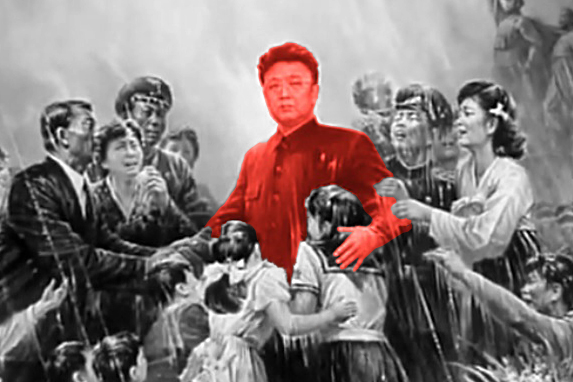
But while they may have gotten caught up in the fervor and over-exaggerated their grief, for most, the sadness was real—especially for that majority of the population under 50 who had never known another leader than Kim, and had been thoroughly persuaded every day since birth that he was their savior. He dominated textbooks, the newspaper, the daily news broadcast, propaganda posters, statues, murals—everywhere you looked in North Korea, there was Kim Il-Sung, smiling with his rosy cheeks and benevolent stature. So it’s not a surprise that many were genuinely heartbroken when he died. Some even went so far as to kill themselves out of grief during this time.
But whether you adored or despised Kim Il Sung, you were left with a sinking feeling of uncertainty. The one constant from the past half century was gone, and now, North Korea was about to become the first communist dictatorship to undergo a hereditary succession.
Kim’s son, Kim Jong-il would take the helm. With life already becoming harder with every passing week and food supplies dwindling ever smaller, would Kim the junior be able to fill his father’s shoes and keep the country afloat?
In retrospect, Kim Il Sung’s death would turn out be lucky timing in terms of maintaining his legacy. Conditions in North Korea had been deteriorating for years, but right around the time he died, they were cascading into an absolute death spiral—one that over the next four years would kill as much as 15 percent of North Korea’s entire population.
But this was no ordinary famine. The Arduous March, as the period would come to be known in North Korea, was an avoidable disaster made all the worse by a newly minted dictator who put holding onto power above all else, on this episode of Manmade Catastrophes.
[Theme music]
[Surrender of Japan newsreel]
The roots of North Korea’s famine of the 1990s began half a century earlier, amid the ashes of World War II.
After being forcefully annexed in 1910, the formerly independent Korean peninsula had been under oppressive, exploitative Japanese rule for 35 years. But with Japan’s World War II defeat in 1945, Koreans were rid of their colonizers and had reason to be hopeful for the future.
But it wouldn’t take long for those hopes to be dashed. As soon as one war ended, a new one began—the Cold War—and Korea would be one of the first chess pieces. The Soviet Union had already begun to invade Japanese-occupied Korea from the north shortly before Japan surrendered, and was perfectly capable of continuing south.
To appease the Soviet Union while protecting what it saw as the more strategically significant southern part of the Korean Peninsula, the United States proposed dividing Korea in half. The Soviets would occupy and administer the north, while the Americans did the same for the south. It was understood that this would only be a temporary arrangement until Korea was deemed ready for self-rule.
Not party to this agreement, were the Koreans themselves, who were furious with the decision. Why were they, one of the victims of the Axis powers, being partitioned in the same way Germany, one of the chief aggressors, was. But neither of the two superpowers were willing to give an inch in the ideological clash of titans getting underway. A 155-mile line was arbitrarily drawn across the 38th parallel to divide North and South—a line that had no real geographic or historic significance. Little did anyone know that this randomly drawn line would eventually become the most tense and fortified strip of land in the world.
As the Cold War rapidly intensified over the following years, negotiations over how to reconcile the question of Korea’s political future faltered, the line dividing North and South hardened, and it became apparent that there would be no amicable reunification of the peninsula.
In 1947, the Soviet Union rejected United Nations calls to hold nationwide elections to establish a unified Korean democracy—so elections would only be held in the South. In 1948, the Republic of Korea was formally established as an independent nation in the South, followed a few weeks later by the establishment of the Democratic People’s Republic of Korea in the North. Both new governments claimed to be the legitimate ruler of the entire Korean peninsula.
In the South, the US backed 73-year-old Syngman Rhee, an ardent anti-communist who would become South Korea’s first president via an indirect election by the new National Assembly. In the North, the Soviet Union installed 36-year-old Kim Il Sung, a trusted Communist who’d fought alongside the Soviets in World War II and also had major street cred with the Korean people as an anti-Japanese guerrilla leader.
While the respective leaders had very different ideologies, they were both tyrannical in their own ways, they both had ambitions beyond being puppets of their superpower patrons, and they were both Korean nationalists who envisioned themselves ruling the entire peninsula.
But it would ultimately be Kim who acted first on those ambitions. By 1949, Soviet and American troops had mostly left the peninsula, leaving the two newly established countries to their own devices. In 1950, Kim secured Soviet leader Joseph Stalin’s blessing to launch an invasion of the South. By this point, the Soviet Union had successfully tested a nuclear weapon, and China had come firmly under communist rule, giving Stalin more confidence in challenging the US, albeit indirectly. But he figured the US didn’t attach much importance to Korea, and wouldn’t actually want to intervene in a Korean conflict, just as it hadn’t in the Chinese Civil War that concluded the previous year.
So on June 25, 1950, North Korean troops crossed the 38th parallel and the Korean War was on.
[North Korea invades reel]
Heavily supplied by China and the Soviet Union, the North significantly outclassed the South militarily on nearly every dimension—in troop numbers, artillery, tanks and air power. They swept southward, taking the capital of Seoul within days and soon after controlled most of the peninsula.
But Stalin’s bet that the US wouldn’t intervene proved a miscalculation. Dispirited by China’s fall to the Reds and now fully subscribed to the theory that communism might start overcoming one nation after another like dominos, President Harry Truman decided Kim Il Sung’s advance needed to be contained. The United Nations Security Council agreed. Though the Soviet Union held a seat there with veto power, it was currently boycotting the council due to the UN’s refusal to recognize the newly communist People’s Republic of China as the Chinese seat. It was instead recognizing the Republic of China that had fled to Taiwan, which obviously supported intervening in Korea against a communist invasion.
So UN forces, led mostly by the United States, entered the war. And just as quickly as North Korean troops had initially pushed southward, UN forces pushed them back north. Then rather than halt their momentum at the 38th parallel, they flipped from defense to offense and continued to drive north, pushing North Korean troops all the way up to the Yalu River that bordered China. But US assumptions that China wouldn’t get involved also proved to be a miscalculation. The one-year-old communist nation sent its troops across the Yalu and turned the tide of the war yet again, driving UN forces back below the 38th parallel.
From that point, the battle front wouldn’t deviate far from the 38th parallel one way or the other, but fighting would go on fiercely for three years. China had greater manpower, and a greater willingness to sustain casualties. But the US had overwhelming air power, and it would use it to try bombing North Korea into submission.
[Bombing newsreel]
This bombing campaign would prove completely devastating to the North, which had few defenses against arial assault. It’s no exaggeration to say that by the end of the war, North Korea was left little more than a smoking ruin. US arial campaigns firebombed North Korean urban centers, virtually wiping out every North Korean city and an estimated 85 percent of all the buildings that had once stood in the entire country. Then, when there were few urban targets left, US bombers began targeting hydroelectric and irrigation dams, wreaking havoc on civilian power and food supplies.
Toward the end of the war, American pilots were complaining that they couldn’t find any remaining structures to bomb. UK Prime Minister Winston Churchill privately criticized the campaign, saying US forces were splashing napalm all over the civilian population. One US State Department official said American planes bombed “everything that moved in North Korea, every brick standing on top of another.”
Finally, in 1953, the two sides agreed to an armistice that ended the fighting. After three long years of death and destruction, they would end up right back where they started—two separate countries, separated at the 38th parallel.
While both North and South had suffered greatly, the destruction had been much worse in the North—due mostly to the US bombing campaigns. Scarcely anything was left standing, there was no industry left to speak of, the agricultural sector was in shambles, hardly any infrastructure remained, and as much as 20 percent of what had been the North Korean population before the war lay dead.
In the United States, the Korean War would go on to be known as “The Forgotten War”. And as author and journalist Blaine Harden put it, because American war reporters rarely mentioned civilian casualties from the gratuitous US carpet-bombing, that’s maybe the most forgotten part of the Forgotten War. But in North Korea, it would be anything but forgotten. It would leave a deep psychological scar on the North Korean people that would carry on for generations, and it would be fundamental to nation’s very identity and that of those who ruled over it.
But perversely, the man who had started it all, Kim Il Sung, would be the war’s greatest beneficiary. He would use it to bolster his cult of personality, with a lot of help from the rewriting of history.
[Ad break]
While there would be plenty of big lies under Kim Il Sung, perhaps THE big lie would be about how the Korean War began. The reality was that Kim Il Sung had carefully planned and executed an invasion with the aim of taking control of the entire peninsula. But after three years of fighting, he still controlled just half of it, only now that half was a cratered ruin with millions dead. Obviously, that narrative wouldn’t do, so a new one was crafted. In fact, it had been the South that started the war under orders of the US imperialists, who wanted to strengthen their puppet Syngman Rhee, boost their own economy from war profiteering, and project their imperialist will around the world.
North Koreans old enough to remember the outbreak of the war on June 25, 1950 knew better—the invasion had been well prepared, and its progress and initial success well publicized. But once the new narrative came down, everyone took their cue, and it became dangerous to deviate from it. By the time the next generation came up, this narrative was deeply embedded and sincerely believed by most. Parents wouldn’t dare correct what their children were being taught in school.
So Kim Il Sung’s credentials were bolstered. His role in the war had not been one of reckless failure, but as valiant defender against imperialist aggression. His early achievements during World War II were likewise greatly exaggerated to suggest his small guerilla insurgency had been the driving force in repelling the Japanese. Time and again, Kim had been savior of the nation, but the threat of another war from the US imperialists was ever-present, and American saboteurs were lurking around every corner. So the country would need Kim to constantly protect them going forward.
In the years after the war, Kim purged any potential rivals, consolidated power, bolstered his cult of personality, and put great efforts into controlling the narrative, the flow of information and the people themselves. One major way this was done was with the establishment of the songbun system – a sort of ideological caste system that classified everyone in the country into three main categories based on their supposed political loyalty and reliability: the core class at the top, followed by wavering, then hostile at the bottom, with 51 sub-categories within those three umbrellas. Your songbun would be decided based on you and your family’s social class and behavior during the Japanese occupation period and Korean War.
The core, which made up about a quarter of the population, were those who came from peasants and had fought loyally for the North. The wavering class—about half the population—included those who were small-scale merchants, intellectuals, held superstitions, or had previously lived in South Korea, had relatives in the South, or more broadly had any connections abroad. Finally, the hostile class—the final quarter of the population—consisted of landlords, capitalists, overtly religious people, political prisoners, those who had supported South Korea, Japan or the US, or were otherwise deemed to be against the ruling Worker’s Party of Korea.
Your songbun classification had huge implications for your opportunities in life—where you could live, how much education you could receive, what job you could get, the quality of your medical care, and crucially, when times got tough, your food allocation. Once classified, it was very difficult to move up your songbun level, but you could very easily be knocked down—and not necessarily for anything you did personally. Actions of your family—even your extended family—had huge bearing on your classification. It created an atmosphere where families put major pressure on one another to stay in line and not challenge the Party narrative in any way.
The sociopolitical dynamic in North Korea was now established—a godlike dictator, a hermetically sealed information environment, and intense pressure all the way down to the household level not to rock the boat or deviate one inch from the party line.
For years after the war, this worked pretty well. When a poor or war-battered country is rebuilding from scratch with an economy that has nowhere to go but up, a stable centralized dictatorship can actually be pretty efficient at directing resources toward building infrastructure and heavy industry. North Korea also had the advantage of an industrial tradition and knowhow inherited from Japanese rule that it could build on.
Furthermore, beyond Korea’s borders, Kim had several winds at his back. He had the support of an international club of socialist nations in Eastern Europe, the Soviet Union, and China, which were still reasonably cohesive and friendly with one another at this point. And even after the Sino-Soviet split in the early 60s changed this, Kim managed to stay neutral and even play China and the Soviet Union off one-another, gaining aid and other concessions from both. With Kim’s consolidated power and steady stream of economic support, North Korea rebuilt and grew.
South Korea, on the other hand, which had traditionally been more of an agricultural region than industrial, rebuilt much more slowly. It would also see decades of political turmoil, coups, a succession of leaders, and oscillate between fragile democracy and unstable military rule. Up through the 1960s, North Korea looked to be winning the post-war ideological battle on the peninsula.
In the 1960s, Kim also began to establish his Juche ideology in a bid to place himself among the pantheon of socialist luminaries like Marx, Lenin, Stalin and Mao and legitimize himself domestically in a way more bespoke to Korea. This ideological framework included many elements of Marxist-Leninism, but it stopped short of promoting the sort of proletarian internationalism and “workers of the world unite” orthodoxy of Marxism. Kim, after all, was a staunch Korean nationalist, so Juche included elements of ancient Korean philosophy and promoted a sort of Korean exceptionalism—the idea that Koreans are a special, pure people. And unlike the supposed exploitative and dependent relationship South Korea had with the United States, North Korea under Kim would be fully independent and self-reliant in every way.
Also in the 1960s, Kim Il Sung’s son, the diminutive and bespectacled cinephile Kim Jong Il began taking on real positions of power. And by 1974, the then 33-year-old had reportedly been chosen as heir apparent and was being groomed to one day take over from his father.
One way state propaganda would begin to legitimize Kim the junior was as a brilliant philosophical mind who developed and expounded on his father’s Juche idea.
[Propaganda clip]
“On February 19th, 1974, Kim Jong Il defined the president’s revolutionary thought and declared a modeling of the whole society on the Juche idea as the ultimate program of the Worker’s Party of Korea.
He said the Juche idea is a new philosophical thought which centers on man. The Juche idea raised the fundamental question of philosophy by regarding man as the main factor, and elucidated a philosophical principle that man is the master of everything and decides everything. By tireless energetic ideological and theoretical activity, Kim Jong Il brilliantly evolved the Juche idea to become a great guiding ideology of the age of independence and made immortal achievements in the development of the philosophical thought of mankind.”
But for all the talk of self-reliance and independence, North Korea was heavily dependent on others, particularly for its food security. Only a small part of the country has good arable land for farming, and its long cold winters make even those parts less than ideal for growing. What agriculture North Korea did have depended on heavily subsidized oil, farming equipment and fertilizer from its foreign communist brethren. And it received a hefty amount of direct food imports.
In the 1970s, cracks began to emerge in the supposed post-war North Korean success story, and Juche ideology wasn’t getting the country any closer to self-reliance—it was actually helping sow the seeds of disaster.
Socialist economies, which aren’t driven by normal supply and demand dynamics, begin to show their inefficiencies more and more as time goes on. By the 1970s, no communist country was doing especially well, but some were doing better than others.
After the death of Stalin in 1953, the Soviet Union began to show a bit more ideological flexibility. Stalin’s successor, Nikita Khrushchev, openly criticized, among many other things, Stalin’s rigid collective farming policies—noting that Stalin never traveled anywhere, never talked to farmers, and knew nothing about the country’s agriculture situation beyond propaganda films. Under Khrushchev, the state loosened its control over farmers and even showed a willingness to learn farming techniques from the United States. This socialism-light approach to agriculture was still very inefficient, and it didn’t end food shortages, but the Soviet Union would never again repeat the catastrophic famines of the Stalin era.
North Korea, on the other hand, did stick to a rigid Stalinist collective farming system, which forced farming collectives to turn over all but a small portion of their crops to the state for redistribution—leaving farmers little incentive to maximize their yields. Any surplus they produced would just be taken away anyways. Private food production and selling on the open market was, in most cases, strictly illegal.
Furthermore, North Korea lacked the abundant natural resources that the Soviet Union had, as well as its extensive trade networks—both with communist allies, and even with capitalist rivals, particularly during the period of Soviet détente and reduced Cold War tensions in the late-60s and 1970s.
And by now, North Korean industry—which had done well in the immediate post-war years—was reaping diminishing returns, and reaching the limits of what had been gained during Japanese occupation. Industrial knowledge, equipment and infrastructure was becoming outdated. While the outside world in the decades leading up to the 21st century was developing by leaps and bounds and seeing breathtaking technological development, North Korea was basically stuck in the 40s. Its rusting, aging factories were producing less that could be used domestically, and less that could be traded internationally.
Juche ideology was making matters worse. North Korea wanted to make itself truly independent and not reliant on trade with any other nation, at least for the essentials. For Kim Il Sung, sure, this would help maintain the country’s sovereignty and national security, but it would also help keep the country isolated from the rest of the world, and anything or anyone that might undermine his narrative, and thus, his power.
But for a small country like North Korea with a poor climate and limited resources, self-reliance is extremely difficult, maybe even impossible in the modern world. With the poor geographic hand it was dealt, it should specialize in certain industries it has a competitive advantage in, which it can then leverage to trade with other countries—especially those with better agricultural output. Japan in the late 20th century would become a shining example of this model. But instead, North Korea tried to make itself a jack of all trades, but became a master of none…in fact, a refusal to seriously engage with the outside world meant it was pretty incompetent at most.
Now, Juche wasn’t just an aspiration at the national level. This self-reliant attitude was rammed down people’s throats down to the local, and even individual farm and factory level. One illustrative North Korean newspaper article gave an example of workers at a Pyongyang granary who had a dilemma. They needed a diesel train to move their grain shipments, but rather than ask the government for one, they reportedly used their small workshop to somehow build their own. It wasn’t reported how functional this supposed locomotive actually was.
From the government’s perspective, stories like this provided an inspirational—and self-serving—message: Figure out problems for yourself and don’t count on anyone else. Or to put it in a more inspiring way: “Hold the revolutionary spirit of self-reliance.”
But however inspiring as that idea might be, in the long term, it couldn’t compete with good old capitalism.
By the mid-1970s, South Korea had caught up to North Korea in development and GDP, and it would never look back. It started steadily inching ahead of the North in its industrial capacity and economic growth throughout the 70s. Then that inching accelerated to a runaway freight train in the 1980s, followed by an absolute rocket ship in the 1990s that would make its economy 70 times larger than the North’s by the 2020s.
South Korea was unambiguously becoming richer and more powerful than North Korea, and by many orders of magnitude, posing new ideological challenges to Kim Il Sung. He could no longer plausibly portray the North as doing better than the South, giving him all the more incentive to keep his country locked down and cut off from the rest of the world and the unwelcome information it could bring.
As South Korea pulled ahead, North Korea also began diverting more and more of its resources to the military in order to maintain parity—again, at the expense of what could have been much more useful industrial and agricultural investments.
With deteriorating industrial production, and a bigger slice of that production going toward military causes, North Korea had less and less of value to trade.
This didn’t cause a major problem before the 1980s, as North Korea could still rely on what essentially amounted to pity trade from the Soviet Union, and to a lesser extent, China. As Russian scholar Andrei Lankov has described it, “the Soviet Union sent spare parts for MiG jet fighters, crude oil, and Lada cars to North Korea and was paid with canned pickles and bad tobacco that nobody wanted to smoke.”
This dynamic—investing in the production of useless junk in exchange for what amounted to charity—was not making North Korea self-reliant, it was making it even more reliant.
Meanwhile, the pressures of North Korea’s stagnating economy were also hitting the agriculture sector, and starting to plant the seeds for disaster. To have healthy, long-term agricultural yields, a farmer should rotate the crops grown on a certain patch of land each season, which keeps the soil nutrients balanced, and prevents the entrenchment and spread of pests and weeds specific to each crop. Similarly, land should periodically be left fallow—in other words, not grow anything, so nutrients and moisture can be replenished, and pest ecosystems disrupted. If a farmer only plants a single crop over and over every season without fallowing at all, the soil will gradually degrade and become less fertile, making it harder to grow anything. But, fertilizers, herbicides, pesticides and irrigation can offset this degradation.
As North Korea’s food situation was gradually becoming more precarious, it focused more heavily on growing a small handful of staples like rice and potatoes at the expense of other crops that could be rotated. And not only was less and less land being left fallow, farmers with ever-growing quotas to meet began taking measures like large-scale deforestation to create new farmland. And all the while, they—and their soil—were becoming heavily dependent on chemical fertilizers.
By the 1980s, now firmly heir apparent, Kim Jong Il was having his own cult of personality burnished, and was assuming more and more real power. State television showed him on the ground at farms, drawing from his infinite knowledge on all subjects to offer on-the-spot guidance to farmers. He would make completely unscientific instructions on how to ease food shortages. Better goat breeding will improve the situation, or the next day, he decided it was ostriches. This region should grow potatoes instead of rice. That region should terrace its hillsides to plant crops on. You should plant seeds closer together, plow your fields deeper, and manually kill pests yourself. You may have to go the extra mile, but there’s nothing that “revolutionary spirit” can’t overcome. Well, that is except the laws of nature.
This succession of hair-brained schemes was quietly making the situation worse. But outside of Korea, the international tailwinds that had been at the Kim family’s back since the war were starting to shift in monumental ways…ways that would set the final conditions for complete disaster.
[Ad break]
[News clips of China and Soviet Union’s 1980s reforms]
In China, after the death of Mao, reformist leader Deng Xiaoping eventually came to power in 1978 and began what he called Reform and Opening Up. He instituted market reforms, tacitly embracing low-key capitalism, and began to open China to the world, even normalizing relations with the United States and visiting the former enemy in 1979.
Meanwhile, in the Soviet Union, reformist leader Mikhail Gorbachev came to power in 1985—and almost immediately openly criticized his country’s inefficient economic system. He instituted what was called Perestroika to loosen centralized control of the economy, allow more private enterprise, and let the market play a more decisive role. Meanwhile, his Glasnost policy encouraged more openness and transparency by allowing much greater freedom of speech and press.
For Kim Il Sung, these were ominous shifts. The ideological tide of the communist world was turning away from his brand of hardcore Leninist, Stalinist totalitarian control. And worse yet, communist allies were beginning to embrace his arch enemy. In 1981, Seoul was granted the 1988 Summer Olympics, indicating broad international support for South Korea. And within a few years, both China and the Soviet Union would establish diplomatic relations with the South—a huge betrayal in Kim’s eyes.
As the 1980s went on, things went from bad to worse. The reforming Soviet Union was becoming less interested in giving aid to North Korea, and with its own economic difficulties, it was less equipped to do so anyways. It started demanding market rates for oil, as well as payment for past assistance. China too was becoming more economically practical and less patient with North Korea’s mounting debts. It also started wanting payment upfront and in full for the food and fuel it sent.
So, less food was coming into North Korea. And on its own farms, the irrigation pumps and tractors that it heavily relied on were running dry of fuel and sitting idle.
Then in 1989, the punches started coming harder and faster.
[Clips from communist collapses in 1989]
One after another, the Eastern Bloc communist governments of Europe began to fall, ironically, like dominoes. By 1991, the communist world was in freefall and North Korea was on its heels. Trade with the Soviet Union and Eastern Bloc nations cratered, and while trade with China ticked up slightly, it didn’t come near making up the shortfall. It’s estimated that in just one year, North Korea’s total imports fell by some 40 percent, and already, the country was experiencing significant food shortages. That year, the North Korean government instituted its “let’s eat two meals a day” campaign in a desperate bid to curtail consumption.
Then, just as it seemed North Korean leaders’ luck couldn’t get any worse, at the very end of 1991, the rug got completely yanked out from under them with one of the most shocking events of the 20th century.
[Soviet Union collapse footage]
After more than seven decades of existence, the world’s first communist state, and North Korea’s biggest benefactor, was no more. The newly democratic Russian Federation had even less interest than Gorbachev in propping up North Korea. Russia’s emerging business class was taking over state-owned enterprises and was far more interested in trading with a thriving South Korea than it was with North Koreans who didn’t pay their bills and mainly produced junk. And there were further knock-on effects still from the Soviet Collapse. With the end of the Cold War, North Korea saw plunging demand for one the few industries it did hold a decent comparative advantage in: arms trafficking.
By 1993, imports from Russia had fallen to one-tenth of what they had been, and energy imports more broadly were down more than 75 percent. That year, reports of food riots started trickling out of North Korea. And by 1994, North Korean radio took the extraordinary step of admitting that there was hunger in the country.
The gradually deteriorating food situation was becoming more of a death spiral, as the myriad of problems began mount and exacerbate one another. Without the cheap fuel that North Korea had relied on for decades, its farming equipment couldn’t operate, nor could its factories. And without factories running, there were even less goods to trade with. With less fuel, coal was another energy option, but many coal mines relied on electric water pumps to remain accessible—pumps that no longer had fuel. There was also wood, and indeed, people did start cutting down more trees, but that’s a far less efficient source of energy than coal or gas, and the labor diverted to cutting down trees took even more manpower away from agriculture. Furthermore, this rapid deforestation caused soil erosion that left farmland more vulnerable to flooding.
Oh, and that farmland—years of bad farming practices were also coming home to roost. The lack of crop rotation and fowling had left much of the arable land with insufficiently fertile soil—a problem that became exponentially worse when fertilizer imports crashed, and North Korea’s own energy-intensive fertilizer factories couldn’t keep the lights on. And many of the hillsides and other marginal lands where farming had expanded to sat at elevations high above water sources, so without electric irrigation pumps, those crops couldn’t be watered.
Even those closest to food sources that did exist—the farmers themselves—were starting to go hungry, and their depleted energy made them less efficient still at tending to their crops. But the government wasn’t making it any easier on them. Authorities started confiscating higher and higher proportions of farmers’ yields, so they responded by hording food they grew, or neglecting the monitored collective farms to tend to their own secret gardens.
By 1993, the public distribution system—which was responsible for gathering food from the collective farms and redistributing it throughout the country—started to break down. Deliveries of rations were experiencing longer delays and showing up with less…beginning with remote countryside areas, then spreading to cities—where residents didn’t have any land they could use to grow their own food.
It didn’t take long for illicit pilfering, diverting and hording of food supplies to unfold among public distribution system personnel and local officials tasked with allocating to their people, which made the situation even worse still. By 1994, food shortages were affecting most of the country, and there simply weren’t enough calories being distributed to sustain the population.
Not everyone was suffering equally though. A number of factors would determine how much food you were rationed, including where you lived, what your job was and what your songbun level was. Cities, and especially the capital of Pyongyang, were constituencies most politically vital to keep loyal, so they ate first. As the famine went on, some entire regions with dispersed rural populations were simply abandoned by the central government—their food rations 100 percent diverted to the urban areas deemed more important.
Those higher on the songbun caste also had priority in getting rations. And laborers got more than those with more sedentary jobs or the elderly who were retired. But it probably won’t come as a shock that it was government officials, members of the Korean Worker’s Party, and the military who were given the very highest priority.
Unbelievably, as the was all going on, the government—by now already largely under the control of Kim Jong Il—continued to pour money and resources into military proliferation, increasingly in the form of nuclear and ballistic missile development. By the early 1990s, North Korea was spending around 25 percent of its entire GDP on the military—an astronomical proportion. Even the United States, with its famously massive military expenditures, devotes less than 4 percent of its GDP to the military.
This was the backdrop by the time Kim Il Sung died in July of 1994: things rapidly deteriorating, many becoming severely malnourished, and more and more starving to death. If Kim the elder had lived on, it’s not likely he would have handled the crisis any better than his son—it had been created under his feckless leadership, after all. But his death was a major psychological blow. The country had been through very hard times before—under Japanese occupation, and then when it was bombed into oblivion by the United States. But the North Korean people had survived, they were told, thanks to the courageous leadership of Kim Il Sung. But now with their savior gone, they were all alone to fend for themselves—and they would have to.
In 1995, less than a year after Kim’s death, North Korea’s mounting struggles became a full-on catastrophe of mass dying. In July that year, weeks of torrential rains caused massive flooding that would affect as much as 30 percent of the country. Huge patches of farmland, crops, and grain reserves–many of which were stored underground–were completely wiped out. The deforestation of prior years to get timber and create new farmland had eliminated a critical absorption barrier, making flooding much worse.
Likewise, the country’s energy infrastructure, which was already on life support, was dealt another blow as floods enveloped power plants, hydroelectric dams, coal mines and transportation lines.
More devastating floods would come in 1996 and 1997 and continued to make a bad situation decidedly worse. But for the North Korean government, the floods did bring a silver lining. Now it had something tangible to place the blame on. In the beginning, authorities had offered up a number of dubious and outright absurd excuses for why food supplies were dwindling—like American blockades or that the government was stockpiling food to donate to starving South Koreans. But now they had a much more plausible excuse. They could say the famine was a natural disaster—exacerbated of course by the US imperialists isolating and trying to choke off North Korea.
The floods actually did magnify the crisis, and they would have caused major problems even in well-run economies. But catastrophic floods happen routinely around the world, and by the late 20th century, they didn’t cause major famines on their own. According to one analysis by the World Food Program, natural causes including droughts and floods from 1995 to 1998 accounted for only about 15-20 percent of North Korea’s food deficit.
With food sources dwindling, the government put more pressure on farmers and began confiscating nearly their entire harvests…which kicked off a cat and mouse game between government and farmers that would further undermine food supplies.
Faced with more confiscation at harvest time, farmers began pre-harvesting crops before they were fully grown so they could horde them. The World Food Program estimated that in 1996, half the country’s corn harvest went missing—likely in large part for this reason. There were even reports of farmers’ roofs collapsing under the weight of hidden corn.
Military units were sent to fields to guard against this sort of thing, but everyone was hungry. So soldiers could be easily bribed with food, and made accomplices in this hoarding and diversion.
Sometimes entire military companies could go rogue. One defector account, recounted in the book Famine in North Korea by Stephan Haggard and Marcus Noland, described what happened in his son’s army unit.
“Soldiers received daily rations, but those were not enough to live on. So the chief of my son’s unit ordered them to forage in the countryside. Small companies were sent out to steal village stocks and if they found nothing in the granaries, they robbed people’s homes. One day, my son protested and said he was not in the army to steal from people. He was immediately shot.”
Now it bears mentioning here that defector accounts like this usually can’t be confirmed, and there have been a number of famous instances of defectors exaggerating or outright fabricating accounts of what they saw or experienced in North Korea. But the fact that there are numerous reports corroborating similar stories like this during the famine years does tend to give them credibility.
Now faced with an existential crisis, the North Korean government took the humiliating step of appealing to the international community for aid, tacitly admitting that it was anything but self-reliant—although the flooding also had the silver lining of providing a face-saving excuse as to why the country needed to ask for handouts.
Many countries and organizations did step up to provide that aid, to the tune of about $2.3 billion dollars-worth from 1995 to 2005. The county’s arch enemies South Korea and the United States were in fact two of the biggest donors, though that of course went unacknowledged within North Korea.
But while the North Korean government was happy to accept this aid, it wasn’t so eager to accept any conditions or monitoring with it to ensure distribution to those who needed it most. And from this dynamic came two major problems.
The first was directly caused by the North Korean government. As the famine was unfolding, Kim Jong-Il’s hold on power may have been more tenuous than it had ever been for the Kim family, which made maintaining loyalty within the military more crucial than ever. His biggest threat wasn’t the starving masses banding together, although food riots were becoming bigger and more frequent, but his biggest threat was the possibility of a military coup. So he instituted the “military first” policy, which prioritized resource distribution to the military above all else. What dwindling food supplies there were, were allocated first to the military—including much of the international aid that came in.
The second problem with foreign aid was more indirect, and it was the same problem facing the public distribution system at large: leakage. Once food entered the system, those tasked with carrying out distribution at the national, provincial, city and even neighborhood and individual level skimmed their share to either consume themselves or sell on the black market, leaving almost nothing for those most in need at the bottom.
For instance, some NGOs and the United Nations Children’s Fund were allowed to bring food aid intended for schools and other children’s centers, but they weren’t allowed to stay permanently to oversee the distribution. On subsequent trips, they found that the children at these facilities were becoming even more malnourished. It was concluded that the staff were pilfering the food to take to their own families or sell on the black market.
In the 1997 documentary, Famine, filmmakers followed an aid worker from the NGO CARE International named Simon Williamson, as he sat through frustrating negotiations with Noth Korean officials. They were loath to let him independently assess which areas most needed the aid, and were racked by suspicion, pride and an insistence to completely control the flow of whatever he brought in.
[Famine clip]
Some estimates reckoned that of the foreign food aid that came into North Korea, as little as 10 percent made it to common people, with the rest being diverted to the military or siphoned by corrupt officials. As this situation gained recognition internationally, aid groups became more reluctant to send aid into North Korea at all, further squeezing one of the few avenues the country had left to feed its people.
The famine was breaking down the entire North Korean political-economic structure. Many of the state-assigned jobs people had were useless even before the famine, but with the entire economy grinding to a halt, huge segments of the working population had no real work to do within their assigned roles. But they were still expected to show up to receive ration tickets. However, with rations getting smaller or not coming at all, people increasingly had to find time to fend for themselves and escape the obligations of their useless jobs. So many took the rather ironic step of paying (AKA bribing) their employers to let them skip work.
By 1997, the public distribution system had almost completely collapsed, managing to feed only an estimated 6 percent of the population. So by this point, most North Korean people were on their own when it came to finding food. This often meant migrating to different regions to do so, which meant the system for controlling people’s movements that had been in place for decades also broke down. Once strictly regulated, and very rare for most people, inter-city and inter-regional travel was now happening on a huge scale.
These unfolding dynamics flipped the script. Those who continued to show up to work as they were supposed to, or stayed in the city they were assigned, or refused to try to get food in illegal ways like theft, black markets or illicit trade—in other words, people who followed the rules—they were the first to die. But before long, death would be everywhere.
[Ad break]
With the breakdown of North Korea’s socialist economy, people had to find ways to provide for themselves other than punching in at a pointless job and getting a ration ticket. So a low-key illicit form of capitalism began to emerge, black markets became more conspicuous, and an eat-or-be-eaten mentality emerged—sometimes in the most literal sense.
People fled to far-flung locations to set up private gardens or trap wild animals. Waves of migrants poured into China to find food and other goods they could trade with. Many women turned to prostitution. And criminal gangs formed to steal and plunder. But most of these means of survival were only available to the able-bodied. The most vulnerable were children and the elderly.
In one account from the book Nothing to Envy by journalist Barbara Demick, a teacher going by the pseudonym Mi-Ran, who later fled North Korea, recalled teaching kindergarten classes early in the famine. She gradually began noticing some of her poorer students becoming emaciated and lethargic to the point that they’d nap through recess, or slump over at their desk during lessons.
“It was always the same progression. First, the family wouldn’t be able to send the quota of firewood; then the lunch bag would disappear; then the child would stop participating in class and would sleep through recess; then, without explanation, the child would stop coming to school. Over three years, enrollment in the kindergarten dropped from fifty students to fifteen. What happened to those children? Mi-ran didn’t pry too deeply, for fear of the answer she didn’t want to hear.”
Hospital workers would learn the answer firsthand though.
Famines don’t tend to immediately cause scores of people to keel over dead from starvation. It usually starts with other health issues. Hunger first weakens the immune system and other bodily defenses against more common medical problems. What would normally be mild infections, for instance, can become deadly serious. Ailments related to the elements like hypothermia or heat stroke can likewise much more easily kill—a situation made much more likely when people have no electricity or other energy sources to guard against extreme temperatures. And a breakdown in normal body chemistry can make older people much more susceptible to sudden strokes or heart attacks.
So early in the famine, it wasn’t immediately obvious how big the problem was. People were dying, but usually not directly from starvation. Although, in North Korea, even if it was unambiguously starvation, doctors still weren’t allowed to list that as the official cause of death.
But before long, elderly and children were pouring into increasingly understaffed and under-resourced hospitals that quickly exhausted supplies of antibiotics and other medicines—resources that would often be allocated or withheld based on a patient’s songbun.
More and more children especially were coming in severely malnourished and with rare diseases doctors had never seen before—like pellagra, which is common in people who eat nothing but corn and causes shiny rashes on hands, collar bones or around eyes.
Children were also coming in with severe constipation or diarrhea due to mixing healthy food like rice and corn with foods of desperation like leaves, bark and weeds. While adults may be able to stomach diets like this, fragile young digestive systems can easily be overloaded. Kids would come in with seemingly minor colds or diarrhea, only to up and die suddenly. Often they would die even before symptoms seemed bad enough for their parents to bring them to the hospital.
Defectors would later recall hospital wards full of emaciated, screaming, dying children—scenes that would haunt them for the rest of their lives. But soon, even the basic medical system broke down. With electricity usually out, no supplies and ever-fewer doctors and nurses sticking around, it became pointless to go to the hospital, even when dying.
At this point, the basest survival instincts were kicking in among the population, and often those who displayed the least empathy toward others had the best chance of survival. As has been displayed time and again over the millennia around the world, when true hunger kicks in, the normal rules of human decency and morality fall by the wayside.
People became less likely to share anything with anyone outside immediate family, and more likely to steal—or worse—to get what they needed. Many people could walk past a dying toddler without stopping for a second to consider parting with any of their precious food. Soon, dead bodies in the street became so common it no longer even raised an eyebrow.
But that’s not to say people didn’t make big sacrifices—and even the ultimate sacrifice—for those they loved. During the famine, it was common for adults to forgo eating so they could adequately feed their children—a valiant sacrifice that would frequently culminate in their own death.
From this sprouted a unique phenomenon North Koreans referred to as kochebi, or “wandering swallows”—referring to children who were on their own, due to their parents dying or leaving to find food. These children would band together to hang out around black markets to scavenge, beg or steal—quickly gaining them a reputation as a group to watch out for.
Some of these kids might conspire to push over a vegetable stand at a black market and run off, leaving accomplices to grab the scattered food while the owner chased them down. Or one child might simply distract a mark while another picked their pocket.
However, the darkest stories associated with these kochebi saw them as victims.
Throughout history, whether it’s an entire nation experiencing famine or a group of rugby players stranded in the Andes Mountains after a plane crash, when food runs out and hunger becomes extreme, people will eat whatever they have to.
As with anything, it’s difficult to confirm specific instances of cannibalism in North Korea during the famine—which is compounded by an obvious reluctance by anyone who may have partaken in the ultimate taboo to admit to it. But while the extent of the practice during the famine isn’t known, it’s almost certain that it did happen. And kochebi children were rumored to be particularly vulnerable targets.
Rumors spread about these children being drugged, killed and butchered for meat that was sold in the markets, advertised as pork or beef. Warnings were exchanged not to buy meat if you didn’t trust the vendor or knew where they sourced it from. So pervasive were these rumors that kochebi children reportedly began to take care of where they slept, and who they slept in the company of, for fear of what could happen to them.
Outside the markets, stories similarly spread of people cooking family members who’d died naturally, digging up corpses or outright murdering the living in order to cannibalize them. Some supposedly even ate their own children. While these are mostly just rumors, they do track with very similar, better documented reports that emerged from China during its massive famine from 1959 to 1961. And there are multiple corroborating reports of people actually being arrested and publicly executed for cannibalism in North Korea.
With such desperation taking hold, many people tried to escape North Korea altogether. Leaving via the southern border with South Korea was nearly impossible, being one of the most heavily monitored and guarded strips of land in the world. So that left the northern border with China.
Up through the 1980s, there had only been a trickle of illegal border crossings into China. In fact, it was more common for Chinese—usually of Korean ethnicity—to migrate into North Korea.
The incentive wasn’t yet there for mass migration northward, since conditions in China weren’t much different than in North Korea. For much of the time after the Korean War, conditions were actually better in North Korea. But as living standards in China rapidly improved in the 1990s amid its reforms, and rapidly deteriorated in North Korea, that trickle became a one-way tsunami north to the tune of perhaps a few hundred thousand North Korean refugees.
As we mentioned earlier, huge numbers were starting to cross the border to obtain goods to bring back in, or work for a short time to make money. But plenty just wanted out permanently. Doing so though was full of potential dangers. The border with China is mostly defined by the Tumen and Yalu rivers, which can be dangerous to cross. Then there’s the risk of being intercepted by North Korean border guards—though, like anyone else, they were easily susceptible to bribes in one form or another during the famine.
Once in China, refugees would often be immediately taken aback at the disparity in living conditions such a short distance from home. One refugee later described being shocked to see a bowl of dog food just sitting outside someone’s home—food that was better than anything they’d seen in North Korea in a long time.
But even once they made it into China, the danger was far from over. China doesn’t recognize North Korean refugees, but rather, considers them illegal economic migrants. So if caught by Chinese authorities, North Koreans would be repatriated back home, where they would be subject to torture, imprisonment, labor camps, or worse. And with the flood of refugees, Chinese living in border towns became more on guard against them. With no more resources than they could carry on their back, these desperate migrants were quickly associated with theft and other crimes.
So North Koreans were immediately vulnerable. Many women ended up in prostitution or unofficial marriages to Chinese men—sometimes voluntarily, to an extent, but often by coercion. A whole industry in trafficking North Korean women emerged.
A lucky few with the resources might make the fraught journey through China to Mongolia, Southeast Asia, or a foreign consulate, where they could then be allowed to go to South Korea. From the end of the Korean War up until the famine, fewer than 1,000 North Koreans had made their way to South Korea. But in the years during and after the famine, that shot beyond 30,000. But more often, refugees would settle into some sort of undocumented life in China, or find themselves back in North Korea—willingly or otherwise.
By 1998, the worst of the famine was beginning to subside. The decimation that farmland had experienced up through the mid-90s floods began to stabilize, international aid was finding more effective ways to get to those who needed it, and as some have posited—there were now simply a lot fewer mouths to feed. When all was said and done, estimates put the number of deaths from the famine at anywhere from 500,000 to 3.5 million, out of a total population of just 22 million.
But maybe the most significant development that helped end the famine came not from the North Korean government at the top, but from an emerging entrepreneurial class at the bottom—and it was a development that would change the country forever.
Necessity is the mother of invention, and faced with a horrific failure of the socialist system, industrious North Koreans invented a rudimentary capitalist system of trade and black markets. By the late-90s, the patchwork of small illicit farmers markets had grown into a sizeable and sophisticated informal private economy that was rising to meet people’s needs. Extensive trade networks spanning the country and into China formalized, people settled into jobs that supplied for actual market demands, and the North Korean leadership had little choice but to tacitly accept this emergence of private markets.
They would, of course, try to crack down on these black markets after the famine subsided, and they would disrupt illicit trade flows with China through beefed up border security. But even the mighty North Korean government was ultimately powerless to reverse the tide. As scholar Andrei Lankov put it, it was the natural death of North Korean Stalinism. Eventually, the government took a “if you can’t beat em, join em” stance. It formally authorized hundreds of these markets and began to collect taxes from them. Today, it’s estimated that some three-quarters of the North Korean population depends on these markets for their food.
But these markets, known as Jangmadang, would have even more profound effects on the country than just feeding people, and they may be the biggest silver lining that came out of the famine.
For instance, in a highly patriarchal society, they’ve shifted some power to women. While it was and is comparatively difficult for men to escape their state-assigned jobs, women have less state employment obligations, so they can more easily start businesses and set up shops in the markets—often making exponentially more money than their husbands. This has given them more power and decision-making authority in the household.
Another side effect of these markets was that over time, after trade lines were firmly established with China, they began selling more non-food items, including fashion, technology and entertainment—even from the United States and South Korea. In the early 2000s, portable DVD players, and later, devices that could play music, TV and movies on even smaller USB drives and SD cards started making their way across the border and into North Korean homes.
Before long, North Koreans—especially young North Koreans—were consuming all sorts of culture from the outside world, despite the threat of very stiff punishments if caught. This entertainment includes just about anything you can think of, like Hollywood movies, Japanese porn, and even anti-Kim family propaganda. But the most popular has proven to be what’s also become incredibly popular across Asia, and increasingly the rest of the world, over the past decade.
[Hyuna “Bubble Pop” clip]
K-pop music and South Korean dramas have proliferated in North Korea, bringing along some major influences—particularly on the young. They’ve shown scenes of affluence and thriving cities in South Korea, as well as unique clothing choices and fashion statements like colored hair that would be scandalous in the North. These scenes have not only completely undermined North Korean propaganda about an impoverished and repressed South Korea, they’ve also brought themes of individualism and self-expression, as well as skepticism of authority and the rigid socio-cultural values promoted by official North Korean media. Some female defectors have even reported being influenced by foreign entertainment and the depiction of heroines who refuse to be subservient, and who stand up to chauvinistic men. For many more broadly, exposure to this sort of media is the first domino toward a decision to defect.
Young North Koreans who came of age after the famine and have been heavily influenced by the array of foreign goods and information in the Jangmadang markets, have come to be known as the Jangmadang generation—distinct for being less obedient, increasingly bold in their fashion choices, more individualistic, and more skeptical of North Korean political ideology. It marks a major shift from older generations who hew much closer to the party line, having grown up in an information vacuum with little to form their worldviews except state-sanctioned propaganda.
What this means for North Korea’s political future remains to be seen. Though North Korean society has changed by leaps and bounds since the famine, its political apparatus has changed very little and it remains firmly in control.
Kim Jong Il did little to alleviate the famine, and in fact made it worse in many ways by tightening controls on information even further, rejecting outside aid that came with monitoring conditions, and diverting precious resources to military proliferation. In the early 2000s, he would even preside over several more smaller-scale famines. But he didn’t seem to suffer much for it politically. In fact, in some ways he would retroactively turn the famine to his advantage. Taking lessons from how his father reframed the Korean War disaster, Kim Jong Il and his propagandists portrayed the Arduous March as yet another heroic struggle of the Korean people against foreign aggression and natural disaster—a struggle expertly navigated by the Dear Leader.
[Arduous March propaganda clip]
Kim Jong Il would remain in power until his death in 2011, whereupon his son Kim Jong Un became the third-generation leader in the dynastic communist dictatorship.
The sad reality is that communist dictatorships are not the most vulnerable during periods of extreme hardship and famine. As North Korea’s Arduous March, as well as China’s famine of the 1950s and 60s, illustrated, when people are desperate and hungry, finding that next meal is the overriding preoccupation; not loftier, energy-sapping goals like organizing to overthrow a powerful government.
Conversely, as illustrated by the Soviet Union’s collapse, and China’s close call at Tiananmen Square in 1989, it’s actually when these closed off dictatorships begin to open, and people get a taste of greater freedoms of speech, movement and assembly, that many have the means and the will to push for even more, and truly imperil their dictatorial leaders.
This seems to be a lesson that North Korea has taken to heart: It’s better to keep the people poor and hungry than it is to allow them any real freedoms or access to outside information. Likewise, it’s better to invest in missiles and nuclear weapons than in agriculture or infrastructure, lest you remain vulnerable to foreign intervention and end up like Saddam Hussein or Muhammar Ghaddafi.
One lesson the outside world learned in the 20th century was that devastating famines don’t happen in functioning democracies. The open flow of information ensures that problems are flagged and rectified before they can become catastrophic, and as long as you don’t close yourself off to the rest of the world, foreign aid can easily make its way in.
But while a lot has changed in North Korea since the 1990s, it still remains vulnerable to famine. Like it was dependent on trade with the Soviet Union in the 1980s, it’s now heavily dependent on China. And Kim Jong Un is still very much his father’s son when it comes to the need to maintain absolute control and suppress unflattering information.
But maintaining a completely closed society in the 21st century is a Herculean task. North Korean authorities are already losing the war against outside information, and the North Korean people are doing much better than they were 20 years ago—some have even gotten rich—not because of the North Korean leadership, but in spite of it. There may not be substantial top-down reforms in the offing for North Korea, like China and the Soviet Union saw in the 1980s, but bottom-up changes could prove to be just as significant.
[Theme music]
That’s all for this episode. One quick note on sources. It’s famously difficult to get reliable information about what’s happening in North Korea. Bizarre, sensationalized rumors routinely get reported, most notoriously by South Korean tabloids, which often get picked up by less scrupulous Western sources, despite a lack of substantiation. But that doesn’t mean the country is a total black box. Many scholars and journalists do excellent work corroborating defector testimonies with a range of other sources to paint a reasonably reliable, if not totally complete, picture.
Some of the most notable sources we used for this episode were the books Nothing to Envy, by Barbara Demick, and Famine in North Korea by Stephan Haggard and Marcus Noland, as well as various works by Professor Andrei Lankov. For links to those and other sources we used, you can go to our website at manmadecatastrophes.com, where you can also see a transcript of this episode and see our full archive and other ways to listen.
Thanks for listening and we’ll see you soon for our next manmade catastrophe.
Sources
- Demick, Barbara. Nothing to Envy: Ordinary Lives in North Korea. New York: Random House, 2010.
- Haggard, Stephan, and Marcus Noland. Famine in North Korea: Markets, Aid, and Reform. New York: Columbia University Press, 2007.
- Lankov, Andrei. The Real North Korea: Life and Politics in the Failed Stalinist Utopia. New York: Oxford University Press, 2013.
- DPRK Video Archive. “Kim Jong Il’s leadership during the Arduous March.” YouTube. Last modified July 12, 2012. https://www.youtube.com/watch?v=ZrmH6bAAFj0&t=304s.
- Armstrong, Charles K. “The Destruction and Reconstruction of North Korea, 1950-1960.” The AsiaPacific Journal7, no. 0 (March 2009). https://web.archive.org/web/20220116204532/https://apjjf.org/-Charles-K–Armstrong/3460/article.pdf.
- Neer, Robert M. Napalm: An American Biography. Cambridge: Harvard University Press, 2013. Video.
- Harden, Blaine. “The U.S. war crime North Korea won’t forget.” Washington Post. March 24, 2015. https://www.washingtonpost.com/opinions/the-us-war-crime-north-korea-wont-forget/2015/03/20/fb525694-ce80-11e4-8c54-ffb5ba6f2f69_story.html.
- “Multiple Perspectives on the Korean War.” Korean War Legacy. Last modified July 4, 2020. https://koreanwarlegacy.org/chapters/multiple-perspectives-on-the-korean-war/#:~:text=The%20North%20Koreans%20had%20their,Asia%20and%20around%20the%20world.
- Park, Sokeel. “SONGBUN: Social Class in a Socialist Paradise.” Liberty in North Korea. Last modified December 17, 2017. https://libertyinnorthkorea.org/blog/songbun.
- Volin, Lazar. “Soviet Agriculture under Khrushchev.” The American Economic Review49, no. 2 (May 1959), 15-32. https://www.jstor.org/stable/1816099.
- History Channel. “Perestroika.” HISTORY. Last modified April 14, 2010. https://www.history.com/topics/cold-war/perestroika-and-glasnost.
- Noland, Marcus, Sherman Robinson, and Tao Wang. “Famine in North Korea: Causes and Cures.” Economic Development and Cultural Change49, no. 4 (2001), 741-767. doi:10.1086/452523. https://web.archive.org/web/20110706214340/http://www.iie.com/publications/wp/99-2.pdf
- Weissmann, Jordan. “How Kim Jong Il Starved North Korea.” The Atlantic. Last modified December 21, 2011. https://www.theatlantic.com/business/archive/2011/12/how-kim-jong-il-starved-north-korea/250244/.
- Natsios, Andrew. “The Politics of Famine in North Korea.” United States Institute of Peace. Last modified August 2, 1999. chrome-extension://efaidnbmnnnibpcajpcglclefindmkaj/https://www.usip.org/sites/default/files/resources/sr990802.pdf.
- Famine. Directed by Journeyman Pictures. 1997. Hobo Media, Film.
- Howard-Hassmann, Rhoda E. “State-Induced Famine and Penal Starvation in North Korea.” Genocide Studies and Prevention7, no. 2-3 (2012), 147-165. doi:10.1353/gsp.2012.0018.
- Fisher, Max. “The Cannibals of North Korea.” Washington Post, February 5, 2013. https://www.washingtonpost.com/news/worldviews/wp/2013/02/05/the-cannibals-of-north-korea/
- Smith, Hazel. “Explaining North Korean Migration to China.” Wilson Center. Last modified September 26, 2012. https://www.wilsoncenter.org/publication/explaining-north-korean-migration-to-china.
- Kim, Jae Young. “Even the Dogs in China Had More Food Than Us.” NK News – North Korea News. Last modified December 17, 2012. https://www.nknews.org/2012/12/even-the-dogs-in-china-had-more-food-than-us/.
- Cha, Victor, and Lisa Collins. “The Markets: Private Economy and Capitalism in North Korea?” Beyond Parallel. Last modified August 12, 2019. https://beyondparallel.csis.org/markets-private-economy-capitalism-north-korea/.
- “A Changing North Korea.” Liberty in North Korea. Last modified December 11, 2024. https://libertyinnorthkorea.org/learn-a-changing-north-korea.
- Weird NK videos archive. “North Korean TV Kim Il Sung death announcement July 8th, 1994.” YouTube. Last modified June 4, 2020. https://www.youtube.com/watch?v=GDq2Y1sfIiE&list=PLoPj7ibpockgR7Vf4kiuDibtLJ76yMbrD&index=3.
- Old News. “North Korea’s Kim Il-Sung Dies [1994].” YouTube. n.d. https://www.youtube.com/watch?v=rk6JmvMfVms&list=PLoPj7ibpockgR7Vf4kiuDibtLJ76yMbrD&index=8.
- Ngan, Joe. “Blame in the North Korean Famine, 1994-1998.” BYU Asian Studies Journal BYU Asian Studies J9 (2024). chrome-extension://efaidnbmnnnibpcajpcglclefindmkaj/https://scholarsarchive.byu.edu/cgi/viewcontent.cgi?article=1052&context=asj.
- Goodkind, Daniel, and Loraine West. “The North Korean Famine and Its Demographic Impact.” Population and Development Review27, no. 2 (2001), 219-238. https://www.jstor.org/stable/2695207
- Public Domain Footage. “Japanese Sign Final Surrender 1945 Newsreel.” YouTube. Last modified October 11, 2011. https://www.youtube.com/watch?v=p09gugpF_hE.
- Critical Past. “North Korea invades South Korea. HD Stock Footage.” YouTube. Last modified June 17, 2014. https://www.youtube.com/watch?v=lghkIl1atnU.
- DPRK Video Archive. “Kim Jong Il, Remodeling Korea with the Juche Idea.” YouTube. Last modified November 19, 2017. https://www.youtube.com/watch?v=SeKw68xumpE&list=PLD6A7EEDA33AD898B&index=19.
- Bate, Peter, and Michael Cockerell. “The Chinese News Machine.” BBC One Panorama. Last modified 1980.
- Laurie, Jim. “Changing Russia: Glasnost vs Perestroika under Gorbachev.” YouTube. Last modified June 20, 2020. https://www.youtube.com/watch?v=vkIO-46gNm8.
- International School History. “ABC – 1990 News reports on the collapse of communism.” YouTube. Last modified April 20, 2015. https://www.youtube.com/watch?v=qBZ2i2m3ai0&t=337s.
- Hyuna Kim. “Bubble Pop.” YouTube. Last modified July 4, 2011. https://www.youtube.com/watch?v=bw9CALKOvAI.
- BBC News. “The Fall of the Berlin Wall (PART 1) – East Germany opens the gates.” Last modified November 9, 1989. https://www.youtube.com/watch?v=fjNz1lvXgzU.
- Rochester TV Archive. “CNN Coverage of the Dissolution of the Soviet Union (December 25, 1991).” YouTube. Last modified September 2, 2020. https://www.youtube.com/watch?v=GcyX6ByWyHA.
- Simon Marks Reporting. “Gorbachev Resigns: December 25, 1991.” YouTube. Last modified September 23, 2011. https://www.youtube.com/watch?v=4lPjMh1zpEo.


 Manmade Catastrophes