Transcript
This episode contains racist language graphic descriptions of violence that may be disturbing to some audiences. Listener discretion is advised.
It’s February, 1885 in Eureka, California, and townspeople are milling about the dirt roads of the gritty frontier city.
Near the state’s northern border with Oregon, Eureka sits between a large bay on one side and tall redwood forests on the other, fueling a booming timber industry. The harvesting, processing and shipping of that timber has driven the city’s development since it was founded three decades earlier, growing its population to somewhere between 3,000 and 4,000.
But it remains isolated. It’ll still be 30 years before a railroad reaches the city, leaving coastal ferries as the only efficient way for anyone to come or go. So most people pretty much stay put once they get there.
Things have slowed down for the chilly winter months, leaving a good chunk of the city’s workforce idle. And it’s not helping that the United States is three years into a recession. So for the city’s White population especially, there’s plenty of time to stew over their growing list of grievances. Foremost among them, is the city’s Chinese residents.
The first major wave of Chinese immigrants had come to the region during the Gold Rush in the 1850s, then another wave came in the 1860s driven primarily by railroad construction. Between 1850 and 1880, the population of Chinese in the United States exploded more than 125-fold, from less than 800 to more than 100,000, some three-quarters of which were concentrated in California, making up about 9 percent of the state’s entire population.
From the moment they began arriving, Chinese were subject to varying degrees of disdain, hostility, and even occasional violence. On top of the general Manifest Destiny White supremacist attitudes that prevailed in the region at the time, many Americans saw Chinese as heathens with strange habits who were unwilling to assimilate to American Christian norms. It also didn’t take long for some White laborers to start viewing Chinese as competition willing to undercut them on wages and tolerate much more Spartan living conditions.
But early on, resources were abundant, building projects plentiful, and manpower still sparse in California, so there was still room for the rising tide of West Coast development to lift all boats, despite the racial animosity.
Eventually though, those tides would begin to recede. Gold would become scarcer, and Chinese workers would mostly be chased out of the gold fields by White miners and prohibitive foreign miner taxes intended to exclude them from the industry. Likewise, the biggest construction project of them all, the Transcontinental Railroad, was finished in 1869. And four years later, a railroad construction bubble burst, kicking off the Panic of 1873 and a serious years’ long economic depression.
With opportunities drying up in the gold fields and railroads, tens of thousands of Chinese workers fanned out into the greater West Coast economy, doing a wider range of jobs.
In reality, Chinese and White workers were largely drawn from separate labor pools and usually weren’t competing head-to-head for the same jobs. But perceptions often don’t match reality, and the tendency to scapegoat is never far behind economic anxiety. By the mid-1870s, with a struggling economy and many White workers finding themselves unemployed, Chinese labor was increasingly being seen as a threat – one that opportunistic labor leaders, political figures and newspapers were all too willing to amplify, exaggerate and caricature.
In Eureka, the Chinese population had grown to a few hundred by the mid-1870s, doing a wide array of jobs in restaurants, laundries, livestock and the many ancillary trades supporting the timber industry. And by 1875, a full Chinatown had been established, making up a single block in the middle of town with high-density, and rather squalid living conditions.
To some White residents of the city, these poor conditions weren’t attributed the systemic discrimination Chinese grappled with, or the substantially lower wages they tended to earn for the same type of work as Whites. To them, this squalor was the basis for even more prejudice—an indication that Chinese were uncivilized and chose to live like animals.
But for whatever prejudices existed, Chinese and Whites had lived in Eureka side by side relatively peacefully for decades. However, 1876 brought signs that things might be starting to change in a very serious way.
That January, as Chinese in the city were celebrating the Lunar New Year, a drunk White man stumbled through Chinatown, and for some reason, barged into a Chinese man’s home and began harassing him. The two men came to blows and ended up out on the street, where the Chinese man produced a pistol and shot his assailant in the abdomen, mortally wounding him.
Word quickly spread, and whatever sympathy there might have been for a man standing his ground against an unprovoked attack in his own home seems to have either been lost in the crowd amid the initial game of telephone, or was simply never extended on account of the respective men’s races.
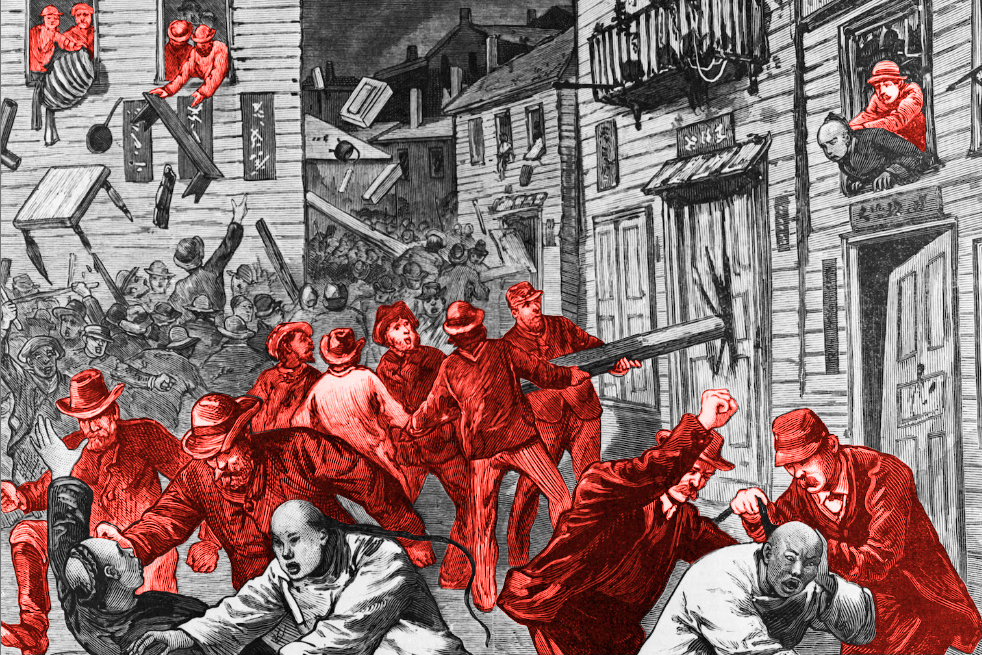
As word spread, a small mob of White residents materialized and rampaged through Chinatown, throwing rocks through windows and committing other acts of petty vandalism. One Chinese man was hit in the mouth by one of these rocks, knocking his teeth out. As they trounced through town, the mob yelled things like “Cut the throat of every Chinaman” and “Tomahawk every heathen in the place.” It looked like things were poised to get much uglier. But fortunately, the city Marshall intervened, telling the mob to stand down. Ultimately, cooler heads prevailed.
Impressively, over the following days, public opinion seemed to fall firmly against the mob. A local paper, The Humboldt Times, published a scathing editorial, calling for the arrest of anyone who took part in the mob destruction. Then it even went on to praise Eureka’s Chinese community as a contributor to the city’s peace and quiet.
“The Chinese are here and cannot be removed. Never, not one single instance can be cited where they have been instigators of any outbreak. They are here, and here they are allowed to stay until some means are devised and adopted by the higher tribunal compelling them to quit the country. We have laws and they are so made as to protect the rights of Chinamen as well as any other nationality. This whole affair is the most disgraceful that has ever occurred here.”
For now, the Chinese of Eureka, and the rest of California for that matter, would remain under an uneasy, fragile status: Welcome by some, but despised by others who would prefer to see them exiled…or worse.
But over the following decade, this precarious status of Chinese in California would continue to deteriorate. The United States would eventually pull itself out of the economic crisis of the 1870s, only to fall back into another recession in the early 1880s. And over the intervening years, more and more restrictions on Chinese would pile up as White workers and their labor groups pressured political leaders, culminating in the national passage of the Chinese Exclusion Act in 1882, which suspended immigration of Chinese laborers. But these political developments were riding the coattails of the deteriorating social atmosphere for Chinese, who were increasingly being targeted.
On the eve of the Chinese Exclusion Act’s passage in early 1882, citizens of Eureka held a meeting where they passed a resolution urging the US Congress to pass the act. The resolution read in part:
“We have anxiously watched hordes of Mongolian paupers flooding our shores. We have seen our civilization almost subverted and our children driven from all avenues of honorable labor by aliens, foreign to our tongue, religion, customs, and social relations.”
White residents of the city, and the country, were showing dwindling tolerance toward their Chinese neighbors. So when another serious incident occurred in Eureka in 1885, it wouldn’t just sputter out as it had a decade earlier.
By this point, the composition of Chinese in the city had also changed, most notably with the emergence of Tongs.
When a sizeable Chinese population formed in nearly any American city during this period, Tongs usually weren’t far behind. These groups would eventually become synonymous with criminal gangs, but they tended to start off with purer intentions, serving as mutual aid associations to assist new Chinese immigrants in the United States with everything from the logistics of getting settled, to starting a business or dealing with legal trouble. Chinese being a group heavily segregated from the rest of American society, and being subject to ever-worsening discrimination and violence, Tongs could provide a crucial line of support and protection.
Over time though, rival Tongs would emerge and vie for greater influence and power by aggressively competing for dues-paying members and territory. And some would gradually realize that using their manpower and connections to dabble in criminal activities like gambling, drugs, human trafficking, prostitution, and extortion could be far more lucrative than toiling in mines or the back of laundries. And once criminal elements got involved in the Tongs’ turf wars, it was only a matter of time before things got violent.
Only a very small proportion of Chinese in the United States had any association with any sort of organized crime, so conflating Tongs with the greater Chinese population was entirely unfair. Criminal Tongs were a greater menace to the Chinese community itself than any other group. But racists tend to have little capacity to make such distinctions.
By 1884, two rival Tongs had emerged in Eureka and their rivalry was becoming more violent and more public by the day. There were numerous instances of gang violence spilling out onto the streets of Eureka that involved clubs, knives and increasingly, guns.
Throughout the summer of 1884, there was one shooting incident after another. And what was angering White residents even more was that the sheriff seemed to have a hard time ever pinning down the culprits. Even when arrests were made, uncooperative witnesses meant they seldom yielded prosecutions of Tong members. In September of 1884, a local newspaper that had previously been sympathetic to the Chinese community was starting to change its tune. The Daily Times Telephone said in an editorial that the Chinese had become a quote “intolerable nuisance to our people, and if some means cannot be devised to make them behave, they should be made to leave.”
The dangers of the Chinese criminal menace were appearing in newspapers side by side with headlines about the bad economy, the oversupply of laborers in Eureka, and the quote, ‘starvation wages’ workers had to accept. The groundwork was being laid for what in retrospect almost seems inevitable.
On February 1st, 1885, yet another gun fight broke out between the Tongs in Chinatown that left two Chinese men dead and three wounded.
White animosity toward Chinese was reaching a boiling point in Eureka, and this was again reflected in The Daily Times Telephone. Four days after the shootout, it published its most inflammatory editorial yet, titled “Wipe out the plague spots,” calling Chinatown a veritable leper colony, a hell-hole, home to a small heathen horde, and it claimed the town’s Chinese posed a threat to public health and morality.
Then, turning back to public safety, the editorial imagined a scenario that would actually turn out to be very prescient:
“It is a wonder that some innocent pedestrian was not made to bite the dust. Such a result is liable to come at any time as long as the representatives of two conflicting Chinese companies are allowed to live in such close proximity. If ever such an event does occur, if ever an offending White man is offered up on the alter of paganism, we fear it will be goodbye to Chinatown.”
The very next day, that’s exactly what happened.
At around 6pm on February 6th, 56-year-old David Kendall was finishing up his dinner. A stable owner and a local city councilman, he was widely respected in the community, and regarded as a kind and gentle man. After finishing his meal, he set out into the dreary, foggy night back toward his stables. But while making his way through the Chinese quarter, shots rang out.
Two Chinese men—presumably from the rival Tongs—had run into each other. What exactly set off the violence isn’t known, but whatever it was, the confrontation culminated in nearly a dozen gunshots being exchanged. During that shootout, one stray bullet found its way into the foot of a 12-year-old White boy, permanently disabling him. But the most fateful shot was the one that went straight into David Kendall’s head.
After the shootout, Kendall was spotted laying in the street by passersby who recognized him and carried him to a nearby home for what would ultimately be futile medical attention. As he lay dying, word quickly spread that Kendall had been struck down by a Chinese gangster’s bullet.
There was never any question that he had been shot by accident, collateral damage in an unrelated gang dispute. But that didn’t matter. The Chinese man who’d pulled the trigger was guilty of cold-blooded murder of a White man, and all his Chinese compatriots in Eureka, by virtue of their ethnicity, were accomplices in that murder. Never mind that most Chinese in the city were also fed up with Tong violence. It was, after all, their neighborhood that was ground zero for these repeated violent outbursts.
But the mob had little capacity to unpack those nuances, and like many small towns in the Wild West, mob justice overwhelmed due process. The question now wasn’t if, but how the entire Chinese community should be punished for what had happened.
Hundreds of enraged townspeople with lanterns spontaneously gathered near the site of the shooting, shouting things like “hang them all” and “burn them out.” Deputies arrested a group of men suspected of involvement in the gun fight and put them in the local jail, where they remained behind armed guards holding off the mob. But the deputies must have been on edge. If the mob had set its mind to overrunning them, there’s no doubt it could have. And it looked like it just might.
About this time, word was spreading that David Kendall had died, throwing a fresh batch of fuel onto the mob’s fury. The yells became louder, and there were more cries for killing and driving all the Chinese into the bay.
With emotions spiraling at this point, some level-headed community leaders redirected the mob to the city’s nearby Centennial Hall to hold a meeting about what to do. This quick-thinking move probably saved lives…and maybe a lot of them. It directed the mob off the street and indoors to a more civil atmosphere, and bought some precious time for the collective fury to dissipate, if only slightly.
About 20 minutes later, some 600 men had gathered in the hall, with a few hundred more crowded around outside. The mayor presided over the meeting, with 15 civic leaders appointed to a so-called ‘citizen’s committee’ to direct the city’s response to the incident.
Some of the violent proposals that had been shouted outside were reintroduced by some of the city’s most prominent figures. Some of the 15 civic leaders, who were supposed to be the proverbial adults in the room, proposed looting and burning down all of Chinatown, and driving the Chinese off into the nearby forest. There were even calls to massacre all the Chinese men.
Fortunately, one of the more measured community leaders was Sheriff Thomas Brown. As proposals were being thrown around to loot, vandalize and massacre, he stood up to speak. He clarified that he had arrested a group of men, but once again, he couldn’t figure out who had actually shot David Kendall. Then he added a warning to the crowd.
“Before there’s anything done, I want you to understand that I am the Sheriff of Humboldt County, sworn to uphold the law, and I will do so to the end. If anybody starts anything violating the law, they’ve got to reckon with me and my deputies.”
This warning seems to have put some of the worst impulses emanating from the crowd in check, and further talk of mass murder and arson was taken off the table.
But still, there seemed to be ample consensus that the entire Chinese community was no longer welcome in Eureka.
Nearly alone on the other side of the debate was 73-year-old Reverend Charles Andrew Huntington, a local pastor who had always expressed admiration for Chinese work ethic, and had even set up a Sunday school for about a dozen Chinese students.
He stood and stressed that David Kendall’s killing had been accidental.
“The Chinaman who fired the shot is guilty of violating a city ordinance and should be summarily punished. But the rank and file of the people in Chinatown are as innocent of the death of Mr. Kendall as I am. They pay their rent, they mind their own business, and you have no more right to drive them from their homes than you have to drive me from mine. If Chinamen have no character, then White men ought to have some. By enforcing this resolution, you become the outlaws and are amenable as such to the courts of justice.”
Those pleas fell on deaf ears though. The committee ultimately decided that the Chinese—all of them—would have to leave Eureka, and do so within 24 hours. But they wouldn’t even get that long. The following afternoon, there would be two steamships ready to depart for San Francisco, and Eureka’s entire Chinese community was expected to be on them.
After the meeting ended, some men built scaffolding with a noose hanging from it, and attached a sign that read “Any Chinaman seen on the street after 3 o’clock today will be hung in these gallows.”
Few of the city’s Chinese residents dared to test the mob’s resolve, and most immediately began packing and hauling whatever personal belongings they could to the docks. An article in The Weekly Times Telephone later tried to suggest that the Chinese took their expulsion in stride, reporting “their movement seemed to be performed in perfect good nature…In fact, they seemed anxious for sailing hour to come (and we do not blame them).”
White townspeople fanned out around town and to the outskirts of Eureka to make sure every Chinese resident knew they had been sentenced to exile and that they should promptly make their way to the docks.
One young Chinese man, however, decided to make a stop on his way, and it nearly cost him his life. Charlie Way Lum regularly studied scripture with Reverend Huntington, and had helped him set up his Bible study group with young Chinese. Lum wanted to say goodbye, but when he arrived to the reverend’s home while he was out, his wife warmly welcomed him in to pray together. Some neighbor children tipped off the roving vigilantes, and within a few minutes, several burly men burst in, demanding to know where the Chinaman was. They assumed that by entering a White home, he was trying to shelter and flout the expulsion order.
Mrs. Huntington pleaded with the men, saying Lum was just stopping by briefly on his way to the docks. And he was well short of missing the 3pm deadline.
Unconvinced, and maybe a little bloodthirsty, the men dragged Lum out and to the gallows that had been erected, where they fastened the noose around his neck and seemed poised to make him the mob’s first casualty. But at the last second, a Methodist minister named C.E. Rich intervened. “Take that rope off that boy’s neck,” he commanded. “If you hang him, you’ll hang him over my dead body.” The men complied without incident.
Finally, nearly all of Eureka’s Chinese residents were either lined up at the docks or on their way to neighboring towns by foot or wagon, en route to a very uncertain future with only whatever they could carry with them. Some had lived in Eureka for more than a decade and had no clue how they were going to start over again from scratch…or whether they might be subject to the same fate again in whichever new town they ended up in.
There aren’t good records of exactly how many Chinese were in Eureka, and thus, were expelled from it that day. Estimates put the number at anywhere from 200 to 800 who had their lives and livelihoods completely upended.
The afternoon of the expulsion, the Eureka Citizens’ Committee convened at Centennial Hall again and declared their formal resolution on Chinese in Eureka, in three points.
First, all Chinamen would be expelled from the city and none allowed to return.
Second, a committee would be appointed for one year whose purpose was to warn all Chinamen who might attempt to come to the city to leave, and use all reasonable means to enforce that banishment. If any Chinamen attempted to circumvent that ban, a mass meeting of citizens would be called to decide on the appropriate action.
And third, a notice would be issued to all property owners through the newspapers requesting that they not lease or rent any property to Chinese.
These edicts would be well adhered to. In fact, it would be nearly 70 years before another Chinese man would dare to move into Humboldt County and make himself known. And even when that man arrived in 1954, he immediately incurred heavy discrimination, and routinely received anonymous phone calls warning him to get out. Up until 1959, Eureka kept a law in place prohibiting the employment of Chinese in the city or the purchase of any Chinese manufactured goods.
Some Chinese who’d been expelled, with the help of the Chinese Consulate in San Francisco, eventually filed $132,000 federal lawsuit against Eureka seeking compensation for being driven out of their homes, their jobs and the very lives they had built. However, the case was ultimately dismissed on the technical grounds that no Chinese property had been destroyed or stolen. Chinese in the city only rented their homes and businesses, so the court said they had no grounds to claim anything was taken from them. Clearly, the White residents of Eureka had no legal grounds to terrorize the Chinese into leaving, but nobody would ever be held accountable for doing so. It set a dangerous precedent.
Most of the Chinese who were expelled from Eureka ended up in San Francisco, including those who had initially been arrested for suspected involvement in the fateful gun fight. Eureka’s town Marshall followed the Chinese exiles and tried to work with San Francisco authorities to identify and prosecute the Tong members responsible for David Kendall’s death, but not enough evidence could be gathered, and no one was ever charged.
One theory suggests that Sheriff Brown may have known the killer’s identity, but withheld it for fear—probably well founded—that the man would be summarily lynched by the mob if he was identified. Or a more cynical take posits that Brown figured if the killer was identified, public anger may have focused solely on that man…and it could have removed the impetus many in town wanted to expel all the Chinese.
But it would be naïve to think that without this specific spark, the Chinese of Eureka might have been spared expulsion. Indeed, several neighboring towns and counties soon followed suit and expelled their own Chinese populations without any need for a specific pretext. Nearby Del Norte County even gleefully threw in an anti-Chinese parade with its expulsion under the slogan “The Chinese must go.”
By this point, “The Chinese must go” had already become a rallying cry up and down the West Coast, and it had very little to do with concerns over gang violence. Riding larger national waves of xenophobia and economic anxiety, Eureka’s White population had tacitly been priming itself for years to rid itself of its Chinese—whether or not they had anything to do with criminal elements. If that stray bullet hadn’t provided the pretext for mass Chinese expulsion, some other incident almost certainly would have.
Eureka wasn’t the first expulsion of Chinese from an American city, nor was it the first instance of White mobs inflicting terror on Chinese communities. But it would mark a sort of turning point. The expulsion would be well publicized around the country. It would embolden other communities to escalate beyond simmering animosity, and take up arms to proactively run their entire Chinese populations out of town. The so-called ‘Eureka Method’ would even be hailed in newspapers as a peaceful, bloodless and supposedly civilized way for communities to solve their Chinese problem. And this method of ethnic cleansing would in fact be replicated some 200 times across the American West in the years ahead.
In retrospect, it is rather miraculous that Eureka ended merely with a bloodless expulsion. If not for the intervention of some very brave and influential individuals at key moments during the height of the mob’s fury, things could have ended very differently. But not every city wanting to rid itself of Chinese would end up doing so without bloodshed.
Inevitably, when you have gun-toting mobs across a whole region who’ve been conditioned to dehumanize, scapegoat, and despise an entire race of people, at some point, cooler heads will cease to prevail. Some mobs wouldn’t be content to stop with expulsion.
If people today know anything about Chinese in 19th century America, they probably know about The Chinese Exclusion Act – a name that, on its own, might suggest Chinese simply became unwelcome to immigrate to the United States. But that act, as damaging as it was on its own, was just one symptom of much deeper societal undercurrents that would burst out in ways large and small that went well beyond immigration law; undercurrents that would yield racial terror and even mass murder.
Eureka would become just one of many data points in a campaign that can only be described as ethnic cleansing of Chinese in the American West. Later that year, this anti-Chinese fervor would reach a crescendo in Rock Springs, Wyoming with an absolute blood bath, on this episode of Manmade Catastrophes.
[Theme music]
China in the early 19th century was a country on the grow. Still overwhelmingly agrarian, to the tune of more than 90 percent of its population being engaged in farming, the introduction of new world crops had transformed the agricultural landscape. Food could now be grown in areas that had been inhospitable to native crops. And a sophisticated transportation network and grain storage and distribution system had greatly mitigated the frequent regional famines and epidemics that had racked China throughout its history. Add all that on top of a period of relative peace and stability, and the country underwent a population boom.
But by mid-century, its luck was running out. The baby boom was hitting a ceiling in some regions, particularly in the South, leaving less and less untapped land to sustain the growing population. And violent conflict—both domestic and foreign inflicted—would also begin to cause major upheaval, most notably with the Opium War with Britain, and later the Taiping Rebellion, a 14-year civil war that would be even deadlier than World War I. Natural disasters, too, reared their ugly head, and with the ongoing conflicts, guardrails that had been built to mitigate the impact of floods, drought, and disease broke down.
The Qing Dynasty government had become corrupt and ineffective, unable to adapt to a changing, industrializing world. It was imposing ever-higher taxes, but failing to keep its people safe and fed. So many beleaguered farmers were pushed to look abroad. This was especially true for those living in Guangdong, with its ports and history of trade with the West.
Meanwhile, the industrializing United States presented a number of pull factors. First and foremost, immigrating there, from a legal standpoint at least, was incredibly easy. As long as you could make your way to a port and didn’t look sick when you got there, you could usually waltz right in. No visas, no background checks, no caps on immigrants, no restrictions based on race or nationality.
But while it may have been legally easy, it certainly wasn’t logistically easy for Chinese. The long boat passage could cost more than a Chinese farmer could hope to save in their entire lifetime. According to US Census data, there were a grand total of three Chinese people living in the entire United States in 1830. Through the 1840s, only a trickle more found their way to American shores, and by 1849, there were still thought to be barely more than 300 Chinese in the entire country.
But that would change quickly with the discovery of gold in California in 1848, which drew wide-eyed prospectors from around the world. You can hear more about that and its effect on the Native American population in our two-part look at the California Genocide from a few episodes ago.
By 1850, word of fantastic riches at Gold Mountain, as California came to be known in China, was spreading around Guangdong.
For many down on their luck men in the region, there was nothing to lose from taking the leap to the New World, and possibly everything to gain. Some were directly recruited and contracted by foreign businessmen needing laborers. Chinese brokers also set up businesses funding workers’ passage, which would then be repaid with interest from their future earnings in America. With the California economy now booming at an incredible rate, there was a reasonable expectation that Chinese immigrants could find work to repay those debts; even unskilled wage labor could easily pay 20 to 30 times what they could earn back home. And once those first cohorts of Chinese immigrants arrived, the snowball of chain migration got rolling. Early immigrants could send money home to help family members to also immigrate.
In 1850, roughly 4,000 Chinese made the journey across the Pacific. By 1852, that number shot up to 20,000 new arrivals—fueled partly by an especially bad crop failure in southern China. That year, San Francisco’s Daily Alta California newspaper even welcomed the new additions, calling them a “worthy integer of our population,” and predicting that one day quote, “the China boys will yet vote at the same polls, study at the same schools and bow at the same altar as our own countrymen.”
For these Chinese immigrants, it could be a very difficult journey, ranging from several weeks to more than three months…often in dark, overcrowded, filthy quarters that may not have even been designed for humans. Between malnutrition, disease, thirst, mistreatment by crews, and a lack of sunlight and physical movement, it wasn’t uncommon for Chinese passengers to die on the journey, and at rates of 10 to 20 percent or more that could rival Transatlantic slave ships.
Sometimes, Chinese could in fact end up as de facto slaves – baited into thinking they were going to California to work freely, only to be switched against their will to a much grimmer fate. In one especially horrific incident in 1855, 450 Chinese boarded a ship in Xiamen they thought was taking them to California. But after boarding, they learned it would be taking them somewhere else entirely—perhaps the guano mines of Peru, which were known for especially harsh, deadly conditions. But the ship’s own conditions would preclude most of them from ever finding out.
Disease, hunger, thirst and generally intolerable conditions drove some to jump overboard to their deaths within a week, and others to rebel against the crew, which got them shot. When the ship was nearing Manila for a pitstop, the crew locked all the Chinese passengers below deck for fear they would jump overboard to escape at the sight of land. But when they opened the hatch 12 hours later, 300 of the Chinese passengers were dead—asphyxiated or driven to suicide.
Most Chinese immigrants who made it to the United States though, contrary to how they would later be portrayed by exclusionists, did freely choose to go there and on terms they accepted. Outright enslavement wasn’t unheard of, especially regarding the very small proportion of Chinese immigrants who were women…often trafficked into prostitution or forced marriages. But for the vast majority of laborers, while the contracts that brought them there could be exploitative to varying degrees, they usually didn’t amount to debt bondage or slavery.
When they did get to California, however, Chinese could quickly realize that their highest hopes had been a bit naïve.
Despite tales they may have been told of people in California wading through creeks and easily scooping up handfuls of gold, most people who got lured into the Gold Rush didn’t strike it rich, and Chinese immigrants were certainly no exception. Some did find riches in the gold fields, but it wouldn’t take long for Whites to try to muscle them out…both through legal channels and brute force.
When Chinese were first trickling in in small numbers, they were treated mostly as curiosities by White Americans and White immigrants from other countries. Their distinct clothing, food, chopsticks, and especially their hair – held in long braided queues mandated by the Manchu rulers of Qing Dynasty China to demonstrate loyalty – it was all chuckled and scoffed at, but not initially with violent hostility.
As Chinese numbers rapidly grew though, this would change, and scoffs at the different habits became more serious prejudice. The different religious beliefs made them heathens, and they were viewed as unable or uninterested in learning English and assimilating into American culture. They only wanted to extract as much wealth as they could from the United States by undercutting local wages, then return home. Furthermore, Chinatown slums with poor living conditions, prostitution and opium dens were frequently exaggerated in newspaper caricatures, presenting images of Chinese as diseased and immoral, cunning criminals and cheats who would stab you right in the back if given the chance. Because after all, they rejected Christianity and its moral compass.
Of course, any even-handed media coverage in the American Wild West would have revealed that prostitution, substance abuse, disease and criminal activity were hardly unique to Chinese communities.
Some of the first talk of Chinese exclusion began to surface early in the gold rush. One White miner’s diary from 1852 reflected the brewing animosity.
“Chinamen are getting to be altogether too plentiful in the country. Six months ago, it was seldom one seen, but lately gangs of them have been coming in. We called a miner’s meeting and adopted a miner’s law that they should not be allowed to take up or hold ground for themselves.”
That same year, the California State Assembly’s Committee on Mines and Mining Interests warned of the quote “vast numbers of the Asiatic races” who were coming with very different customs, language and education, who were unassimilable to the country.
This sentiment was hardly universal though. In early 1852, the second governor of California, John McDougal, in his outgoing state of the state address, promoted more Chinese coming to California, thinking they could be a cheap labor sources for Whites. With all the work to be done, he said Chinese were quote “one of the most worthy classes of our new adopted citizens.”
But in a preview of the political friction that quickly emerge, just three months later, McDougal’s successor took a very different tack. California’s third governor, John Bigler, called on the state’s legislature to quote “check the tide of Asiatic immigration,” claiming that while the US policy had been to open its arms to the oppressed people of all nations, that should not extend to the Chinese, whose racial and cultural differences made it impossible for them to ever fit into American society. Furthermore, he misleadingly portrayed Chinese immigrants as being under oppressive contracts at nominal wages, with their families back home held hostage as collateral. His portrayal of so-called Chinese coolies as debt slaves with no agency, is one that would stick for decades to come.
It didn’t take long for laws to start stacking against Chinese. In 1850, California instituted a tax that charged all foreign citizens an exorbitant $20 a month to mine. It was later repealed, then reinstituted to $3 then raised several more times over the following years. And tax collectors were known to get violent to collect payment from Chinese. Perversely though, these discriminatory taxes may have forestalled serious talk of Chinese exclusion, as they resulted in pretty substantial tax revenue to California that political leaders weren’t eager to give up.
This was an early signal of two divergent views toward Chinese immigrants that would develop, especially with the yawning wealth inequality of the later Gilded Age. Elites and capitalists saw Chinese as a crucial labor source needed to drive the economy, pay taxes, and open trade opportunities with China. But the working class – particularly other immigrant groups from Europe – saw them primarily as economic competition. This tension would gradually trickle its way up to the highest levels of politics, as politicians friendly to business interests would butt heads with those looking to ride more populist waves.
But on the gold fields, it wasn’t just protectionist taxes thwarting Chinese. Straight up intimidation and violence was playing an even greater role.
It didn’t take long into the Gold Rush for most of the shallow, easy to tap deposits to be scooped up by the growing legions of prospectors. So more and more sophisticated operations were needed to tap into the deeper-lying deposits, and competition intensified.
Some Chinese immigrants banded together and established some pretty sophisticated mining operations – operations that were known to unearth gold in sites that had already been abandoned by White crews. For unsuccessful, destitute White miners who stumbled across scenes like this, it could be infuriating.
Around the Northeast, Whites were driving Chinese off their claims, or simply robbing them of their more immediate possessions. They tore or burned down Chinese encampments, threatened or beat Chinese directly, and sometimes, simply murdered them.
As we covered in our episodes on the California Genocide of Native Americans, murder and even full-on massacres were nothing new in the region at this time. But Chinese were a relatively new addition to the West, and it wasn’t necessarily clear yet how socially and legally acceptable violence against them was. That would change though in a big way in 1853.
That year, just north of Sacramento, three white men attempted a robbery at a Chinese mining camp. During the robbery, one of the men named George Hall shot a Chinese miner named Ling Sing in the back with a shotgun, killing him.
Hall was prosecuted for the murder, and with the testimony of three witnesses, he was convicted and sentenced to hang. There was just one problem: all three of those witnesses had been Chinese. Hall appealed the verdict on the grounds that their testimony shouldn’t count under an 1850 statute that declared “No Black or Mulatto person, or Indian, shall be allowed to give evidence in favor of, or against a White man.”
The California Supreme Court ultimately agreed in the landmark People vs Hall ruling. In their rambling decision buttressed by racist pseudoscience, the justices reasoned among other things, that when Christpher Columbus landed in North America, he had thought he landed in the Indies of Asia. And the physical features of the natives he encountered seemed to support this belief so much that he referred to them as Indians. So, from that time until the present, “the American Indians and the Mongolian, or Asiatic, were regarded as the same type of the human species.” Therefore, although the statute did not specifically bar Chinese or other Asians from testifying in court, the spirit of the legislation intended that there are basically two races: White and non-White.
The evident intention of the statute, they continued, was to protect the life and property of the citizen, which could only be secured by removing him from the corrupting influences of degraded castes. And if the legislature saw fit to exclude domestic Blacks and Indians, who did often manage to assimilate and have correct notions of their obligations to society, surely it didn’t mean to turn loose on the White community “more degraded tribes of the same species, who have nothing in common with us, in language, country or laws.”
Furthermore, the justices pondered in their decision, if Chinese were granted the right to sit on the witness stand, where will we see them next? The jury box? The voting booth? Our legislative halls? With equal rights of citizenship? Clearly, those possibilities were too much too stomach.
So in declaring that Chinese couldn’t testify against Whites, California’s highest court effectively sentenced them to the same vulnerable legal status that was helping enable the ongoing genocide of Native Americans in the region. It would now likewise be much easier to rob, beat and kill Chinese with impunity.
By the mid to late 1850s, some Chinese were still working in the gold fields independent of White operations, but gold deposits were diminishing and the danger was rising. In 1859 in the town of Shasta, White miners gathered to discuss what was to be done about the “vast hordes” of Chinese “depriving the American miner of what his own country’s blood, toil and treasure had bequeathed to him.” They decided to tell Chinese miners they had a month to get out of town, but before the deadline even arrived, a mob of 200 Whites stormed through a Chinese camp and beat several of its miners, even killing one of them. They then kidnapped some 75 of the miners and paraded them through town. The governor eventually had to dispatch 150 men to put down the riot. Gold mining was becoming virtually closed to Chinese.
But often, in gold rushes both metaphorical and literal, there’s more opportunity in selling picks and shovels than there is in actually searching for gold…something many entrepreneurs quickly realized. As a complex economy developed around the Gold Rush, many California cities like San Francisco and Sacramento saw their populations explode, providing more numerous and specialized trades for Chinese to find a place in. They worked in laundries, restaurants, small shops, pharmacies, gaming halls, garment repair, agriculture—many jobs that White men, and it was mostly men in California, just weren’t interested in. As time went on, many Chinese became skilled in very specialized trades, and some entrepreneurial minded immigrants started very successful businesses, becoming rich and defying perceptions that they couldn’t assimilate.
Then one new area of opportunity began to emerge in the 1850s: railroads, which were slowly beginning to connect the growing cities of California. But it was in the 1860s that the industry really got into high gear, and presented the next big opportunity for Chinese workers. In 1862, the US congress passed, and President Abraham Lincoln signed the Pacific Railroads Act, which supported the building of a transcontinental railroad across the Western United States that would connect to existing Eastern rail lines. It would finally allow high speed coast to coast travel. But it would be an enormous undertaking, the biggest engineering project in American history in fact – one that would involve complicated, labor-intensive construction in some of the country’s most inhospitable terrain.
Construction of the Transcontinental Railroad would mostly be done by two companies, starting at opposite ends in California and Nebraska and building toward one another in a sort of race to construct more mileage. The Union Pacific would build from the East over the Great Plains, and the Central Pacific would build from the West, and through its unforgiving mountain terrain.
Irish immigrants had been arriving to the United States in large numbers in the 1840s, fleeing the country’s catastrophic potato famine, and they would make up a large part of the Union Pacific workforce in the East, along with many former soldiers and freed Blacks after the Civil War ended in 1865. Initially, it looked like that would be the case with the Central Pacific from the West as well.
That year, the company put out an ad in Sacramento seeking 5,000 workers to build the railroad. But only a few hundred White workers responded to it, and of those who did, many didn’t last very long. The pay was low, the work was back breaking, the environment could be oppressively cold and snowy, dirty and rife with illness, and many figured if they were going to do this sort of chipping and digging all day, they may as well do it in the Nevada silver mines.
Still, construction superintendent James Strobridge was initially reluctant to hire Chinese, believing they weren’t strong enough and generally not up for the job. There was also concern that racism would cause distracting tensions with White workers on construction sites.
But after a group of Irish workers started complaining about wages, Central Pacific Director Charles Crocker suggested Strobridge reconsider the idea of hiring Chinese, saying that he had seen them prove their mettle on earlier railroad projects, and they had also stepped in before as strikebreakers when Irish walked off the job. Crocker reportedly even invoked the Great Wall of China as proof that Chinese were capable of large-scale construction projects.
Eventually, with few other options to address his labor shortages, Strobridge agreed to hire 50 Chinese workers for very basic work as a trial, and he was pleasantly surprised.
The Chinese proved to be diligent, punctual workers who were every bit as capable of strenuous work as the White workers…usually even more so. And their legal and social discrimination meant they had fewer competing opportunities to walk away to once they were hired.
And their apparent advantages kept piling up: they didn’t tend to get drunk on the job, they were more willing to do the most dangerous jobs, they would work for far less pay. And intriguingly, they even tended to get sick less often. Nobody knew it at the time, but the Chinese workers’ tendency to boil their water so it could be used for tea protected them from dysentery and other waterborne illnesses. Furthermore, rather than subsist on the spartan diet the company provided of mostly just boiled meat and potatoes, they tended to prepare their own meals and set up their own food supply chains that provided a much more varied, healthy diet that included fruits and vegetables, which kept them healthier and stronger. It flew in the face of stereotypes that Chinese were weak and disease-ridden.
Soon, the Central Pacific was hiring as many Chinese as it could…almost exclusively so. And when it couldn’t find enough Chinese in California, its representatives went to China to recruit even more. At their height, Chinese made up as much as 90 percent of the Central Pacific’s workforce, numbering more than 12,000.
However, the railroad’s satisfaction with Chinese didn’t necessarily translate to good treatment, and many Chinese workers would never get to enjoy the fruits of their labor. Chinese were paid 30 to 50 percent less than Whites for doing the same jobs, and they had to pay for their own food and living accommodations, whereas White workers received that in addition to their pay. Their hours were brutal – often 11-hour work shifts, 6 days a week inside dark, oppressive tunnels. And White foremen were known to beat and whip Chinese workers, and send them to do the most dangerous jobs.
Much of the work consisted of chiseling and blasting through the Sierra Nevada Mountains, which presented a wide variety of ways to meet an early demise. Disease, exposure to the elements, cave-ins, dust, falls, exhaustion. Rock and snow avalanches could take out dozens of men at a time. And highly volatile nitroglycerin was used to very gradually blast through solid granite rock through a routine of chiseling and blasting that could yield just inches of progress per day. And guess which workers were sent in time after time to ignite the explosives, which frequently went off before intended? It’s thought that at least 1,200 Chinese died during the construction of the Transcontinental Railroad, some 10 percent of the entire Chinese workforce.
At one point in 1867, Chinese workers fought back against their conditions, and defied perceptions that they would just passively endure whatever was inflicted on them. For more than a week, some 3,000 Chinese workers banded together and stopped working, demanding equal pay to White workers, shorter workdays, and better working conditions. At the time, it was the biggest organized labor action in American history.
But the railroad was unyielding. Director Charles Cocker was never willing to yield an inch when it came to labor agitation for fear of the precedent it could set. So as they were striking, he cut off the Chinese workers’ food supply lines and threatened to withhold all their outstanding wages. Eventually, racked with hunger, they returned to work without gaining any concessions. But that doesn’t mean the strike was in vein. Over the coming months, likely aware that it couldn’t take the Chinese workers’ acquiescence for granted, the railroad did quietly begin reducing hours, improving conditions and raising pay.
Over the years of the railroad’s construction, Chinese worked alongside Irish and other White workers, for the most part, without the widespread vitriol and violence some had feared. Cocker was also known to skillfully play different groups of workers off each other, and he had essentially told Irish workers they could either get along with the Chinese or be completely replaced by them. But the seeds were being planted for later hostilities.
White workers resented how Chinese were apparently outshining them with their work ethic, and doing so for lower wages and far more modest living conditions. While there was still plenty of work to be had for anyone that wanted it, the Chinese presence was keeping White workers in check from pushing too hard for better pay or conditions. And they portended an even greater future threat if more Chinese were to come. But as it often does, this economic anxiety rested on top of more base racist anxieties. And the ostensible positive attributes Chinese displayed on the railroad could in fact add to those anxieties.
The Chinese workers’ physical resilience, tolerance for cramped and squalid living conditions, and their apparent resistance to diseases, for instance, made some Whites view them as an entirely different human subspecies.
As Princeton Professor Beth Lew-Williams put it in her 2018 book The Chinese Must Go, Chinese were seen to pose a peculiar threat in 19th century America: Thought to be inferior to Whites in most ways but not all. They were heathen and servile, but also dangerously industrious, cunning, and resilient. Chinese migrants hailed from an ancient and populous nation, which Americans granted had once been home to an advanced civilization. But assumed to be permanently loyal to China, the Chinese appeared racially incapable of becoming American. So while White citizens worried that Native Americans and African Americans would contaminate the nation, they feared the Chinese might conquer it.
In 1869, the Transcontinental Railroad was officially completed when the two railroad companies met at Promontory Summit, Utah.
The railroad turbocharged the West Coast economy, and really, the entire American economy. What had previously been an arduous four to sixth month journey by horse and wagon could now be done in a week, and carry people and goods by the trainload. Crops could now be easily transported across the country, huge deposits of resources like coal, iron ore and timber from the West could be tapped. Huge new rural populations were made mobile, and brought into the greater economy both as consumers and producers. And it wouldn’t have happened without Chinese immigrants.
Their contributions would not be appreciated though. In fact, the railroad’s completion marked the beginning of the end of what welcome they still held in the United States. It wouldn’t be immediate – there was still work to be had in railroad construction for a few more years. But that would eventually end rather abruptly, as would Chinese hopes for acceptance in Gilded Age America.
[Break]
Throughout the 1850s and 60s, grassroots dislike of Chinese immigrants was slowly coalescing into more organized opposition. Anti-coolie clubs started popping around San Francisco. And more cities, states and territories began passing explicitly anti-Chinese legislation.
In 1862, for example, California passed its ‘Anti-Coolie Act,’ imposing a monthly tax of two dollars and fifty cents on most Chinese workers to “protect free white labor against competition with Chinese coolie labor, and discourage the immigration of Chinese into California.” The following year, Washington Territory passed a similar act to tax “every male and female ‘Mongolian’ in the territory.” ‘Mongolian’ at the time was often used as a pejorative, dehumanizing term for Asians that evoked images of uncivilized invading hordes.
With the end of the Civil War in 1865, legal questions about race started to become especially salient. The new 14th and 15th amendments to the Constitution gave citizenship and voting rights to Black Americans. But these were carefully worded to exclude Chinese.
Technically, the 14th Amendment did entitle those born to Chinese parents in the United States to be US citizens, but at this point, that applied to very few people…and even later, when it did apply to more, it often wouldn’t be recognized in practice until the Supreme Court officially upheld it in 1898.
When debating naturalization laws in 1870 and how to rectify the current stipulation that only “free White persons” could naturalize to become Americans, there were proposals to do that in the most straightforward way and simply eliminate the word ‘White.’ But the implication that that would open the door to Chinese naturalization was unacceptable to many in Congress. The usual talk of Chinese being unassimilable and heathen was invoked. One senator reasoned that allowing Chinese to become citizens would result in their own extermination, since furious White mobs would presumably wipe them out before they could ever naturalize. Eventually, the Naturalization Act of 1870 was passed, extending naturalization rights beyond Whites only to quote “aliens of African nativity and to persons of African descent.”
For now, Chinese in America basically had no vote or voice in civic affairs and no way to naturalize and obtain those rights.
1868 did bring one bright spot for Chinese in America, when the United States signed the Burlingame Treaty with China, in hopes of opening new trade opportunities and gaining American Christian missionaries access to China. Among other things, it guaranteed free migration between the countries by the citizens of each. So for the moment, talk of Chinese exclusion from the United States was kept at bay.
But social currents were firmly moving against Chinese, and in 1871 Los Angeles, people would see that it had gotten worse than just about anyone had realized.
Los Angeles at the time was still a dusty frontier city of less than 6,000 people, and it was still racked by the sort of lawlessness and routine violence that the Wild West was becoming infamous for. Roughly 200 of the city’s residents were Chinese, mostly working as domestic helpers or running small businesses like laundries or vegetable carts. More than half of the city’s Chinese lived on Calle de los Negros, also known informally as Negro Alley, in reference to most of the street’s residents being of color…though few, if any at this time were actually Black. In addition to Chinese, there were descendants of Spanish and Mexican settlers, Native Americans, and some poor Whites. It was known as a very rough part of town, filled with saloons, gambling dens and brothels.
For years, up and down the West Coast, newspapers had been attacking Chinese, but Los Angeles newspapers were particularly notable for the anti-Chinese bile they printed. An 1867 article in the Los Angeles Daily News claimed that in matters of “truthfulness, courage, morality, stamina – on every measure of quality, Chinese men were inferior and their women were degraded almost to a level with the brutes.”
In another article that year, the paper asserted that Chinese coolieism has quote “all, and more than all, the evils of African slavery, without any one of its redeeming virtues.” Playing on tropes of Chinese as mere debt slaves, the paper reasoned that those who enslaved Africans at least had an interest in their slaves’ long-term health and wellbeing, so they made sure they were well provided for and taught them to believe in God and the ways of religion. Whereas the Chinese coolie’s master would discard them as soon as they were injured or sick, and allowed them to revel in the worship of heathen idols. The paper made no attempt to substantiate these claims..
As debate began in the late 1860s about the14th and 15th amendments and naturalization laws, the vitriol picked up, and Los Angeles papers vehemently attacked the idea of including any political or citizenship rights for Chinese. They called Chinese quote “Mongolian hordes” invading the country and supplanting White labor, who, if given the chance, would overrun the Pacific Coast and make it a Chinese vassal state.
One article in 1869 claimed there were “a hundred thousand Chinse pagans in our midst.”
“All of whom insist upon their civilization, and adhere to the customs and traditions of their native country. Under their coolie system, their men are sold into bondage equal to the worst of slavery, and their women into prostitution in defiance of our laws. Open the doors of citizenship and political equality to them, and a million of their starving countrymen will occupy our fertile hills and valleys, and force their pagan civilization upon a Christian people. The only hope of saving the people of California from pagan domination is in democracy; to boldly announce determination to pass such laws at the next session of the legislature that will prohibit the further immigration of Mongolians to our state. Let the watchword be freedom from Negro and Chinese domination, and protection to labor and White laborers.”
The hostility also took on a more local Los Angeles flare, frequently exaggerating and sensationalizing the squalor, filth, debauchery and violence of the Chinese in Negro Alley.
In 1870, a shoe factory in North Adams, Massachusetts sparked a national firestorm when its mostly Irish workers went on strike, and the factory bosses responded by bringing in 75 Chinese workers from California to replace them. It was a watershed event closely followed by press on the East Coast, which was still relatively unaccustomed to Chinese. They had been tapped as a cheap labor source for two decades on the West Coast, but before 1870, the arduous overland journey to the East Coast was too expensive and difficult to be worthwhile for Chinese labor. But with the completion of the Transcontinental Railroad, Chinese could now easily be transported East. The North Adams shoe factory was hyped as an experiment that could have national labor market implications.
Plenty of newspapers panned this experiment, dabbling in the usual anti-Chinese tropes about coolie wages, inability to assimilate, and hyperbolic doomsaying of Chinese overrunning the country. But a fair number of papers actually praised the factory owner, depicting him as bold, enterprising, shrewd, and resourceful for thinking to tap Chinese labor in the face of agitators. Some similarly wrote about the Chinese workers in supportive, even glowing terms…portraying them as unthreatening, enthusiastic workers who were persistent, hardworking and intelligent. Though some, even while ostensibly praising the experiment, still managed to belittle Chinese workers as flaccid and easily controllable.
An article in the New York Herald suggested that the shoemakers of Massachusetts were thanking their lucky stars that, through their wisdom, they were now masters of more minute and docile fingers than they had once employed. It extrapolated to suggest that soon, even poor households, burdened with menial daily chores, might also benefit from Chinese labor and “find in the quick, fairy-like aid of the Chinese girl, whose clothing and food are both frugal and simple, very present help that their aching limbs and worried brains have long craved.”
Articles like this were widely reprinted across the country, and West Coast newspapers reacted to these welcoming sentiments from their East Coast counterparts with a mix of bemusement and horror.
An article in the Los Angeles Daily News mocked Massachusetts for welcoming Chinese to the state, saying that once the Mongolians find employment in the factories of New England, they’ll swarm in like ants to a sugar loaf. And with Chinese habits being as they are, they could live on half of what a New Englander could, and will soon drive every White man and woman from the shops and mills of the region. Then it zoomed in on the New York Herald’s remarks about Chinese females.
“The reference made to by the Herald to the Chinese girls does more credit to the philanthropy of the journal than to its knowledge of the character and habits of the Chinese girls. Out of the one hundred thousand or more Chinese in this state, we have never heard of a Chinese girl engaging in any useful occupation. The business of their lives seems to be prostitution in its most degraded and beastly form. A walk through the Chinese quarter of San Francisco, or Negro Alley in this city, would satisfy the Herald that Chinese girls are not exactly what is required for house maids in a well-regulated household. Once in the manufacturing cities, the men will fill the factories and workshops, and the girls will be crowded by hundreds in a single tenement, where their loathsome presence will drive every White inhabitant from the part of the city in which they quarter themselves.”
Through an unending parade of inflammatory articles like this, Chinese were depicted to the people of Los Angeles as filthy, rat-eating, opium guzzling derelicts; its men conniving criminals or indentured servants stealing their jobs, and its women prostitutes and immoral scourges on the community.
As we saw in our episodes on the California Genocide of Native Americans, this sort of dehumanization is often a precursor to mass violence, and mass murder. Not only does it present the outgroup an economic threat, but also as a fundamentally different species; disgusting, immoral, an affront to our values and very civilization – a group not entitled to the same political rights, or necessarily even the right to exist.
Perhaps sensing that the imminent possibility of mass violence was in the air, an unsigned editorial appeared in the Daily Alta California in 1870 that described a prophesy the authors had of an anti-Chinese riot.
“We had a dream. We saw that most horrid of horrors, a mob in their frenzy, drunk with blood and whisky, headed by two notorious demagogues, who called upon the multitude in the name of Christianity and civilization to drive the Chinamen from San Francisco. The mob, blinded by prejudice, answered their calls with demonic screams of approving rage. A scene of indescribable confusion and fury followed. The Chinamen rushed out and pleaded for mercy, but in vain. They were shot down as if they had been enemies of the human race. Even the little boys, who had been taught by their parents to stone the wicked Mongolians, were there armed with long knives, with which they dispatched the wounded Celestials, still in the agonies of death.”
In this hypothetical massacre, the authors posited that Chinatown would also be ransacked and destroyed, and the surviving Chinese driven out of town, with the perpetrators going unpunished.
The editorial probably seemed strange at the time, but it would turn out to be very prescient in many of the details it imagined. Only it wouldn’t be in San Francisco where the powder keg of anti-Chinese animosity would first ignite. A year later, Los Angeles would be the site of the first mass murder of Chinese in America…and it wouldn’t be the last.
[music]
In our next episode, we’ll conclude our look at the ethnic cleansing of Chinese immigrants in the 19th century American West. An incident in Los Angeles spirals into mob violence that will end in the largest mass lynching in American history. Then things go from bad to worse, as Chinese exclusion becomes federal law, and enflames violence and killing that will reach new heights…particularly at Rock Springs.
This episode was based on many sources. Some of the most notable were the books Strangers in the Land by Michael Luo; The Chinese Must Go by Beth Lew-Williams; Ghosts of Gold Mountain by Gordon H. Chang, and The Chinese in America by Iris Chang. For links to those and other sources, head to our website at manmadecatastrophes.com, where you can also see a transcript of this episode and our full archive and other ways to listen. Thanks for subscribing and see you soon for part 2 of “The Rock Springs Chinese Massacre.”
Sources


 Manmade Catastrophes