Transcript
This episode contains racist language graphic descriptions of violence that may be disturbing to some audiences. Listener discretion is advised.
It’s October 24, 1871 in Los Angeles – a dusty frontier city of only about 5,700 people, who, like with most California cities at the time, are mostly men.
Horses and carriages plod along the city’s dirt roads that are laden with manure, and patrolled by wandering packs of stray dogs. The roads are surrounded by one or two-story adobe buildings, many of which house an array of vices to occupy a town full of young, single, roughnecked men: gambling dens, brothels, and saloons – reportedly more than a hundred of them, an impressive number for a town of just a few thousand.
Slightly less impressive is the city’s law enforcement. There are a grand total of six police officers in town, and they don’t exactly have a reputation for being on the up and up.
So many people in town carry guns, or at least knives. You’d almost be foolish not to.
With very weak and corrupt law enforcement and legal institutions, the city epitomizes the Wild West. It’s known as the quote “toughest and most lawless city west of Santa Fe.” But even that reputation probably doesn’t do it justice. Between 1847 and 1870, Los Angeles had a per capita homicide rate 10 to 20 times that of New York City over the same period – a rate that today would make it one of the most violent cities in the world.
For how small and isolated it is, Los Angeles is very diverse. Its population consists of White Americans, Native Americans, European immigrants, Hispanics, and increasingly, Chinese. Since California was conquered from Mexico in 1848, remaining Mexicans and Mexican Americans have been a frequent target for racist violence. Throughout the 1850s and 60s, there were dozens of lynchings and other murders of Mexicans in the city, sometimes as extrajudicial mob justice for crimes that were alleged…often dubiously. And it was rare that their killers faced any justice of their own.
But now, Chinese are becoming public enemy number one. Most of the roughly 180 Chinese immigrants who’ve come to the city have found themselves living on Calle de Los Negros, more commonly known as Negro Alley – a reference to the many dark-skinned residents of Native, Hispanic or Asian backgrounds. Those who live in the neighborhood do so by economic necessity, not by choice. It’s regarded a slum – poor conditions, crowded, and home to the city’s most notorious establishments of ill-repute.
As we heard in the last episode, for years, local newspapers have been merciless in chastising Chinese. They’ve portrayed those in the city as dirty, immoral and criminal; and they’ve dehumanized Chinese more broadly as a savage, heathen, virtually sub-human horde that threatens good White Christians’ jobs, values, and very civilization.
With the completion of the Transcontinental Railroad two years ago, and Chinese workers fanning out across the region, tensions have been heating up, violence is on the rise, and it seems like only a matter of time before all hell breaks loose somewhere. If you were a gambling man, Los Angeles would be a good bet as to where that would be.
It all started with an escalating conflict between two rival Chinese criminal groups. The conflict was complicated and long-building, but reportedly finally blew up in 1871 with one group kidnapping a young Chinese woman married to a leader from the other. With Chinese women a very precious minority in the American West at this time, conflicts over quote unquote “ownership” of them, either for marriage or sex trafficking, could get vicious. Throw that on top of other long-brewing tensions between the two groups, and by October 1871, stores were noticing a huge uptick in gun sales.
On October 23rd, the cauldron finally began to burst. Ah Choy, reportedly the brother of the woman who’d been abducted, and an accomplice accosted Yo Hing, the leader of the rival criminal group, while he was standing outside on Negro Alley, alone and unarmed. As he turned to run inside a home, the two men shot at him twice, barely missing as he escaped to safety.
All three men were later arrested and released the following day after paying bail, whereupon Ah Choy went to a home in Negro Alley and sat down for a meal at around 4:30. That’s when all hell broke loose. He heard a commotion outside, and when he went to investigate, saw Yo Hing with three other men from the rival syndicate. They opened fire and one bullet went through Ah Choy’s neck, mortally wounding him.
Hearing the gunshots, several police officers rushed to the scene and managed to detain one of the shooters. Officer Jesus Bilderrain then pursued the other men into a nearby building. But while inside a corridor confronting them, he was shot in the shoulder. As Bilderrain stumbled through a storefront out onto the street bleeding, he warned others to stay away. But Robert Thompson, a long-time resident of the city and a former saloon operator, entered the mix. Whether he was just a bystander who decided to get involved, or was acting in an official deputized capacity isn’t clear. But despite Officer Bilderrain’s warnings to stay back, Thompson approached the shop to confront the gunmen, and was promptly shot in the chest through the door. Apparently sensing the seriousness of his wound, he choked out “I’m killed” and would be proven right about an hour and a half later.
With that, the killing of a White man, the entire tenor of the situation changed.
The shootout intensified as police began getting backup from nearby residents taking up arms. One man was shot in the hip, and a 15-year-old boy in the leg before the shooting from inside the building stopped. It wasn’t clear if the Chinese shooters had escaped or were still holed up inside. So a sort of standoff ensued.
Many who’d seen the commotion or heard what was happening quickly ran home to retrieve their own pistols, shotguns, or whatever weaponry they could find. And by now, word was rapidly spreading that Thomson had been killed, along with false rumors that the Chinese were on a wholesale rampage massacring Whites.
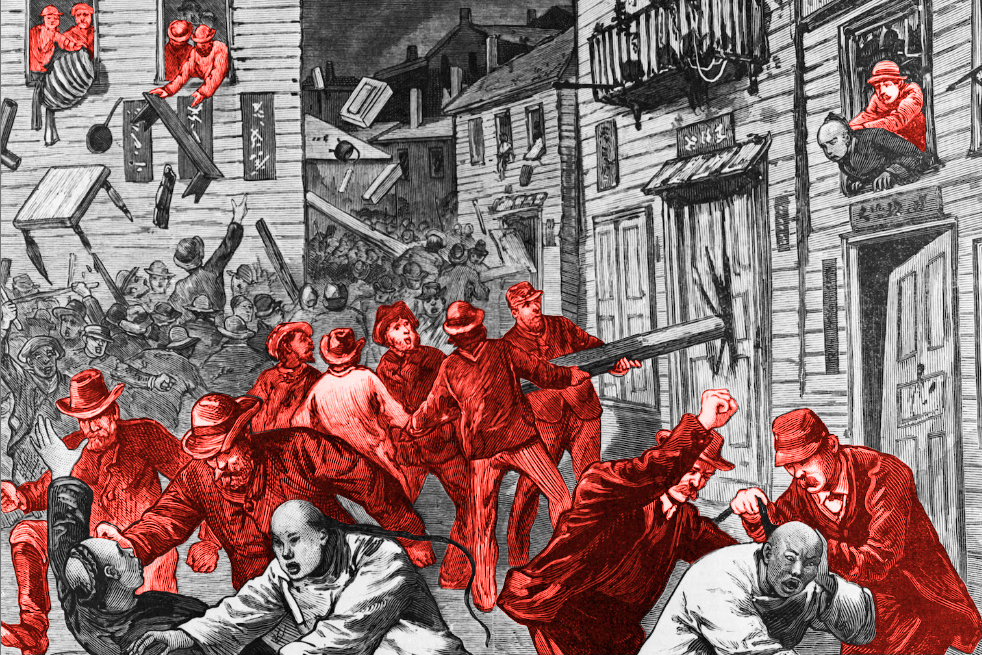
As the sun was setting, as many as 500 White and Hispanic residents had descended on Negro Alley. Many Chinese residents completely innocent of the earlier shooting retreated from the enraged mob into the Coronel Building, a block-long structure that contained businesses and apartments where many Chinese worked and lived. With Chinese going into the building, mob vigilantes thought perhaps that’s where the shooters had fled. But for most, the distinction between innocent Chinese and guilty Chinese ceased to exist.
The crowd began chanting “Hang them!” Any pretense that this was still a simply an attempt to quell a criminal shootout and apprehend the guilty parties was dropped, and anyone Chinese became fair game for the mob’s vengeance.
Some men from the mob climbed on top of the building and chopped through the roof with axes and sledgehammers as they shot indiscriminately at Chinese huddled inside. As the mob was breaching the building, one Chinese man armed with a hatchet tried to escape, but was stopped by police, and escorted toward the jail. But before they could make it, a pack of men intercepted them, and took custody of the prisoner. They dragged him down the street as onlookers shouted, “Shoot him!” “Hang him!”
He was taken to a nearby gateway and a rope wrapped around his neck. He was pulled up to hang, but the rope snapped, so a stronger one was found. Again, he was strung up and this time, the rope held. As he was squirming for his life, one of the men who’d captured him remarked that he didn’t seem to be hanging right, so the man climbed the side of the gate and hopped on the victim, straddling his shoulders, drawing cheers from the crowd as the man finally succumbed. He would be the first lynching of the night.
By 9pm, the Coronel Building was fully breached by the mob, and grotesque, torturous violence was unleashed. Eight Chinese men were dragged from the building, beaten and hanged from makeshift gallows—some from the gateway of a corral and one from a wagon. One man reportedly had a rope tied around his neck and was dragged down the street and over rocks while still alive before he was hanged.
Rioters worked their way down the block, pulling any Chinese they could find outside and shooting those who tried to flee.
One murder in particular illustrated how divorced the violence had become from any pretense of righteous vigilante justice. Gene Tong was an affable old man and an herbal medicine doctor well-liked in the community by residents of all races. But when the mob reached his door, they dragged him and his wife out. Tong pleaded with his captors in both English and Spanish, making the obvious case that he’d had nothing to do with the earlier shooting. But they were unmoved. Someone summarily shot him in the face. The men then picked Tong’s pockets, and someone even cut off his finger to steal the ring he was wearing. Tong’s body was then dragged down the street and strung up for display with two other men who’d already been hanged.
As the mob continued to drag Chinese out into the street, two Chinese women came out to plead for mercy, and were promptly shot. As several men were being hanged from a wagon, a White attorney named Henry Hazard tried to intervene, asking if the rioters knew for sure that the men they were about to kill were guilty. “He’s a Chinaman,” one of the killers snapped back. As Hazard continued to press his case against the lynchings, the killers apparently grew weary of his interference and fired several warning shots in his direction.
Hazard wasn’t the only one who tried to stop killings that night. At least several other local residents sheltered Chinese in their homes and shops. Robert Widney, a lawyer in the city, made perhaps the most significant impact. The head of a “law and order committee” that had recently been formed by concerned citizens in the face of rising crime, Widney gathered up around 10 other members of the committee and headed to Negro Alley to try to quell the violence. In some cases, he was unsuccessful, but he and his group did find some guns and managed to rescue Chinese captives from the mob. Widney later estimated that his group saved around two dozen Chinese that night.
Police, however, were basically derelict in their duty to protect Chinese. Some did help Chinese escape the area or intervened to stop rioters from setting fires or doing other property damage. But there were no reports of any officers using their weapons or making arrests to prevent lynchings or other violence.
By about 9:30pm, the sheriff did convene a group of around 25 volunteers to restore order and they made their way to the Coronel Building, but by then, the massacre had petered out. The mob dispersed, with many men heading straight into nearby saloons to drink and revel in what they had just done. One man with blood still on his shirt reportedly boasted that he had personally killed three Chinamen.
The area was a grim scene, with corpses laying in the street and many still hanging on display where they’d been lynched. One witness later recalled a Chinese boy that couldn’t have been older than 6 or 7 tugging at the leg of one of the men who’d been hanged, whimpering “come down papa, come down.”
The witness later recounted: “I stood and stared stupidly, ashamed for the first time of my own race.”
The next morning, the bodies were collected and laid out in rows, many of them badly mutilated. Altogether, at least 18 were killed, 10 percent of Los Angeles’s entire Chinese population, and many more had been wounded by gunshots, stabbings or beatings. 15 had been hanged, making it the deadliest mass lynching incident in American history. One of the victims was just 14 years old. The others were mostly cooks, laundrymen and shop owners. It’s believed that only one of those killed had actually been involved in the original gun fight that started it all.
True to form, the Los Angeles press was less than sympathetic. The next day, the Los Angeles Daily Star published an unsigned editorial titled “The Chinese Outrage” blasting the quote “horrible assassinations” perpetrated in the city the previous night. But it was referring not to the Chinese killed, but to the four white men who’d been shot, only one of whom, Robert Thompson, had actually died.
“The horrible assassinations which were perpetrated in our city last night by the brutal, uncivilized barbarians that infest the country is an indication of what the consequence would be were their race transmigrated in large numbers upon the coast. Upon all the earth there does not exist a people who value life so lightly, who practice so many horrors, or are so unmerciful in their outrages. From their very mode of existence they have little regard for their own lives and none whatsoever for the lives of others. The shooting of our citizens upon the streets yesterday, before daylight had gone, and the frequency of their horrible acts of a sinister nature, has now, at last, set our citizens thinking as to the best mode of ridding ourselves of such a living curse.”
The article went on to absurdly claim that in the excitement of the previous evening, several methods had in fact been proposed for dealing with the Chinese, including allowing them all to leave the country, or withholding all employment from them. But because the friends of the killed and wounded Americans were so exasperated, the hanging and shooting could not be quelled, until the horror of the scene became sickening even to the participants themselves.
The Los Angeles Daily News took a slightly harder line on the rioters, condemning mob rule and the quote “horrible feast of indiscriminate death.” But lest anyone think they’d become soft on the immigrants, it clarified: “We are opposed to the Chinese.”
Over the next several days, 79 witnesses testified at an official inquiry. Due to the mob nature of the massacre, it was difficult to determine for prosecution purposes who exactly had killed who. But many of the White witnesses weren’t very willing to point fingers. And as you’ll recall from our last episode, the California Supreme Court had ruled in 1854 that Chinese were not allowed to give testimony against Whites.
But still, some names did come up again and again as particularly flagrant participants in the massacre. Eventually, a jury issued 25 murder indictments, and also threw in a harsh criticism of the town’s police force for failing to make any attempt to arrest anyone who was so openly committing violence and murder.
But only 10 men ended up going to trial, and of those, eight were eventually convicted on downgraded manslaughter charges. But even those convictions wouldn’t stand. The California Supreme Court later overturned them on an almost laughably minor technicality. It ruled that the original indictments never specified that a person was actually murdered. For that, all the men were released after serving just a year in jail. They could easily have been re-tried with this technicality corrected, but none ever were. Yet again, murder of Chinese immigrants had been committed with virtual impunity. And it’s something that was just getting started in the American West.
In a way, Los Angeles was a bit ahead of its time in this sort of mob violence and ethnic cleansing of Chinese. In that instance, it seemed to be mostly fueled by pure racist animosity in a particularly violent city, enflamed by a notably inflammatory media. Systemic economic anxiety didn’t yet seem to be a major contributor to the violence. Los Angeles was booming, and the overall US economy was still doing ok.
But that would soon change in a very big way. And throughout the 1870s, serious economic anxiety would enflame more base racist hatred. In retrospect, the Los Angeles Massacre wasn’t an isolated incident, but rather, a canary in the coal mine for more routine and systemic ethnic cleansing, and more mass murders that would surpass even LA’s unspeakable carnage, on this episode of Manmade Catastrophes.
[Theme music]
In our last episode, we looked at the mass migration of Chinese to the American West Coast. If you haven’t listened to that yet, you might want to go back before continuing this episode.
As Chinese poured in for the gold rush and railroad construction, racist resentment and economic anxiety grew, which was increasingly being expressed in discriminatory laws and grassroots violence. In this episode, we’ll conclude our look at how this transitioned to formal Chinese exclusion at the federal level and precipitated an epidemic of intimidation, violence and murder of Chinese that can only be described as ethnic cleansing.
A major turning point in the building resistance to Chinese immigrants would come in 1873.
Since the US Civil War had ended 8 years earlier, there had been a frenzy of railroad development, and many railroad companies went deeply into debt to fund construction on increasingly questionable projects. It was quietly fueling one of the biggest speculative bubbles in American history, and it would eventually burst with the help of a souring global economy.
Jay Cooke & Company was one of the largest American banks at the time, and it had gone in big on railroads. But with international investors dumping railroad bonds to stay solvent, Jay Cooke, and railroad companies more broadly, struggled to sell new bonds to fund projects, and railroad company borrowers weren’t making payments on their loans. Jay Cooke eventually declared bankruptcy on September 18, 1873.
It was a bombshell – the 19th century equivalent of Lehman Brothers, except there were a lot fewer guardrails in place to mitigate the fallout. Jay Cooke’s collapse set off the Panic of 1873. There were runs on banks, a chain reaction of bank failures, and dozens of railway companies collapsed, in turn cratering many supporting industries. It sent ripples through the economy and caused mass layoffs. The economic crisis would last some six years and shrink the US economy by nearly a third. It actually came to be referred to as The Great Depression, until the events of 1929 would set a new benchmark and seize that title.
With legions of blue-collar workers now unemployed and struggling, Chinese workers became a more appealing scapegoat than ever. And opportunistic labor and political leaders were all too happy to ride, and enflame, xenophobic currents to greater influence in power.
One of the first major pieces of anti-Chinese legislation during this time was the Page Act of 1875, introduced to the US Congress by California representative Horace Page, who said it was intended to quote “end the danger of cheap Chinese labor and immoral Chinese women.”
Playing on longstanding coolie debt slave tropes, the act prohibited the import from China, Japan or any other Oriental country, any unfree laborers. And even more significantly, it prohibited women brought for prostitution or other lewd and immoral purposes. In practice, the act did little to slow the flow of male Chinese laborers to the United States, but it virtually stopped the flow of Chinese women in their tracks. Chinese women trying to enter the US came to be routinely subjected to humiliating interrogations and physical examinations that presumed them to be prostitutes, and far more often than not, they were deemed to be so whether or not there was any real evidence. The already large gender imbalance of Chinese immigrants became even more skewed, making it even more difficult for Chinese families to form and settle in the country.
As the 1870s went on, the economic malaise continued to deepen. Several years into the depression, it was getting desperate for many among the working class. And it came to a head in July of 1877 when the Baltimore and Ohio Railroad announced that it would yet again be cutting the wages of its workers, this time by 10 percent. Workers were already earning barely enough to scrape by from their hard and dangerous labor for the railroad, and this was the third time their wages had been cut in the past year. Backed into a corner, workers went on strike and even physically impeded railroad operations.
With similar dynamics in play across the country, the strike rapidly spread to dozens of cities. At its height, the Great Railroad Strike of 1877 would involve more than 100,000 workers and shut down more than half of the freight movement across the country’s railroads. And in some cities, it got violent as workers outright rioted. Confrontations between troops and strikers resulted in massacres in multiple cities, and it’s thought that overall, more than 100 people were killed amid the strikes.
The events even reached across the continent to San Francisco. In response to the strikes transpiring across the country, the Workingmen’s Party of the United States, a pro-labor socialist political party, organized a sandlot rally near City Hall in support of the movement.
But even before the rally began, speculation was spreading that it could take a violent anti-Chinese turn. The organizer of the rally was known for his anti-Chinese stances, and rumors circulated that the rally intended to move to the streets and burn down docks and the Chinese quarter.
When the rally got underway, there were some 8,000 people in attendance. In his opening remarks, the organizer clarified that this was not an “anti-coolie meeting” but was intended to support the working men on the East Coast. But that didn’t seem to interest the crowd. During the speech, people shouted things like “Give us the coolie business” and “Tell us how to drive out the Chinamen!”
Subsequent speakers who failed to rail against Chinese were also shouted down. The event ultimately fizzled out, but not before highlighting the anti-Chinese agitation that was building among the masses and providing an issue to rally around. As the rally dispersed, attendees coalesced into mobs and started rampaging through the Chinese quarter, smashing windows, ransacking businesses, setting fires and attacking Chinese residents.
The riot only spread from there, and went on for two days, growing to involve thousands of people. It was eventually suppressed by a quote “Committee of Safety” consisting of a few thousand volunteers who’d been mobilized. When the smoke cleared, at least three Chinese residents of the city had been killed.
The railroad strikes had illustrated an anti-capitalist, anti-robber-baron fervor that was building amid a growing class divide in Gilded Age America. But the anti-Chinese turn that the San Francisco events took by popular demand of the crowd illustrated how, in California at least, Sinophobia was an even more salient issue to rile up the working class.
One of those who had been part of the safety committee and witness to the riots was a 30-year-old Irishman named Denis Kearney. But his participation in quelling the violence didn’t mean he had any sympathy for the Chinese who’d been targeted. In fact, he would become one of the most prominent figures in pushing Chinese exclusion and anti-Chinese violence.
Immigrant Irish laborers were unfortunately a pool with many ready-to-recruit anti-Chinese agitators, which was especially unfortunate given Irish immigrants’ own recent history of being targeted.
Irish immigrants had begun pouring into the United States during Ireland’s potato famine of the 1840s, and like Chinese, they had aroused a hefty amount of resentment from native-born Americans for their willingness to work at lower wages, as well as for their Catholic religious beliefs in a predominantly Protestant America. And again like the Chinese, the swelling ranks of Irish in the 1840s and 50s inspired nativist political parties, like the Know Nothings, and occasional protests, riots and mob violence that put Irish in the crosshairs.
So one might think that a generation later, when Irish immigrants saw Chinese enduring very similar discrimination and oppression, they might be inclined to show sympathy and solidarity. Unfortunately, that usually wasn’t the case. It was similar to how some Hispanic residents of Los Angeles, despite their own history of being repressed and randomly murdered, were among those who enthusiastically participated in the massacre against Chinese. Often, racial and class hierarchies develop, and those below the most privileged group – in this case, White Protestant native-born Americans – can seek to establish dominance and superiority over those even lower down the perceived hierarchy. When you’re perceived as different and ‘the other,’ it’s often tempting to target a group who’s even more different and more other to turn the tables on.
Prior to the riots, Denis Kearney had already been outspoken on labor issues, like monopolies and greedy capitalists, and he’d even tried, unsuccessfully, to start a political party. But he hadn’t been so vocal on Chinese. That would change after the San Francisco riots though. Two months later, at another gathering of a few hundred people at the sandlot near City Hall, Kearney gave a speech in which he called for all the Chinese working in San Francisco to be fired, and for businesses to quote “give the White man a chance.” The speech resonated with the crowd, and he only became more vitriolic from there.
Less than a week later, he told a crowd that we must settle the Chinese question within the next two years, or the system will have settled us, and he encouraged his followers to keep a musket in their house with ample ammunition. He also blasted the employers who hired Chinese, saying they should recognize that the Anglo-Saxon spirit is not dead. The concept of survival of the fittest is growing more salient, he continued, and Whites are superior to the Mongolians and will outlast them.
As he continued to give more inflammatory speeches, his crowds grew from hundreds to thousands. In October of 1877, less than 3 months after the riots, he and other organizers established the Workingmen’s Party of California, not associated with the existing Workingmen’s Party of the United States, though many members of the latter would abandon it in favor of Kearney’s group. The party elected Kearney its president and established a platform that went all in against the Chinese, vowing to rid the country of cheap Chinese labor as soon as possible and by all the means within their power. It also labeled anyone who continued to employ Chinese as public enemies.
Kearney continued to give inflammatory speeches every Sunday to growing crowds, establishing himself as a leading anti-Chinese demagogue. And his rhetoric promoting violence became less subtle, as illustrated in this excerpt from one of his speeches in December of 1877.
“When the Chinese question is settled, we can discuss whether it would be better to hang, shoot, or cut the capitalists to pieces. In six months, we will have 50,000 men ready to go out, and if the Chinese don’t leave here, we will drive him and his kind into the sea. We are ready to do it. If the ballot fails, we are ready to use the bullet.”
He would go on to routinely call for violence and destruction, including the killing of specific government officials, and the blowing up of arriving steamships carrying Chinese. In one instance, it looked like he might make good on his violent threats when he marched some 1,500 followers to a woefully under-protected City Hall to demand relief for the unemployed. Officials inside braced for an attack, but thankfully, the crowd was talked down. For their rhetoric, Kearney and other leaders were later arrested for inciting violence, but they were ultimately acquitted.
Kearney took his show on the road to other cities around California, and later across the Midwest and East Coast, whipping up crowds of thousands with his signature anti-Chinese vitriol.
One line he would commonly use was “We intend to try and vote the Chinaman out, to frighten him out, and if this won’t do it, to kill him out.” But it was his even more concise finisher that would resonate most, and become a broader rallying cry: “The Chinese must go.”
East Coast newspapers were far more critical of Kearney than their California counterparts, treating him as a brash attention seeker and farcical carnival barker who traded in abuse without offering any substantive arguments. He was indeed sneered at by elites, but his message clearly resonated with many segments of the population, evidenced by the swelling number of supporters he had wherever he went. At one point, he even got an audience with President Rutherford B. Hayes, who praised him for bringing people’s attention to these, quote “evils.”
In 1878, due partly to pressure from labor leaders like Kearney, California held a convention to update its three-decade old state constitution. And Kearney’s Workingmen’s Party managed to win a third of the 152 delegate seats that would decide the new constitution – a rather phenomenal feat for a party that had existed for less than a year.
Unsurprisingly, during debate at the convention, the Workingmen made anti-Chinese policies an overriding priority. There were measures proposed like banning all Chinese from California or making it illegal to ship the deceased remains of immigrants overseas – something that clearly targeted Chinese, due to their widely held belief that being buried at home was crucial for your soul to find peace.
Most measures like these were ultimately rejected for fear that they would be struck down for violating the US constitution. But some harsh proposals did ultimately make it into the final document ratified in 1879. Under one section explicitly titled ‘Chinese’, it banned any corporations or public entities from hiring Chinese. It gave the state and local governments broad power to pass regulations to defend against quote “the burdens and evils arising from the presence of aliens who are, or may become, vagrants, paupers, criminals or invalids afflicted with contagious or infectious diseases.” And it declared the presence of foreigners ineligible to become US citizens, ie, Chinese, to be dangerous to the well-being of the state, and said the legislature should discourage their immigration by all means within its power.
It was the highest level, and most sweeping set of anti-Chinese policies to date, but it would still go further yet. The tide toward broader Chinese exclusion had begun, and within a few years, it would be formalized into federal law.
[Ad break]
As the 1870s drew to a close, the United States had finally pulled itself out of the long economic depression. But that didn’t translate to any less hostility toward Chinese. By now, national leaders in Washington were pandering to anti-Chinese sentiment on the increasingly populous West Coast. And a decade into the operation of the Transcontinental Railroad, more Chinese were turning up on the East Coast looking for work every year, making them an increasingly debated political issue there as well.
In 1879, a bill was introduced in the US Congress aimed at indirectly curtailing Chinese immigration by limiting ships to bringing no more than 15 Chinese passengers to the US at a time. In debating the bill, Republican Senator James Blaine, who had his eye on a bid for the presidency, gave some of the most hyperbolic arguments in favor of the bill, claiming the Chinese presented an existential threat to the United States, and that either the Anglo-Saxon race would control the Pacific Coast, or the Mongolians would.
A lonely voice on the other side of the debate was 69-year-old Republican Senator from Maine Hannibal Hamlin, who would retire the following year… likely emboldening him to say things that might otherwise cost him re-election. He stressed that apocalyptic talk like Blaine’s was overblown, and that the relatively small numbers of Chinese coming to the US each year were far from an existential threat. He went on to say that if Chinese were treated well, they would become good American citizens. And he pointed out Chinese contributions to the country, like building the railroads and producing uncounted millions in wealth. He ended by saying that America should demonstrate a spirit of hospitality in line with its highest ideals, and that his vote against the bill was his last legacy to his children, so that they might regard it as the brightest act of his life.
In the end though, this high-minded talk fell flat. The bill passed with overwhelming support from most Democrats and about half of the Republicans. However, it wouldn’t end up becoming law. The 1868 Burlingame Treaty with China was an impediment to any attempts like this to restrict Chinese immigration. Its terms granted each country’s citizens free access to the other, and citing the treaty, President Hayes vetoed the bill.
Ultimately though, that veto would only be a temporary setback. By the late 1870s, China had a weakened position internationally, and it was willing to make concessions to the United States in exchange for its own concessions in other areas of interest. The time was ripe to try to unwind the Burlingame Treaty, and that’s exactly what happened in 1880. That year, China agreed to the new Angell Treaty, which still guaranteed the protection of Chinese laborers already in the United States, but it allowed for quote “reasonable” restrictions on future Chinese immigration.
In 1882, the US Congress overwhelmingly passed a bill to completely exclude Chinese laborers from the United States for 20 years. President Chester A. Arthur felt though that 20 years went beyond the quote “reasonable” restrictions allowed by the Angell Treaty, so he vetoed the bill, prompting Congress to repass it with a 10-year limit. Then on May 6, 1882, Arthur signed into law what would become known as the Chinese Exclusion Act.
The act did not completely exclude all Chinese. Those who weren’t laborers, like students, merchants, and diplomats were still allowed entry if they could prove their status. But in practice, even many from permitted groups found themselves unable to enter the country under overly aggressive enforcement of the act. Those who were already in the country too were supposed to be allowed to exit and re-enter, provided they obtained re-entry permits before they left, but that too became difficult in practice. And in 1888, the Scott Act was passed, formally prohibiting those Chinese who left the US from coming back. To say that it disrupted and upended the lives of many Chinese immigrants – some of whom had lived in the country for decades – would be a vast understatement.
The letter of the law of the Chinese Exclusion Act was bad enough on its own, but it was made all the worse by the aggressive enforcement tactics it inspired, like humiliating interrogations and lengthy detentions. And worse yet, it essentially gave tacit sanction for more general discrimination and abuse of Chinese still in the country. The highest American body had, in no uncertain terms, declared that Chinese were not welcome.
Still, as harsh as the law was, many Chinese managed to circumvent it and enter the country, either by working the system and obtaining dubious documentation, or simply by being smuggled across America’s porous borders. In 1884, one customs officer in Washington Territory lamented the number of illegal Chinese crossings from Canada.
“I believe they are coming to our side every day, by water and by land, and by boats and canoes. Between British Columbia and this country, it seems to me the restriction act is almost worthless.”
Frustrated by a lack of manpower to seal the borders and an inability to stem the flow of Chinese migration, Washington customs officials eventually enlisted help from the public. Officials started offering cash rewards to informants and even said private citizens would have the right to arrest and detain Chinese they caught illegally entering the country, then be paid a three to four dollar bounty for their trouble. Many took officials up on the offer and became extralegal immigration enforcers.
And it wasn’t just White citizens who took part. Some Native Americans, and even fellow Chinese, worked as informants and deputies to thwart new Chinese from entering. One interesting fissure that emerged within the Chinese community during the Exclusion Era was between those who were in the United States legally through one means or another, and those who weren’t. Often, the former resented the latter for bringing suspicion and discrimination on all Chinese, and they wanted to draw a distinction. Some even viewed new Chinese arrivals as competition in one form or another. So some were willing to help in border enforcement efforts.
In 1885 though, even with vigilantes aiding in border enforcement, illegal Chinese migration across the northern US border surged. Railroad construction in Canada slowed down significantly, and it also began cracking down on Chinese immigration and the acceptance of deported Chinese from the United States. This created a new spike in Chinese flowing into the United States, who were then likewise more difficult to deport than they once had been. The Seattle Call newspaper expressed mounting frustration.
“There is no longer any hope of obtaining relief from this Chinese curse through the laws enacted by Congress. Their inefficiency to prevent Chinese immigration has been demonstrated. To this northern country, bordering on British Columbia, they absolutely afford no protection whatsoever. We must protect ourselves or be overrun by these heathens.”
Many cities were indeed already beginning to take it upon themselves to run their Chinese communities out of town. As we saw at the beginning of our last episode, in February of 1885, following an outburst of violence between two Chinese gangs that resulted in a White man getting killed in the crossfire, a mob in the city of Eureka, California promptly took up arms and drove its entire Chinese population out of town in less than a day. The event inspired other communities to do the same. Throughout 1885, there had been many incidents of mobs intimidating Chinese and their employers, and increasingly crossing the line into violence and even murder.
This was intensified by yet another economic depression that had begun just a few years after the last one had ended. The Depression of 1882 to 1885 again heavily impacted railroads, their supporting industries, and the blue-collar workers that depended on them. So yet again, Chinese became a prominent scapegoat.
With intimidation and violence against Chinese becoming normalized around the West Coast, it was only a matter of time before something, somewhere tipped the scales into something much darker than just mass expulsion…something that would exceed in scale even the atrocities of Los Angeles 14 years earlier. That incident would finally come in September of 1885 in Rock Springs, Wyoming.
[Ad break]
The Transcontinental Railroad, which passed through Wyoming, had first brought settlers to the territory in large numbers in the late 1860s, including the many Chinese laborers who’d worked on the railroad. That in turn kickstarted a coal-mining industry in the region to help power the increasing rail traffic. By 1875, the community of Rock Springs had developed substantial mining operations, and grown to a population of around 1,000 people, mostly European immigrants who worked for the Union Pacific railroad.
That year though the seeds started to be planted for conflict with Chinese workers. That November, the Union Pacific reportedly wanted to ramp up production ahead of winter and was cutting costs while also putting more pressure on workers. While the exact cause isn’t clear, for whatever reason, miners went on strike that month.
The Union Pacific responded by promptly shipping in a trainload of Chinese laborers under armed guard of the US Army, dispatched by Wyoming’s territorial governor. The new Chinese arrivals immediately went to work in the mines, while company officials posted a list of White workers who would be allowed to return to work that only amounted to about a third of those who had walked off the job. And that was that. No more negotiations. Operations resumed with about 200 miners – 150 of them Chinese and only about 50 of them White. It was a very unwelcome introduction to the Chinese community for the White residents of Rock Springs, to put it mildly.
But the two groups went on to coexist in Rock Springs without major incident for nearly the next decade, albeit, with very segregated lives – the White miners mostly living in downtown Rock Springs, with the Chinese in their own separate section just outside of town near the mines. But despite the relative peace during this period, the White workers must have been stewing in the knowledge that Chinese workers and their willingness to accept lower wages meant they had far less negotiating power.
In 1884, that dynamic began to come to a head. By then, mining operations in Rock Springs had grown substantially, with some 550 Chinese workers and around 300 White workers. But the railroad economy, and the greater US economy, was on its heels and company leaders were squeezing their workers left and right, through pay, conditions and output expectations.
At one point, as labor relations across the country were again becoming tense and work stoppages were becoming common, White miners in Rock Springs reportedly approached their Chinese counterparts about joining them in a strike. They knew that any labor action on their part without Chinese participation was doomed to fail. Just as they had in 1875, company leaders would inevitably use Chinese labor to keep White labor in check unless the Chinese joined them. But Chinese miners weren’t interested in any labor action.
Tensions between White and Chinese workers continued to grow in 1885, as higher-earning Whites were finding themselves increasingly iced out of mining work while more Chinese workers continued to be hired. White workers also often complained that Chinese were being given more desirable rooms to work in the coal pits, which was important since workers were paid by the ton of coal they produced.
By that summer, as news of mass expulsions of Chinese around the West Coast were becoming well known, threatening flyers were posted in several mining towns around Wyoming warning Chinese in those places to get out. Labor unions were likewise becoming more explicit in their rhetoric and threats against Chinese. And in Rock Springs, rumors were starting to circulate that a storm was brewing over the quote “Chinese problem.”
It isn’t entirely known to what extent the events in Rock Springs were pre-meditated. But on September 2, 1885, it didn’t take much of a spark to light the conflagration. That morning, two Chinese workers were assigned to go down go down into a coal mine and work in what was considered a desirable mining room. According to later testimony, they were then accosted by around a dozen White workers who declared that they had no business being there. The Chinese men tried to reason that they were just following orders, and they didn’t want any trouble, but the White men reportedly proceeded to badly beat them with shovels and other mining tools. One of the Chinese men would later die from his injuries.
Other nearby Chinese workers tried to intervene, and were also badly beaten for their troubles. But then the fighting stopped temporarily, and the White attackers walked out of the mine and left the area. But they weren’t through.
Many went to their homes and retrieved guns or other weapons, and began to rally other White residents. While en route, some passed Chinese food deliverers, and proceeded to throw rocks at them. Finally, several dozen men reassembled near the mines and began to head into town. As they walked, they chanted “White men, fall in. White men, fall in.”
Their first stop was the local chapter of the Knights of Labor, a national labor union that had ardent anti-Chinse views, and locally, had seen intensifying anti-Chinese language at its meetings lately. There, more men joined the mob. Then many retreated into local saloons to drink and commiserate with other workers who were starting to come in for their lunch break.
Maybe saloon owners sensed the violent intentions of the White workers who had gathered, or maybe they were persuaded by Union Pacific bosses, but for whatever reason, by mid-afternoon, the saloons and other shops downtown decided to close down as a precaution. But that seems to have had the opposite of the intended effect, sending the separate mobs, likely now freshly fueled by alcohol, back out onto the street to once again coalesce.
Now, anywhere from 100 to 150 White men had gathered, many of them armed with rifles or pistols. And even some women and children joined in the revelry. Someone screamed out “Vengeance on the Chinese!” An impromptu vote was taken on whether to expel the Chinese residents of Rock Springs, which obviously received overwhelming support.
The mob broke into two groups and headed toward two separate entry points to the Chinese quarter—one over a plank foot bridge, and one over a railroad bridge. On their way, one of the mobs ran into a group of Chinese workers, and proceeded to fire wildly in their direction.
Finally, both groups arrived outside the Chinese quarter, and men with their rifles began to take up positions from the sheds and hills surrounding the community. At the time, there were around five to six hundred people living in the Chinese quarter, and because of a Chinese holiday that day, most of them were at home. Luckily, some of those residents had been forewarned about the trouble brewing downtown earlier, and when they saw the mobs approaching, promptly ran for the hills…literally. But many never got that chance.
A few of the White men walked into the quarter and informed the Chinese residents that they had an hour to pack up and get out of town. It looked poised to be yet another unjust, but non-deadly expulsion of Chinese residents, like Eureka and many other towns in the West had already seen. But this time, the Chinese wouldn’t be so lucky. Apparently some of the rioters had a bloodlust that couldn’t wait for the 1-hour deadline.
It isn’t clear why, but after just 30 minutes, shots began to ring out from some of the men positioned around the Chinese quarter. And with that, others took their cue, and a massacre began.
Chinese residents began to fall fast. One of the first killed was a 56-year-old man.
The attackers then advanced into the quarter and started bashing down doors to hunt those inside buildings. Chinese ran out their doors or climbed out windows and fled in every direction, many running through the surrounding creek and into the hills, if they were lucky. But some were dragged out of their homes and shot point blank or cut down while running through the street. One witness later recalled seeing the hills “literally blue with the hunted Chinamen” fleeing for their lives under gunfire.
Not all rioters were willing to kill. Some stopped Chinese, robbed them, then turned them loose, or beat them with the butt of their gun before moving on. Some simply stood by and cheered or laughed without actually participating in the killing.
One group of women gathered on the foot bridge to watch the massacre, as they cheered it on. A few of them reportedly even picked up guns and fired shots. One woman who lived nearby encountered Chinese men fleeing past her, so she drew a pistol and shot down two of them – an act she was later celebrated for in Rock Springs.
After rioters had looted the homes, they began to burn them down. Some remaining Chinese residents were hiding in cellars, which would be the salvation of a few. One man remained hiding in a cellar for a week, and another survived by hiding inside a large oven for several days.
But for most of the people still hiding in homes, the fires would spell their end in one way or another. Some were forced by the flames to flee into the street, whereupon they would be shot. Or worse, they remained inside and burned to death. That evening, the rioters would burn down nearly 80 homes, and they began to throw the dead bodies that were scattered around the quarter into the homes as they went up in flames, creating a visceral stench of burning human flesh. The looting, arson, and last scattered killings went on for several more hours until night fell.
Many Chinese residents had managed to flee the area and the immediate danger of the murderers, but some would succumb to wounds or to thirst and the elements in the desolate surrounding hills that night or over the following days.
With the Chinese quarter burning and nearly all of the Chinese residents either dead or in flight out of town, some rioters turned their attention to Union Pacific bosses who had hired Chinese and told them to get out of town immediately. Greatly outnumbered and outgunned, they complied.
Other Union Pacific officials frantically sent off telegrams seeking help to quell the violence as the massacre was still unfolding. Those who received them included the county sheriff who was in the town of Green River 14 miles away, as well as Territorial Governor of Wyoming Francis Warren. But neither could mobilize reinforcements in time to make any difference.
The best the Union Pacific could do was pack a train with food and water, and slowly run it down the tracks between Rock Springs and Green River, picking up and giving aid to any Chinese they encountered fleeing along the way. But many wouldn’t ever see the train. Those who had managed to escape had little option but to trudge through the night the 14 miles to Green River, now badly shaken, destitute from having been robbed of all their possessions, and possibly wounded. It took some struggling survivors two days to make the trek.
Back in Rock Springs, the sky was lit up with a red glow as the fires continued to burn throughout the night, and pockets of remaining rioters continued to whoop and holler as they randomly popped off gun shots. Then, when the sun came up the next morning, the full extent of the carnage would come into horrifying view.
[Ad break]
When the sun rose on Rock Springs’ Chinese quarter, the once modest but thriving community had been reduced to a flattened, blackened hellscape. The dozens of homes that had stood a day earlier were now nothing more than charred, smoking ruins. And upon closer examination of those ruins, the true horror came into focus.
Several bodies of those who’d been shot down as they tried to flee were still prostrated out on the ground amid the ruins and near the creek. But the most awful scenes were those in burned out homes and cellars, where many Chinese residents had unsuccessfully tried to hide out from the murderous mob. Cowering bodies were found, sometimes clustered together in groups. Some had unsuccessfully tried to burrow themselves into the walls or the ground to shelter themselves from the flames, leaving grotesque scenes of half intact, half charred bodies. Accounts from witnesses who examined the scene described many bodies that were found only in portions.
But one the most disturbing things witnessed at a scene that had no shortage of horrors, was a group of hogs feasting on a body that they had pulled from a burnt out home. Five bodies were described by a witness as quote “more or less mutilated”, though it isn’t clear if this mutilation was done by rioters, fire or animals.
The day after the massacre, Governor Warren himself traveled to Rock Springs, and was mortified by what he encountered, even before arriving at the scene, as he later recounted in his writings.
“The smell of human flesh was sickening and almost unendurable, and was plainly discernible for more than a mile along the railroad both east and west.”
When the final counting was done, at least 28 Chinese had been killed in the massacre…though that only includes confirmed deaths. Some who fled were never accounted for. It’s possible that they simply ran off and began new lives without ever being recorded as survivors, but it’s likely at least some of those who ran into the hills that night ultimately died without ever being found, and the true death toll may have been as high as 50. Unconfirmed accounts were later reported of people dying in the hills while fleeing and being eaten by coyotes. One newspaper report claimed a mother and her infant child had died of thirst in the hills, which immediately drove the father with them to suicide.
In the aftermath, White racists in the region did not stand down. Chinese who fled to Green River or Evanston were subject to new threats of violence and warnings to get out of those towns. One Chinese man in Green River was reportedly chased by a new mob there, until he was given shelter by a woman running a local hotel, who bravely stood up to the attackers and shooed them away when they tried to pursue the man inside.
A week after the massacre, federal troops dispatched by President Grover Cleveland finally arrived to ensure order remained restored. They would remain there for years.
The Union Pacific was determined not to let the rioters dictate their operations. And the company president reportedly instructed subordinates to yield nothing to the rioters. Unfortunately though, this stance didn’t just include taking a stand against the rioters. It also involved hoodwinking the Chinese survivors.
Shortly after the federal troops arrived, hundreds of Chinese workers who’d fled Rock Springs were put on trains by the Union Pacific and told they were being sent to San Francisco—likely welcome news to many of them who wanted nothing more to do with the area. But in fact, it was a trick. The Union Pacific was sending them straight back to Rock Springs to return to the mines.
When they arrived, the Chinese passengers were furious, but there was little they could do. A few dozen of them refused to accept this bait and switch, and found their way back out of Rock Springs by one means or another. But many others had fled with nothing more than the clothes on their back, and the Union Pacific refused requests to provide survivors with train tickets out of town, or even the months of back pay many workers were still owed. Penniless and desperate, many of the Chinese had little other option than to stay with the company and its mining work in Rock Springs to begin rebuilding their lives.
When the returning Chinese went back to the Chinese quarter to assess the damage, they confronted a still horrific scene a week later. Some of the bodies had been buried, but many were still laying out in the open where they’d been left, decomposing and some partially eaten by hogs or dogs. For many, it was too much to bear…and they collapsed to the ground in tears.
Despite the presence of federal troops, the Chinese who intended to stay were far from out of harm’s way. Many of the murderers who’d participated in the massacre had yet been apprehended, and some White miners were still determined to stop the Chinese from returning to work in the mines. Over the following months, there were more minor incidents and skirmishes, but ultimately, the Union Pacific got the remaining White workers in line, hundreds of Chinese continued working in the city and the Chinese quarter was slowly rebuilt. Despite the unprecedented massacre, the rioters failed in their attempt to rid Rock Springs of its Chinese residents.
However, by now, it probably won’t surprise you to learn that the murderers would all ultimately escape justice. Within days, 16 men were arrested for murder, arson and rioting and released on bail while the incident was investigated. But during that investigation, authorities had a very difficult time finding anyone willing to testify against the men—likely due either to fear of retribution, or support for their actions. Afterall, many townspeople who hadn’t directly participated in the violence had still enthusiastically cheered it on.
A grand jury was assembled to decide what, if any, charges should be brought. Some two dozen White residents of Rock Springs testified, but none provided any testimony that implicated specific rioters. And bafflingly, a local pastor who lived near where the massacre took place even testified that Chinese residents themselves had set fire to their own community—an absurd claim.
Unlike in California, Chinese were allowed to testify in Wyoming. But none did in the case of Rock Springs. It isn’t entirely clear why, but Chinese diplomatic officials would later claim that prosecutors had no real interest in achieving indictments. And ultimately, the grand jury chose not to bring any, declaring that quote “no one had testified to a single criminal act committed by any known White person that day.”
The jury even went on to turn things on Union Pacific officials, who they blamed for abuses in the mines. The men who had been arrested were released and returned to Rock Springs that night, where they were greeted by a cheering crowd of hundreds.
The US government did end up paying some compensation though, not for the killings, but for damaged property. It was initially reluctant to do even that, but American diplomats in China were sending word that the events of Rock Springs were being widely reported around Guangdong and Hong Kong. There were fears that Americans in China could be targeted for retaliation, or trade might be severely impacted. So Congress appropriated nearly $150,000 to pay in compensation, which it specified was a gift, rather than an acceptance of responsibility for the attack.
For his part, President Cleveland did condemn the massacre, and most newspapers across the country similarly decried the violence. But true to form, some West Coast and Wyoming papers equivocated, or outright sympathized with the rioters, and victim-blamed the Chinese. The Tacoma Daily Ledger newspaper in Washington said that while violence is to be deplored, Rock Springs had illustrated an effective way of settling the Chinese question. It reiterated the frustrations of the previous year in stemming Chinese migration to the country, and predicted that soon “the contagion of this Rock Springs episode will be universal and lead to a simultaneous concert of action in expelling the Chinamen from the country.”
Unfortunately, it was right. Rock Springs would not be the grand finale of violence toward Chinese during the Exclusion Era. It instead would inspire further violence, killings and illegal expulsions of Chinese in the region. Just five days after Rock Springs, Chinese hop pickers in Squawk Valley, Washington were sleeping in tents on the farm they worked, when a group of White and Native American men began randomly shooting into their tents, killing three of the Chinese men. It’s likely they had been inspired by Rock Springs, news of which had just hit the front pages of Washington papers.
On September 18, two weeks after Rock Springs, the mining city of Pierce City, Idaho would see a mass lynching of Chinese. After a White business owner was found dead in his store, White residents of the city immediately blamed a local Chinese store operator and competitor. A group of some two dozen men appointed themselves to a so-called vigilance committee and proceeded to detain the Chinese man and a business partner, torture them, and extract forced confessions. They then went on to detain three other Chinese, and pressured them to confess to separate criminal activities, and accused them of having some involvement in the murder. While authorities were transporting the five to another city to stand trial, they were confronted by a gang of armed, masked men. The gang took custody of the prisoners and promptly hanged them. And surprise, surprise, nobody was ever held accountable for the deaths.
Then there was Tacoma, whose press had predicted a “contagion” of the Rock Springs episode, which may have become a self-fulfilling prophesy. Residents of that city seemed to take the massacre as lesson that Chinese could be easily expelled with little to no repercussions. So just two months after Rock Springs, they had their own anti-Chinese riot and expulsion.
Unlike earlier spontaneous mob expulsions, Tacoma was very calculated and pre-planned. After weeks of warning Chinese residents to get out of the city, a mob of hundreds formed and started rampaging through Chinatown, yanking people out of homes and telling them to leave the city. Once the Chinese population was cleared, Tacoma’s Chinatown was looted and burned down. Like the previous “Eureka Method”, this would come to be known as the “Tacoma Method” of getting rid of Chinese…a method actually touted as more civilized than the deadly Rock Spring method. A few months later, Seattle would follow suit with a similar expulsion and riot, as would dozens more smaller cities across the American West over the following years.
Then in 1887, there would even be one more large-scale massacre of Chinese. On the Snake River in Oregon that May, two separate groups of Chinese workers were panning for gold in Hells Canyon when a gang of seven thieves ambushed their camps. Over the course of two days, the thieves systematically gunned down everyone in the camps, and as they returned from elsewhere by boat. They killed as many as 34 Chinese men. Apparently, one of these men was run down and beaten to death with a rock by one of the gang members after he ran out of bullets.
The thieves proceeded to steal the Chinese men’s gold and other possessions, then mutilate their bodies and throw them in the river. It took weeks for the bodies to begin to be discovered, and the murders went unsolved for a time.
Some papers in the region yet again victim-blamed the Chinese. The Lebanon Express said it was more than likely done by Whites who look with an evil eye upon Chinese intrusion in American mines. And that it served as a severe warning to Chinese miners.
The following year, there was a break in the case when one of the killers confessed and agreed to testify against his six accomplices. Three of the men immediately fled and were never seen again. The remaining three were prosecuted and tried, but ultimately acquitted by a jury after just a two-day trial, despite the testimony of their co-conspirator. So yet again, no one was ever punished for the wanton mass murder of Chinese.
While robbery was certainly a central motive for the massacre, by some accounts, the plan to target Chinese specifically had been pre-meditated and intentional. One contemporaneous account from writer Harland Horner claimed that one of the killers had proposed the plot to his accomplices, saying they should do their country a favor by going down and killing off this band of Chinese miners, and get some gold for their trouble.
Whether or not that account is true, that the thieves targeted Chinese almost certainly wasn’t a random accident. Afterall, there were already too many instances to count in the American West of White men killing Chinese with impunity…something these killers would ultimately experience for themselves. With the legal system as it was, targeting Chinese or Natives rather than Whites was a coldly rational decision.
This would be the last large-scale massacre of Chinese in the American West, but it would hardly be the end of anti-Chinese violence. And it would take a long time for the political and legal system of the United States to stop explicitly oppressing Chinese.
In 1892, the year the Chinese Exclusion Act was set to expire, it was extended for another 10 years and saddled with new, more stringent requirements, like requiring legal Chinese residents to carry a residence permit at all times under threat of deportation or a year of hard labor. Then, when that extension was set to expire in 1902, it was simply made permanent with no expiration date. It would remain in place another four decades until 1943, when the United States was allied with China in World War II.
Still, even that repeal only allowed for a quota of 105 Chinese immigrants to come to the United States each year. It wasn’t until the Immigration and Nationality Act of 1965 that this quota and the last vestiges of Chinese exclusion were finally removed from federal law.
While the worst of the anti-Chinese violence and massacres would end by the end of the 19th century, Chinese continued to endure harsh discrimination and regular violence well into the 20th century, which could flare up based on geopolitics.
After the more friendly period of relations up through World War II, attitudes would again abruptly shift in the 1950s, as Mao and his communist forces took control of China, and the Red Scare in America swept up many Chinese. And anti-Chinese violence would persist in many forms into the late-20th and even 21st centuries—sometimes with the sort of impunity that harkened back to the 19th century.
In 1982, when the United States was in a recession, and the American auto industry was on its heels due to fuel shortages and competition from more efficient Japanese cars, the auto manufacturing hub of Detroit had upwards of a 15 percent unemployment rate. That year, a Chinese American man named Vincent Chin was at bar in the city for his bachelor party when he encountered two White autoworkers who reportedly began dropping racial slurs and saying things like “it’s because of you little motherfuckers that we’re out of work.” After a scuffle with the defiant Chin, they later tracked him down in the neighborhood and brutally attacked him with a baseball bat. Chin died four days later from his injuries.
[news reel]
The judge explained the unbelievably light sentences, saying the men didn’t have previous criminal records, they had stable lives in the community, and they simply, quote, “weren’t the kind of men you send to jail.”
Even today, in the 21st century, harsh racism against Chinese and calls for outright Chinese exclusion haven’t gone away. The rhetoric can even be spouted in some of the country’s most prominent political and media figures, like Fox News’s Laura Ingraham.
[Clip]
Or Nebraska Governor Jim Pillen
[Clip]
Or US Senator John Cornyn
[Clip]
Tropes about Chinese being unassimilable, disloyal, untrustworthy, diseased, harboring disgusting cultural habits, and stealing opportunities from native-born Americans have survived in some form nearly two centuries to the present day, and are being joined by new tropes, like that Chinese are mere vectors for Communist espionage.
The widespread othering and villainizing of Chinese in the halls of political power and media, especially amid the recent US-China trade war, economic anxiety, and the Covid-19 pandemic, helped fuel a rash of anti-Asian violence that would be recognizable to those who lived through the Chinese Exclusion Era of the late 19th and early 20th centuries.
[Anti-Asian violence clips]
While the immediate issues and dynamics may have changed, many of the factors that fueled the anti-Chinese legislation and ethnic cleansing of the 19th century are timeless: Demagogues, sensationalist media, and opportunistic political leaders fanning xenophobic undercurrents that they can ride to greater power and influence; beleaguered workers racked by economic and cultural anxiety looking for a scapegoat to lash out at; and a disadvantaged minority being mercilessly ‘othered’ by a majority who would rather judge and condemn, than try to understand and empathize.
One of the greatest lessons of the Rock Springs Massacre and the wider campaign of grassroots ethnic cleansing that unfolded in the American West, is that hostile rhetoric that demeans, discriminates, and dehumanizes a minority can gradually spiral into systemic violence and even mass murder.
But these events also demonstrated a silver lining. At various points in these incidents, there were also brave individuals who took a stand against the riled-up masses and stepped in to prevent what could have been even worse bloodshed. And there were lonely political leaders who resisted the tide of anti-Chinese sentiment and tried to fight destructive legislation.
When nativist sentiment takes hold, and an entire ethnicity is scapegoated, there are those who succumb to the social pressure of the mob and those who take a stand against it.
[Music]
This episode was based on many sources. Some of the most notable were the books Strangers in the Land by Michael Luo; The Chinese Must Go by Beth Lew-Williams; Ghosts of Gold Mountain by Gordon H. Chang, and The Chinese in America by Iris Chang. For links to those and other sources, head to our website at manmadecatastrophes.com, where you can also see a transcript of this episode and our full archive and other ways to listen. Thanks for subscribing and see you soon for our next Manmade Catastrophe.
Sources


 Manmade Catastrophes