Transcript
This episode contains discussion of death and sexual violence that some audiences might find disturbing. Listener discretion is advised.
It’s the middle of the night on June 14, 2023, and you’re in the middle of the Mediterranean Sea below deck on a rickety fishing trawler called The Adriana.
Down in the ship’s hold, you’re surrounded by hundreds of migrants from countries including Pakistan, Syria, Egypt and Afghanistan – people going to extreme lengths in search of a better life – but right now, things are getting desperate.
The problems were apparent before the trip even began, with the ship packing in nearly twice as many people as it was designed to hold safely – an attempt to maximize the number of migrants it could smuggle across the sea from Libya to Italy.
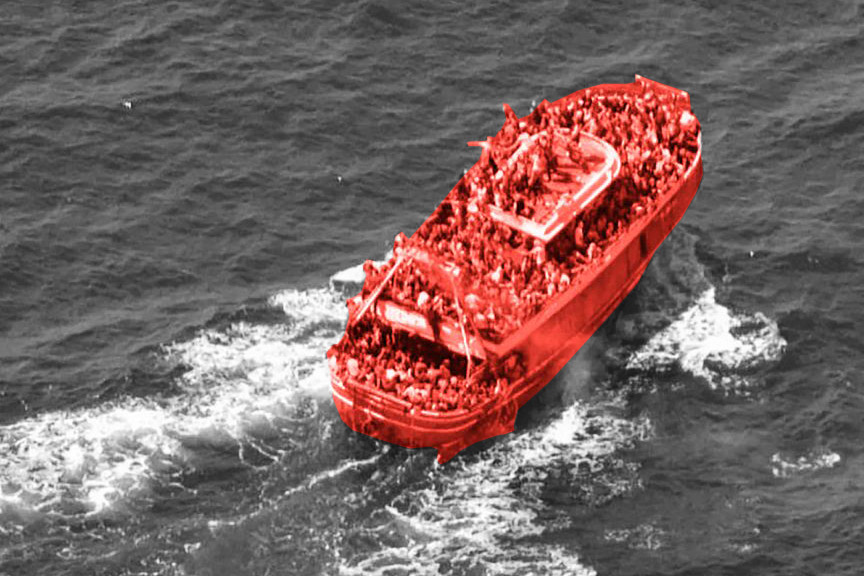
The ship has three levels: the deck, and two levels of cargo holds beneath it…each level packed to the brim with increasingly distressed human beings. And dozens of those people in your hold are young children.
What started off as a very uncomfortable situation is now rapidly becoming a full-on nightmare.
It was only supposed to be a three-day voyage, but it’s now stretched into day five. The air in your tightly packed room is getting thick and oppressive with the breaths of hundreds of people. And worse yet, the food and clean water has almost run out.
This is starting to cause panic and unrest among those around you, and even physical fights over what nourishment remains. Some people are putting dried prunes into seawater, naively hoping they’ll soak up some salt to make it drinkable. Others are paying as much as $20 to other passengers for a gulp of very questionable dirty water.
Eventually, you start hearing wails and moans from across the hold…cries not of desperation, but anguish. It hits you that some people are starting to die.
But then, the problems manage to get even worse. All of a sudden, the hum and vibration of the ship’s engine sputters out and the lights flicker off.
Your heart sinks. You realize that whatever hope remained that this nightmare might nearly be over may have just sputtered out along with that engine.
Now, people are having panic attacks in the dark cargo hold. Flickers of terror and confusion around the room are lightly illuminated by a few cell phones of fellow passengers who are desperately trying to get a signal and call for help. As bad as the journey had been up to this point, most still didn’t want to get any authorities involved. That would likely mean they wouldn’t make it to Italy. So all the time, money and hope they’d invested in this long-shot journey to a better life, would be for nothing.
But with the engine now dead and the boat apparently drifting aimlessly in the middle of the sea with no supplies left, people are starting to accept that circumstances have hopelessly changed, and it’s now a life-or-death situation.
You continue to drift in the dark for one excruciating hour after another, unaware of what’s going on above deck, and whether you’re getting any closer to salvation. The desperation is bringing out the worst in some passengers, who start to get violent with one another. This violence isn’t just dangerous for those engaged in it. The abrupt movements it causes affect the entire overcrowded ship.
Every so often, the floor beneath you tilts sharply to one side, giving a fresh injection of terror into an already terrifying situation. Well aware of the implication of these sudden tilts, many around you try scrambling to the opposite side of the ship to help balance it out, which seems to work.
But then, during a period of relative stability, all of a sudden, you feel the ship thrust forward, even though you never felt or heard the engine spark back to life.
Then, minutes later, the ship once again tilts sharply to the right, unleashing another cacophony of screams. Then, it tilts even more sharply to the left….then sharper still back to the right and it keeps going further, further, further to the point that you know without question, this time is different. There’s no going back from this tilt.
The Adriana lists uncontrollably until it completely succumbs to the sea, rapidly going down with hundreds still trapped below deck. And for those above deck, there’s not a life jacket in sight.
When The Adriana sinks to the bottom of the Mediterranean, it will take more than 500 people with it…people who had risked everything to find a better life for themselves and their children.
But this was more than just a single tragic accident caused by greedy human smugglers.
When The Adriana went down off the coast of Pylos, Greece, it was just the latest mass causality incident in a long-building human catastrophe that had sent tens of thousands of people to watery graves over the preceding decade. It laid bare the routinely deadly consequences of a refugee crisis, hardline anti-migrant policies in Europe, and possible cover-ups by authorities. And it was emblematic of indifference, and even disdain that had developed toward some of the world’s most vulnerable people…on this episode of Manmade Catastrophes.
[Theme music]
[Arab spring newsreels]
Some of the early roots of the Mediterranean migrant disaster began 13 years earlier on the streets of Tunisia — a small country at the northern tip of Africa.
On December 17th, 2010, a 23-year-old street vendor in the country named Mohamed Bouazizi set up his small cart to sell fruits and vegetables but was soon after accosted by police. They accused him of running an unlicensed stand and got pushy – something that had apparently become a routine hassle for him. While the exact events that followed are disputed, the officers allegedly spit on him, slapped him, and insulted him, then toppled over his cart and confiscated his equipment. After the altercation, he went to a local government office to complain, but officials there refused to see him. Completely dejected and at the end of his rope, he went to purchase a can of gasoline, returned to the government office, and shouted, “How do you expect me to make a living?!” Then he set himself on fire. He would die from his injuries a few weeks later.
His story quickly spread and resonated with a lot of people. In a country where many were suffering from unemployment or underemployment under a corrupt and feckless government, he became a martyr and galvanized common people to take to the streets. And in the new age of social media, news of these protests blew up and quickly sparked a full-on revolution. Less than a month after the self-immolation, Tunisia’s government collapsed and President Ben Ali fled the country, ending his 23-year authoritarian reign. But that was only the beginning.
[Arab Spring news reels]
Countries across the Middle East were experiencing dynamics similar to Tunisia’s: Legions of unemployed youth battered by the Global Financial Crisis were fed up with their corrupt, oppressive, useless dictators. Major demonstrations spread well beyond Tunisia, to Morocco, Iraq, Algeria, Lebanon, Jordan, Kuwait, Oman and Sudan, and full-on uprisings took root in Libya, Egypt, Yemen, Syria, and Bahrain.
But not all these countries’ dictators would go down without a fight. And even when they did fall, it didn’t necessarily result in a situation that was any better than before. After the initial euphoria of the Arab Spring, came what would be deemed the Arab Winter.
Political instability and outright civil war took hold in several countries. Perhaps the worst of them was the civil war in Syria, which would stretch into a 14-year catastrophe that tore the nation apart, as President Bashar al-Assad stopped at nothing to cling to power, including chemical attacks against civilians. And throughout the region, power vacuums and war also gave rise to transnational extremist groups like ISIS, which seized significant territory in the wake of the Arab Spring and became notorious for its brutality, kidnappings, systematic sexual violence, and genocidal mass killings.
For many people in the region, life had become substantially worse and more precarious than before the Arab Spring. So naturally, many of those people sought to leave however they could.
To most of the region, Europe was the closest safe haven. But getting there presented a number of obstacles — most obviously, the Mediterranean Sea.
Twenty-two countries surround the sea, and depending on the route, a journey across it usually entails at least several hundred miles over open ocean, meaning it can’t be done on just any old boat.
People have been crossing the Mediterranean for thousands of years, but it wasn’t until the 1990s that so-called ‘irregular migration’ began to substantially pick up. Irregular migration essentially means entering a country outside of its normal immigration rules, though it doesn’t necessarily mean criminality. Those who enter a country unconventionally in order to legally claim asylum would still be considered irregular migrants.
Through most of the 20th century, most migration from the Middle East and Africa was quote unquote ‘regular’. But after the fall of the Soviet Union and the Eastern bloc of Europe in the early 1990s, irregular migration began to pick up, as the gulf in living standards between European countries and those across the Mediterranean began to widen, and several conflicts in Africa broke out.
Still, sea routes and smuggling operations were nascent, and the number of those crossing each year was thought to only be in the low thousands. But by the turn of the century, that had ticked up to well over 10,000 per year. And after the September 11, 2001 attacks in the United States, concerns about terrorism caused borders to tighten in Europe as well, making legal immigration paths more onerous, which only boosted illegal immigration across the Mediterranean. Then, the Iraq War a few years later, and the Global Financial Crisis a few years after that ticked those numbers higher still, bringing the number of annual illegal crossings to anywhere from 30,000 to 60,000. During this time, human smuggling operations were maturing and becoming more normalized.
But then the Arab Spring of 2011 would absolutely turbo-charge these crossings. It didn’t happen all at once. Migrant crossings across the Mediterranean during that first year of the uprisings ticked up a bit, clocking in at anywhere between 70,000 and 100,000. But as these conflicts became more entrenched and violent over the following years, those numbers rapidly began to grow. And in tandem with this growth in desperate migrants came increasing incidents of abuse and exploitation by opportunistic smugglers. Then, there was likewise rapid growth in the number of deadly accidents.
One of the first major disasters during this period came in 2013 near the Italian island of Lampedusa. In October that year, a 66-foot fishing boat run by smugglers from Libya, Somalia and Sudan set out from Libya for Italy with more than 500 migrants, mostly from Syria and Sub-Saharan Africa.
For many of these migrants, their horrifying journey to Europe had begun well before they ever set foot on the boat. For those from Sub-Saharan Africa especially, who needed to get across the Sahara Desert, being smuggled across the Mediterranean was just the last of many legs in a long, arduous trip. And over the course of that journey, they could be handed off from one criminal group to another…who, under the most charitable interpretations, may not have been on the same page with one another about expected payment. Under a less charitable, but more likely interpretation, some of those traffickers purposely baited-and-switched the migrants under their care, and were happy to exploit the power they had to extract anything and everything they could.
Reportedly, some of the migrants that would end up on the fishing boat had first been taken to a holding camp in Libya, where their traffickers-slash-captors demanded thousands of dollars more in addition to what they had already paid—an astronomical sum for these migrants. Men who were unable to pay were reportedly tortured through beatings with batons or electric shocks to their feet. Women who were unable to pay were reportedly also tortured and raped. One survivor recounted women being passed around the captors, quote, “as if they were cups of tea.”
But finally, more than 500 of the migrants were taken to make the Mediterranean crossing, and packed into a fishing boat that was in poor condition and propelled by a rickety diesel engine. 36 hours later they were within sight of Lampedusa just half a mile off its shores. But then, while it was still the middle of the night, the engine stopped. It isn’t clear whether it died on its own or was purposely cut. Smugglers on ships like this would sometimes purposely kill the engine when close to their destination and wait for the Italian coastguard to tow them in. This would allow them to surreptitiously blend in with their passengers to avoid being identified by authorities as the smugglers.
But in this instance, they never got that chance to be towed in. While the ship was stopped, a leak began to pour into its bilge, and since the engine was cut, the bilge pump wouldn’t work. The captain apparently tried to restart the engine, but it wouldn’t spark back to life. As the leak continued to grow, he panicked and poured gasoline onto a blanket, lit it on fire and waved it around to signal to someone on shore that they were in distress. But then, the fire burned his hand and he dropped it, igniting some of the gasoline on the deck that he’d spilled. This sent nearby passengers into a panicked stampede to the opposite side of the deck, and that was all it took to capsize the severely overloaded vessel.
Those below deck didn’t stand a chance, and went down immediately with the ship. Those who’d been above deck were thrown into the water, where they would have to tread for hours before help arrived…a task many just weren’t physically equipped for. At least 366 migrants died in the accident.
What happened over the next week would give an early indication of how migrants trying to traverse the Mediterranean to seek asylum had more than just logistical hurdles to overcome. There were now growing political hurdles.
Those who survived the shipwreck were taken into Italy, but most weren’t planning to settle there as their final destination. Its economy was still reeling from the Global Financial Crisis, and many also viewed the country as under-equipped to deal with asylum seekers and generally less friendly to immigrants than other countries. But according European Union laws, refugees were required to claim asylum in the first EU country they entered. And if they were registered in one European country, then tried to claim asylum in another, the rules dictated that they should be sent back to the original country. Several survivors, who’d only planned to transit through Italy en route to countries like Norway, Sweden or Germany, were so desperate not to be registered for asylum in Italy that before they could be processed, they burned their fingers to disfigure their fingerprints—something that was fairly common at the time.
For its part, Italy’s patience was starting to wear thin with the increasing number of migrants turning up on its shores, and with its obligation to take responsibility for their asylum claims. This frustration went from the government down to ordinary citizens. France 24 later interviewed residents of Lampedusa island – some of whom expressed attitudes that were less than sympathetic toward desperate migrants turning up on the island.
[News clip]
Just eight days after the sinking off the coast of Lampedusa, another migrant ship disaster would strike very nearby, and illustrate what some would come to regard as Italian authorities’ indifference, or even antipathy toward the growing numbers of migrants.
Another overloaded fishing vessel set out from Libya toward Italy, thought to be carrying somewhere between 400 and 500 refugees, mostly from Syria. At one point early in its journey still near Libya, it was attacked with machine gun fire from another boat—its crew’s motives unclear, but possibly attempted piracy for robbing or kidnapping. The ship escaped the attackers, but not without damage that was slowly allowing water to seep inside. By the time the ship was about 61 miles off that same Italian island of Lampedusa that had seen a migrant ship tragedy the previous week, it too was in serious peril.
A Syrian doctor on board the ship called the Italian Coast Guard, telling them that the ship was sinking, and he even provided exact coordinates of where they were. But he was repeatedly rebuffed. Despite the ship being just 61 miles from Italy and 116 miles from Malta, the Italian operator insisted that they were in international waters that fell within Malta’s search and rescue zone—something that, according to the international law of the sea, shouldn’t have mattered. State parties are obligated to assist those in distress at sea if they’re able to, regardless of where it is.
Over repeated, increasingly desperate calls from the ship, Italian authorities continued to insist that the imperiled passengers should call Malta. At one point, an operator reportedly even lied, telling the ship that they were actually physically closer to Malta—an absurd claim. Worse still, there were a number of Italian ships in the area that could have assisted the distressed migrant ship…including one that could have reached it within an hour. But Italian authorities instructed that ship to stand by, rather than start making progress toward the distressed ship. Over the following five hours, Italian authorities argued with their Maltease counterparts, who implored the Italians have their ship that was closest to the scene intervene, but to no avail.
Finally, the doctor made one last frantic call to Italy, saying, “Please come, we’re dying.”
Eventually, a Maltease patrol boat arrived on the scene, only to find the migrant ship had already sank, taking 268 lives with it, 60 of whom were children…leading the disaster to be known as “The children’s shipwreck.”
Some of the survivors would later file an official complaint with the United Nations Human Rights Committee, which would eventually issue a blistering rebuke of Italy’s actions, saying that the Italian authority had a duty to save the lives of the migrants, and that if they had responded immediately to the distress calls, the rescue would have reached the imperiled vessel at least two hours before it sank.
The committee, which had no authority to issue punishments on its own, urged Italy to do an investigation and prosecute those responsible. In 2019, two officials, the head of the Italian coast guard’s operation center and the commander of the navy’s operation room, were ultimately charged in connection with the sinking with manslaughter, negligence and refusal to turn over official documents. But prosecutors later expressed that there had been no malice and there was no real case against the men. The case officially died when its statute of limitations expired in 2022.
There’s no direct evidence to suggest that any Italian officials acted – or failed to act – in assisting the sinking ship due to concerns about migration. But by this point, migration was becoming a rapidly growing concern…and the real-world incentives were stacking up for countries to delay, or outright avoid helping migrant ships in distress.
Under the existing status quo, a country that rescued migrants usually also effectively had to assume responsibility for bringing them ashore, processing their asylum applications, and then assimilating them into their country…something that could have very real short-term and longer-term economic, social and political implications. As some residents of Lampedusa had portended, these implications were becoming a growing political liability.
But these twin disasters off the coast of Lampedusa that together resulted in more than 600 migrant deaths in 2013 were just the beginning, and a prelude to a full-scale humanitarian disaster on the Mediterranean. 2015 would mark a major turning point—not just in the scale of death, but in the European backlash, and growing aversion to desperate migrants seeking refuge on the continent.
[Ad break]
The two Lampedusa disasters had earned Italian officials some very bad press both at home and internationally. And the Italian government recognized that it did indeed have a growing humanitarian crisis at its doorstep. So just a week after the second migrant ship sinking of its coast, the Italian government launched an ongoing military-humanitarian operation known as Mare Nostrum.
The operation vowed to prevent migrant deaths at sea through expanded monitoring and search-and-rescue operations in the Mediterranean, which involved an extensive network of ships, helicopters, submarines, drones, radar stations and nearly 1,000 personnel. And rather than wait for ships to break down in or near Italian waters, the operation was more proactive, and went further out into the Mediterranean, particularly near Libya, to nip potential problems in the bud early.
The operation was remarkably effective, reporting in 2014 that in less than a year, it had rescued more than 150,000 people on the Mediterranean, possibly preventing hundreds, even thousands of deaths. But in a way, the operation’s success would help spell its demise.
Many Italians were beginning to wonder why they were being left to foot the bill for this very expensive operation, when it was helping to solve not just an Italian problem, but a wider European problem.
But perhaps the biggest issue was that the operation was taking more of a humanitarian approach, rather than border control, meaning most of those rescued under the program ended up being taken into Italy – either as a gateway to elsewhere in Europe or as permanent settlers in Italy. And this was helping to fuel a growing anti-immigration backlash.
Critics of Mare Nostrum claimed that by offering rescue and safe passage to these migrants, they were in fact reducing the risk of irregular migration across the sea and therefore incentivizing it. Some political leaders likened it to a taxi service for illegal immigrants. Up and coming far-right Italian politician Matteo Salvini said Italians were spending €300,000 a day to help smugglers and encourage the quote, “invasion.”
It was an increasingly salient political issue that was whipping up growing crowds – one that in the years ahead, far-right leaders across Europe like Salvini would ride to greater influence and power.
[Salvini clip]
There’s little evidence that Mare Norstrum was encouraging migration into Europe at any meaningful scale that otherwise wouldn’t have been attempted. Interviews with smugglers during this period tended to suggest that migrant passengers usually had little knowledge of what rescue initiatives were ongoing at any given time. They were just desperate to flee their home countries, and whatever they were running away from felt like a greater danger than whatever the Mediterranean presented, rescue operations or not.
Migration into Europe did continue to rapidly grow in 2014 though as the Arab Winter deepened and conflicts around the Middle East and Africa intensified. Anywhere from 200,000 to a quarter million migrants made the journey across the Mediterranean that year. By October of 2014, Operation Mare Nostrum was no longer tenable for Italy, and it ended just a year into its existence.
It was replaced by a wider European initiative, called Operation Triton. Though it was still mostly conducted by Italy, it was funded by the EU and overseen by Frontex, the EU’s border security agency. It was significantly scaled back from Mare Nostrum, with a budget only one-third as large, and far fewer assets and personnel involved. It also shifted from a humanitarian rescue focus to prioritizing border enforcement. Mare Nostrum had sent ships far out into the Mediterranean in order to rescue ships before they became desperate, but Triton pulled ships back much closer to European shores. And as this was happening, border security in Europe more generally hardened.
From a humanitarian standpoint, these developments couldn’t have come at a worse time. In 2015, the Arab Winter went from very bad, to even worse. It was becoming apparent that the conflicts in Iraq, Afghanistan, Libya, Sudan, and especially Syria would not be resolved any time soon – most were in fact intensifying – causing more and more people to abandon any hope of a stable future in those places. Deepening repression, forced conscription and economic malaise in Eritrea and Nigeria were likewise sending people in those countries fleeing. And refugee camps within the Middle East were deteriorating amid overcrowding and underfunding. So 2015 would become a banner year in the refugee crisis.
Over the course of that year, an estimated 1.3 million people would claim asylum in Europe…the most in any single year since World War II. And over a million refugees would attempt to cross the Mediterranean—more than quadruple the number of just the previous year.
An unprecedented number of crossings, significantly scaled back search and rescue operations, and a political atmosphere that was rapidly turning against migrants—it was a recipe for a humanitarian disaster, and it would be.
The first major disaster of the year came that April, when a boat carrying around 550 migrants set out from Libya to Italy and capsized 60 miles off the Libyan coast just a day into its journey. Around 400 migrants are thought to have died in the incident.
Then, just five days later, yet another catastrophic accident occurred…one that would exceed all previous migrant shipwrecks on the Mediterranean in the scale of its deadliness.
[News clips]
More than 800 people died in just this single accident, giving it the distinction of the deadliest-ever migrant shipwreck on the Mediterranean.
The ship, just like the accident that preceded it five days earlier, was en route from Libya to Italy with migrants who’d paid between $1,500 and $2,000 for the passage. The captain, who was brandishing a gun, apparently seemed to have little clue what he was doing, and reportedly even had to ask his passengers how to read a compass.
The captain placed a distress call to the Italian Coast Guard when about 85 miles off the coast of Libya, who in turn alerted a large Portuguese container ship that was in the area. To its credit, that ship did immediately change course to assist the ship. It isn’t clear exactly what happened next or who hit who, but in the darkness of night with almost no visibility, the ships collided. Being much smaller than the Portuguese ship and severely overloaded, the migrant ship toppled over and within minutes sank 1,200 feet to the bottom of the ocean.
More than a year later, the small 90-foot wooden fishing trawler would be recovered and taken to shore. What investigators found was horrifying.
The main body of the ship was still mostly intact, and seeing it immediately prompts the question of how on earth more than 800 people could have fit on it. It looks as if even 50 people would be a stretch. But when investigators got into the hull of the ship, they got the very distressing answer. Passengers had been stuffed into the hold and a machine room like sardines as densely as five people per square meter and locked in. It was somewhat miraculous they were even able to breathe well enough to survive the short time at sea before the accident. But once the boat tipped, they didn’t stand a chance. More than a third of the some 800 victims were between 12 and 17 years old…yet another children’s shipwreck.
Similar to how the twin disasters near Lampedusa in 2013 had sparked outrage and calls for action, these two disasters within a week of one another off the coast of Libya in April of 2015 sparked an outcry and some soul-searching within Europe.
Soon after the disaster, EU leaders had an emergency meeting on how to deal with the migrant crisis, and a more formal summit months later. It wouldn’t become clear until later, but these discussions on an immediate humanitarian disaster were in fact laying the groundwork for a monumental shift in the European political landscape.
Two imperatives would start to emerge from these and later talks: save lives, but also reduce the flow of migrants into Europe. But these two goals would increasingly come into greater conflict with one another.
One of the most contentious issues to emerge during these talks was, if Europe was to take a more humanitarian approach and rescue and accommodate more refugees, where would they go?
Liberal and moderate European leaders advocated for greater assimilation of these migrants. German Chancellor Angela Merkel advocated opening Germany’s doors to more than a million migrants in her famous ‘we can do this’ speech in August of 2015.
Merkel: “Quite simply, I say that Germany is a strong country—and the spirit with which we approach these matters must be this: We have achieved so much; we can do this — we will do this. And wherever obstacles stand in our way, they must be overcome; work must be done to resolve them. The Federal Government will do everything in its power to ensure precisely this is achieved.”
On September 2, the migrant crisis got perhaps its most visceral illustration to date, when a two-year-old Syrian boy named Alan Kurdi died at sea along with his mother and brother when their small, overcrowded inflatable boat run by smugglers capsized. Kurdi washed up on shore in Turkey, where his tiny, frail, face-down body was photographed and made headlines around the world. For the moment at least, the tension between immigration control and humanitarianism seemed to swing in favor of the latter in public opinion.
European Union representatives met a few days later, and top of the agenda was a proposal to spread the burden of hosting asylum seekers. Rather than leaving it to common first-point-of-entry countries like Greece and Italy to handle, as had been the previous policy, the proposal was to relocate many of the asylum seekers more equitably across the EU bloc.
[News reel]
In the end, a majority of EU states voted in favor of a measure to distribute 120,000 refugees throughout the EU. But there was a minority that strongly resisted. The policy came with mandatory quotas of migrants for each country to accept, which did not go down well with Eastern European countries without a tradition of accepting large number of immigrants, like Hungary, the Czech Republic, Slovakia and Romania. And even within Western European countries that had traditionally been more amenable to immigrants, even the very modest increases in the number of refugees they would have to accept would arouse nativist backlashes, and become a right-wing rallying point.
Over the next few months, several events would throw fresh fuel on the fire of this backlash. That November, a terrorist attack in Paris by ISIS Islamic extremists using guns and explosives killed 130 people.
[Newsreel]
Although most of the attackers were later found to have been EU citizens, two had reportedly traveled through Europe and come to France by posing as Syrian refugees…something that ignited new opposition to open migration policies.
Then the following month, New Years Eve celebrations in Germany turned sinister, with hundreds of reports of muggings and sexual assaults.
[Newsreels]
Events like this became far-right talking points across Europe, and even well beyond the continent. Then-US presidential candidate Donald Trump seized on events in Germany to attack his opponent Hillary Clinton.
[Trump clip]
Despite claims like this, statistics from the German Interior Ministry showed that the overall crime rate in Germany remained essentially unchanged during the height of the migrant influx. In fact, numerous independent studies, in Europe and the United States, have concluded that in the aggregate, higher immigration does not result in a higher crime rate…or for that matter, a higher unemployment rate for citizens.
On the crime side, immigrants in fact usually commit crime at lower rates than citizens. With a precarious legal status, they have more incentive to avoid illegal activity that could imperil their status. And on the employment side, especially in regions with aging populations like Europe and North America, immigrants – both legal and undocumented – have consistently been found to improve economic growth and increase the number of jobs for natives by filling gaps in the labor market, paying taxes and contributing spending.
But as would be seen in immigration debates around the world in years to come, sensational anecdotes tend to be far more emotionally salient than cold hard overarching statistics.
Back on the Mediterranean, in addition to the policy to relocate refugees, EU measures agreed to in 2015 also included increasing funding for maritime operations, greater border control and cracking down on smugglers. But if the goal was to save lives, it didn’t seem to work very well.
One after another, shipwrecks involving dozens, sometimes hundreds, of migrant deaths piled up over the course of 2015 – many of these incidents so overlooked that they still don’t even have Wikipedia pages, or anything more than brief, passing news reports from the time. It’s thought that in 2015, at least 4,000 migrants died while trying to cross the Mediterranean. But unfortunately, that death toll would be exceeded just the following year.
While 2015 marked the height of the European migrant crisis in terms of the number of refugees fleeing to the continent, 2016 would actually be deadlier.
One reason had to do with the routes people were taking. In Hungary, the far-right Prime Minister Viktor Orban took a hard line on immigration.
[Orban clip]
Orban’s government began erecting fortified fences on the country’s borders and beefing up border security, which greatly impeded a major land route migrants were taking.
Sea routes were also getting more difficult. For those crossing the Mediterranean from Africa and the Middle East, there were three main routes to Europe. The two shortest and safest routes were Morrocco or Algeria to Spain, and Turkey to Bulgaria or Greece. But amid the refugee crisis, security measures and physical barriers on both these routes were beefed up. In particular, a deal between Turkey and the EU in 2016 increased measures to curtail irregular migration from Turkey to Greece, including the ability to return anyone who arrived to Greek Islands irregularly back to Turkey.
The clampdowns on the safest sea routes were sending more and more migrants on the longest and most perilous route: Libya or Tunisia to Italy or Greece. Additionally, smugglers were starting to more routinely use highly questionable boats to make the crossing, including very tenuous inflatable rafts.
So even though fewer migrants made the journey across the Mediterranean in 2016, more of them would die—to the tune of an estimated 5,100 that year, more than a 25 percent jump over the already disastrous 2015.
And as 2016 progressed, anti-immigrant sentiment would too. As many politicians had found before them, and many many more would continue to find after them, taking a hard line on immigrants who can’t vote tends to be an effective political strategy. In Europe, and beyond, far-right elements were becoming more mainstream.
In Germany, the far-right AfD party rose from obscurity on ethnonationalist messages of preserving German identity and halting immigration to the country entirely. It went from a new party, being founded just three years earlier, to a major political force and a top opposition party.
In France, far-right politician Marine Le Pen similarly rode anti-immigrant sentiment to greater influence and bid for the presidency, vowing to end all immigration to the country.
Le Pen: “What would happen under Merkel’s pressure. One of her proteges, Macron or Fillon, continue to accept several millions of migrants. Your neighborhood, your village, your children’s school, your life, your wages will be inevitably impacted by immigration. I, as president will put our borders back in place my first day in office.”
In Holland, Geert Wilders and his right-wing populist Party for Freedom also climbed the polls on an anti-immigration, anti-Islam platform.
Wilders: “It’s a disgrace that you are not warning against this. We’ve had enough of this political correctness. We’ve had enough of the Islamization of our society.”
But perhaps the biggest European political upheaval of 2016 wouldn’t even be in country heavily impacted by the migrant crisis.
That year, the UK would hold a referendum on whether to leave the European Union. Though the vote on Brexit, as it would come to be known, had been long building over a multitude of issues, the European migrant crisis added significant fire to debate.
The UK was not one of the major destinations for refugees during this time, but for the purposes of populist political rallying, that didn’t necessarily matter. The migrant crisis helped underpin to Leave supporters that the EU was becoming borderless, chaotic and unable to control migration, and that the UK was subject to EU decisions on accommodating refugees that they didn’t necessarily like, and thus, it was losing its sovereignty.
Right-wing immigration hardliner and major Brexit booster Nigel Farage famously unveiled an anti-migrant poster depicting a line of thousands of mostly non-white refugees under the heading “Breaking Point. We must break free of the EU and take back control of our borders.”
[Farage clip]
Though messaging like this incurred heavy criticism, at the end of the day, it worked.
[Brexit newsreel]
Then, five months later, another shock to the political establishment.
[Trump newsreel]
Taken as a whole, the events of 2016 sent a clear message: The far right was on the ascent globally, and politicians who showed sympathy or accommodation to immigrants, did so at their own risk.
[Ad break]
In 2017, inclinations in Europe to rescue migrants on the Mediterranean and absorb them into the continent continued to dampen, and efforts tilted more toward preventing them from ever reaching European shores. A big part of this involved quote ‘externalizing’ migration control. In other words, getting authorities in the countries migrants originated from to help in preventing them from going to Europe.
One of the major developments in this tactic was when Italy made a deal with Libya in 2017, backed by the EU, to help prevent migrants from making it across the Mediterranean. The deal involved Italy giving money, training and resources, like ships, to the Libyan Coast Guard, which in exchange was expected to step up efforts to intercept migrant ships before they left Libyan waters. They would then bring the migrants back to Libyan shores before they could ever come within sight of Italian ships, which would be obligated to rescue the migrants and bring them into Italy for asylum processing.
But with a fractured, unstable political apparatus in Libya, much of this work ended up being outsourced to Libyan militias—who were frequently accused of working both sides of the human smuggling trade; running their own trafficking and smuggling operations and getting paid by the migrants they escorted, while also getting paid by the government to intercept the smuggling operations of their rivals. These militias were also frequently accused of violence, abuse and extortion.
In a 2017 Vice News documentary, a reporter interviewed a Moroccan migrant who’d been brought back to shore by a Libyan militia.
[News clip]
After being taken back into Libya, migrants like this were usually put in detention facilities, which similarly had a reputation for inhumane conditions, abuse, sexual assault, and even torture. If they survived their detention in these centers, they might be sent back to their home country, or they might be trafficked to criminal groups. Human rights organizations accused Italy and the EU of turning a blind eye to the situation amid a growing determination to keep migrants out at all costs.
This determination not only involved significantly scaled down rescue operations on the Mediterranean; it also even began to involve preventing private non-governmental organizations from trying to fill the gaps and conduct their own rescue missions.
Before 2013, European governments discouraged private vessels from taking it upon themselves to rescue people on the Mediterranean, but no one really stopped them. But amid the migrant crisis though, and the rising power of far-right leaders on the continent, this rapidly began to change.
In 2015 amid the record inflow of migrants, the European Border and Coast Guard Agency, better known as Frontex, was expanded, and EU countries began going after NGOs that ran rescue missions at sea. And after the Italy-Libya deal in 2017, NGO ships began to have tense, sometimes violent confrontations with the Libyan Coast Guard.
One of these confrontations was documented in a 2018 New York Times documentary from aboard a German humanitarian NGO’s ship. The ship responded to a call reporting a small inflatable raft full of migrants that had disembarked from Libya that was in distress. The German humanitarian ship arrived to find a much smaller and less equipped Libyan Coast Guard ship, with crew that was half-heartedly attempting to rescue migrants, many of whom were in the water.
Footage shows the Libyan Coast Guard operating ineptly and even callously, failing to deploy its smaller more nimble inflatable raft to aid in their rescue, accidentally sucking people under their ship, and threatening the more capable German crew.
[News clip]
These NGOs also faced resistance from EU country authorities, who were gradually taking more steps to thwart them — physically, legally and in the court of public opinion. In 2017, One Italian prosecutor in Sicily named Carmelo Zuccaro began publicly making vague and dubious accusations against NGO rescue missions.
[News clip]
Zuccaro never actually brought criminal cases for these supposed crimes, or substantiated his claims. But his narrative was one that many who wanted to stop immigration into Italy happily latched on to. Over a relatively short period, NGO rescuers went from being heroes, to being criminals and conspirators offering quote “sea taxis” to illegal immigrants.
The pressure stepped up the following year, when Matteo Salvini – the hardline anti-immigration Italian politician – became Italy’s Interior Minister and Deputy Prime Minister. He famously began turning NGO ships returning with rescued migrants away from Italian ports, leaving them stuck at sea for days with limited supplies.
Salvini also dubiously claimed these NGOs were working with smugglers, and at one point even claimed to have seen evidence that some of these NGOs were also helping to traffic weapons and drugs. This supposed evidence never materialized publicly.
Over the following years, Italian authorities continued to ramp up the pressure on NGOs, impounding ships and prosecuting crews for facilitating illegal immigration and smuggling. Greece, Spain and Malta likewise launched dozens of criminal cases against NGOs. For its part, Frontex also criticized NGOs, claiming their rescue missions were acting as a pull factor, encouraging more migrants to attempt the dangerous journey across them Mediterranean…in fact leading to more deaths.
This idea was widely repeated at the time, but a study by the European University Institute of migration patterns from 2014 to 2019 later found quote “no relationship between the presence of NGOs at sea and the number of migrants leaving Libyan shores.” Factors like the weather and political events in Libya were what really drove rises or falls in the number of migrants attempting the journey.
But the crackdown on NGOs missions, along with dramatically scaled down state rescue missions during this time, did have an unmistakable effect on the number of people who completed their journey alive once they started it…and those who didn’t.
Though the annual number of Mediterranean crossing attempts and overall number of deaths declined after 2016, the death rate continued to grow. By 2019, it was estimated that about one out of 21 migrants who attempted to cross the Mediterranean died during their passage—more than double the rate of 2016.
Probably not coincidentally, there had been 10 NGO boats actively rescuing migrants in the Mediterranean in 2016. But by 2019, years into the crackdowns, there were only 2. Ten ships in 2016 may not sound like a lot, but these crews were highly capable and highly motivated. Some of these missions reported individually having rescued people at sea numbering well into the tens of thousands. So 10 of these missions being reduced to 2 left a big hole in rescue capabilities on the Mediterranean.
The period from 2014 – the year Operation Mare Nostrum ended – and 2020 would be a particularly devastating one on the Mediterranean. Of the some 38,000 migrant deaths and disappearances recorded globally by the International Organization for Migration, more than half, about 19,400, were lost on the Mediterranean. Though, since this number only includes known incidents and missing persons, the true number is almost certainly higher.
But intolerance toward these migrants would only continue to dial up. This was particularly true in Greece, along with Italy, one of the top entry points to the EU on the Mediterranean.
Like the rest of Europe, anti-immigrant sentiment had been gradually growing, especially since the migrant crisis peaked in 2015. But this was kicked into overdrive in 2020, when a crisis on the Greek-Turkish border unfolded involving tens of thousands of migrants.
In 2016, Turkey had signed a deal with the EU to try to curb the flow of irregular migrants from Turkey into Europe, particularly Greece, in exchange for billions of dollars to help handle the influx and a promise to accept a certain proportion of Syrian refugees into the EU. But by 2020, Turkey was hosting some 4 million refugees, and the country claimed the EU wasn’t doing enough to absorb its share of the burden.
On February 28, 2020, Turkish President Erdogan announced he was unilaterally opening his country’s borders and would no longer stop migrants from crossing into the EU, most notably Greece. Within hours, tens of thousands of migrants showed up at the border trying to enter Greece, some of them reportedly even bussed there by Turkish police and military. But Greek forces on the heavily fortified border were not eager to let them in, and things quickly got violent.
[News clip]
At least several people were reported to have been killed in these clashes. But the chaos wasn’t just at land borders. There was also a huge spike in confrontations at sea between migrants and Greek authorities.
[News clip]
The Greek-Turkish border crisis would highlight, and appear over the following years, to increase what are known as pushbacks of migrants by Greek authorities.
Pushbacks are when refugees trying to enter a country are forcibly turned around without being given the chance to apply for asylum or any individual assessment of their protection needs. They can happen on land or at sea, and they’re illegal according to EU and international law under the principle of non-refoulment—in other words, returning refugees to a place where they would likely face persecution, physical threats or other human rights abuses. Authorities who encounter these migrants are obligated to direct them to the proper asylum-seeking channels inside the country.
But Greek authorities have been accused of thousands of these illegal pushbacks over the years. Some alleged survivors of pushbacks have even reported seeing or experiencing horrific abuses, including robbery, beatings, torture and even murder.
In May of 2023, a reporter from the Turkish broadcaster TRT World interviewed a migrant who’d been brought back into Turkey by Turkish authorities after a failed attempt to reach Greece by boat.
[News clip]
Also in in May of 2023, the New York Times published video from the Greek Island of Lesbos showing men appearing to wear Greek Coast Guard uniforms escorting 12 migrants, including young children and a 6-month-old infant, from an unmarked van. They then put them on a Greek Coast Guard boat, drove them out to sea, and abandoned them on a small inflatable emergency raft without so much as a motor.
The raft was later rescued by Turkish authorities, and the New York Times tracked down the migrants, who verified exactly what the damning video had appeared to show. The migrants had fled Somalia and taken a dinghy from Turkey into Greece but were soon apprehended on land by Greek authorities…who then coldly, and illegally, dropped them back out at sea. “We didn’t expect to survive on that day,” one of the Somalian migrants told the Times. “When they were putting us on the inflatable raft, they did so without any mercy.”
The following year, a BBC investigation reported even more harrowing accounts from asylum seekers…some of which would amount to straight up murder if true. The investigation reported on 15 alleged incidents between 2020 and 2023, which together resulted in 43 reported deaths. Some of the incidents were similar to what was shown in the New York Times video, with migrants saying they were put on motorless rafts, some that were even deflated or punctured, and abandoned at sea.
But in five of the reported incidents, some of which were corroborated by multiple witnesses, migrants were reportedly thrown directly into the water by Greek authorities. One man from Cameroon reported that he and two others were beaten and thrown overboard from a Greek Coast Guard ship without life jackets, leading his two companions to drown. In a separate incident, a Somalian migrant said after being caught on land in Greece, he and several others were also driven back out to sea, had their hands zip-tied behind their backs and were tossed in the water to die…and most of them did. The survivor only lived to tell his story by managing to float on his back long enough to break free of his ties and swim within sight of the Turkish Coast Guard.
During the BBC investigation, reporters interviewed Dimitris Baltakos, the former head of special operations with the Greek coastguard, and showed him the New York Times video, which Baltakos downplayed.
[Baltakos clip]
But during a break in the interview, Baltakos was caught on a hot mic speaking to someone on his phone in Greek.
Baltakos: “I haven’t told them too much. What do you think? Yes, it’s crystal clear, but what should I tell them? When you look from the outside, it’s very clear isn’t it? It’s not nuclear physics. I don’t know why they did it in broad daylight. It’s clearly illegal. Obviously, obviously illegal. It’s an international crime.”
While most reports of pushbacks can’t be proven, the clear documented video evidence of some of them, along with numerous corroborating reports from survivors, indicated they were without a doubt happening. And investigations by journalists, human rights groups and even official EU bodies uncovered evidence that officials in the EU border and coast guard agency, Frontex, were complicit in these pushbacks, and helped to cover them up.
A 2022 report by the EU’s Anti-Fraud Office, which was initially classified but later leaked, found that top managers at Frontex committed “serious misconduct and other irregularities” in failing to investigate, or covering up pushback incidents. It said Frontex officials had privately expressed concerns about quote “repercussions” from Greek authorities if they reported pushback violations. Frontex had also shared incorrect information with higher EU officials, diverted airplanes so they wouldn’t witness pushbacks, and ignored or mishandled reports that they were happening.
By 2023, it had become obvious that authorities in Greece and Frontex were frequently unsympathetic to the plight migrants on the Mediterranean – they had in fact in some instances directly endangered migrants themselves…and been less than forthcoming after the fact about what had transpired.
In June of that year, it would come to a head when a rickety, overcrowded ship called The Adriana turned up near the coast of Greece with more than 700 migrants in desperate need of help.
[Ad break]
In June of 2023, the refugee crisis emanating from the Middle East and Africa was still very much ongoing, but now a severe financial crisis in Pakistan was also sending large numbers of migrants from that country into Europe. So when human smuggling ships set out from Libya, they were increasingly taking Pakistani passengers with them.
Such was the case when The Adriana set out from Libya on June 9 with Italy as its planned destination. As many as 750 people were packed into the rusty fishing trawler, each paying as much as $4,500 for their spot. About 350 of these people were from Pakistan.
Some passengers would later say smugglers had lied to them about how many people would be on the boat—a number smugglers assured them would be within the ship’s designed capacity. But when the passengers arrived, twice that capacity were crammed in. Having already paid their fee without any hope of a refund though, most continued on.
There were two levels of cargo holds on the ship, plus the deck above board, and passengers were distributed in a sort of hierarchy—mostly Arabic-speaking Syrian, Palestinian and Egyptian men on the top deck, women and children in the top cargo hold, and Pakistanis in the bottom, most dangerous hold. Though, passengers could pay an extra fee to be on the top deck, which in addition to being the safest in the event of an accident, was also the most breathable and comfortable…or probably more accurately, least uncomfortable. It was still very tightly packed. And regardless of which level you were on, nobody had life jackets.
The problems started early on. By the second day, the engine began to periodically break down, slowing the ship’s progress on what was supposed to be a three-day trip. By the third day, supplies were running low, and unrest was spreading. At one point, Pakistanis from the bottom reportedly tried pushing their way up to the upper deck, but Egyptians working with the captain roughed them up and beat them with belts. And survivors later reported by that by that point, the captain appeared to be lost.
By day four, things were becoming desperate, especially in the lower holds, where air was thin and food and water were running out. This is when the dying began, at least six people by this point, including a child. But the captain still appeared intent on sputtering ahead toward Italy. It’s likely that he wouldn’t have been paid unless he made it. And many passengers also did not want to abort what could be their only shot at making it to Europe.
But by day 5, June 13, hopes were seriously dimming that the ship could make it to Italy on its own, and the outside world got the first indication of trouble on the ship. That morning, an Italian activist who had been in contact with passengers posted on Twitter that a ship was in distress and shared its location.
Shortly after, the Italian search and rescue operations center in Rome was informed of the ship in distress with a large number of migrants, and at 1pm, a Frontex plane flew overhead and confirmed the reports. It reported the ship’s coordinates to Greek and Italian authorities—a location that was in international waters within Greece’s search-and-rescue zone.
After 3pm, the Italian activist tweeted again, saying more passengers had fainted. And soon after, a Greek coastguard helicopter flew over and took pictures, which would later show that the ship was obviously dangerously overcrowded, and people were waving their hands from the deck, presumably beckoning for help.
The appearance of the helicopter gave some passengers hope that a rescue by the Greek coastguard was imminent. But it wasn’t. Greek authorities would later claim that The Adriana was on a steady course toward Italy, and that it didn’t want assistance—a claim it would use as justification for not immediately sending rescue that it would have been obligated to send if the ship was in distress; rescue that would likely have meant bringing the migrants all into Greece.
Instead of sending coastguard ships, Greek authorities contacted nearby commercial ships asking them to approach The Adriana to provide food and water.
But survivors would later report that by this time, they were lost and meandering through the sea slowly and aimlessly—reports that were later backed up by satellite imagery and tracking data from nearby ships. Those showed that The Adriana barely moved during this time, and in fact it had already gotten the closest it ever would to Italy by the time Greece summoned commercial ships to provide supplies, then it drifted back further away.
Later that evening, two separate private tankers would approach The Adriana hours apart. An encounter with the first would give the first indication that Greek authorities wanted to avoid the migrant ship from coming into Greece.
As the first private ship, called the Lucky Sailor, approached, an operator at a Greek rescue coordination center talked to the captain of The Adriana by phone, as confirmed by later leaked recordings. The operator instructed the captain that when the Lucky Sailor arrived, to be sure to tell it that those onboard The Adriana did not want to go to Greece.
When the Lucky Sailor made it to The Adriana to transfer supplies, it indeed reported that some passengers screamed that they wanted to keep going toward Italy—people that some witnesses later said included the captain and some of the Egyptian men he’d enlisted to be his muscle against unrest on the ship.
However, other passengers below deck were separately making distress calls, including to Alarm Phone, a nonprofit group that takes migrant distress calls and channels their messages to the relevant authorities. This group repeatedly told Greek authorities and Frontex that people on The Adriana were desperate and needed immediate rescue. So it seems likely that different people on the ship were sending conflicting messages as to whether they needed help.
But Greek authorities were apparently happy to take no for an answer from those above deck. Later, another operator from the Greek rescue coordination center spoke with the captain of the Lucky Sailor, and asked him to be sure to write down in his logbook that the passengers did not want to stay in Greece—that they wanted nothing from Greece and they wanted to go to Italy.
Hours later, a second merchant ship, called the Faithful Warrior approached The Adriana, but its arrival apparently prompted some passengers—far from content to stay on The Adriana toward Italy—to scramble to that side of the ship and try desperately to jump over to the Faithful Warrior. This sent The Adriana tilting erratically, prompting the Faithful Warrior to pull back and report to Greek authorities that it was rocking dangerously.
Later on, sometime before midnight, though the exact time is disputed, Greek coastguard ship number 920 finally arrived at the scene—nearly half a day after the first signs of distress had been reported. This was despite having had ample sea vessels in the area that could have reached The Adriana much earlier.
From this time on, accounts from migrant passengers and evidence from tracking data would begin to seriously diverge from what Greek authorities claimed.
Many of The Adriana’s passengers were reportedly unnerved when the Greek ship came close, as the men standing on deck were wearing masks. Reports of the Greek coastguard’s alleged mistreatment and abandonment of migrants had been well-publicized, and it was something many migrants knew to be on guard for.
The 920 would stay near The Adriana for some three hours but kept a distance without attempting a rescue—something it would later be criticized for. But this indeed could have been strategic, given how the proximity of the Faithful Warrior earlier had apparently caused a passenger rush that destabilized The Adriana.
From here though, accounts of what happened begin to seriously diverge.
Greek authorities contended that The Adriana had steadily and safely been progressing toward Italy. Tracking data would in fact show it had barely moved over the previous seven hours, and had actually drifted further away from Italy. And photos would later show The Adriana sitting still with no water rippling around it, showing it wasn’t moving forward.
But after the 920 arrived, with what little power The Adriana had left, it did start moving westward in the direction of Italy. Greek authorities would claim that The Adriana did this of its own initiative, refusing the 920’s assistance. But survivors would say the 920 in fact instructed The Adriana to follow it towards Italy.
Then at 1:40am, The Adriana’s engine died for what would be the last time. What happened next would become the biggest discrepancy between Greek authorities’ version of events, and those of migrant survivors. According to survivors, a rope was tied to The Adriana and the 920 began to tow it. This was corroborated by passengers below deck who felt the ship suddenly jolt forward quote, “like a rocket”, despite The Adriana’s engine never coming back to life. One survivor would later speculate that the Greeks wanted to push them out of Greek waters, so their responsibility would end.
Greek authorities later denied that the 920 ever tied a rope to The Adriana, but after later survivor testimonies and media reports contradicted that claim, the Greek coastguard acknowledged that it had briefly done so hours earlier, but only to assess conditions on the ship before untying the rope.
But at around 2am, The Adriana took a sharp tilt to the right, a sharper turn left, then finally completely listed back to the right, capsizing the ship. Survivors from The Adriana would later say in no uncertain terms that the capsizing was caused by the towing attempt. The Greek coastguard would claim that they were in fact a safe distance away, and the capsizing had been caused by a commotion on the ship.
Regardless of the cause, the ship tipped over quickly, throwing those fortunate enough to be above deck against each other and into the water. Some clung to whatever they could to stay afloat, including one another in a struggle to survive. One person would later recount actually swimming away from the Greek ship, fearing its crew would try to drown him, as he’d heard they had done in the past. Others said the 920 was apparently in no rush to rescue them after the sinking, and that they spent two hours in the water before it did so—something else the Greek coastguard denies.
For those below deck though, primarily the women, children and Pakistanis, there was little chance of escape. Eventually, 104 survivors would be pulled from the water. There were no women and children among them. And of the some 350 Pakistanis who’d been on board, only 12 survived. Altogether it’s estimated that well over 500, and maybe more than 600, died, including the captain.
When the survivors were brought to shore in Greece, the alleged cover-up began. Two survivors told The BBC that when they got to land, coastguard officials told survivors to shut up when they began discussing how the towing attempt had caused the sinking. Other survivors reported that they’d recorded video from their cellphones moments before the sinking, but their phones were confiscated by Greek authorities.
Cameras on the Greek ship should have shed light on exactly what happened, but the coastguard claims they weren’t turned on because the crew was focused on the rescue—a claim undermined by a source who told The Guardian that the cameras shouldn’t need to be manually turned on…and that they’re designed to constantly be recording.
Furthermore, there were also allegations that Greek coastguard officials may have tampered with witness testimony. Survivors gave two rounds of interviews—first to coastguard officials, and later to a civil prosecutor. Coastguard records show several survivors, despite being from different countries and speaking through different translators, describing the sinking in identical wording, supposedly saying quote, “We were too many people on the boat, which was old and rusty…this is why it capsized and sank in the end.”
According to coastguard transcripts of interviews with eight survivors, none blamed coastguard actions or mentioned a towing attempt.
But a few later, six of those same survivors told the civil prosector that the towing attempt by the Greek coastguard was the cause. One man emphatically said that if you find the ship at the bottom of the ocean, you’ll still find the rope tied to it. Investigating that wreckage probably won’t happen any time soon though, if ever. The Adriana went down in one of the deepest parts of the Mediterranean, and it may be more than three miles below the surface—deeper than The Titanic.
A joint investigation by several media outlets and non-profit organizations, including Der Spiegal, Lighthouse Reports, and Reporters United, later tracked down 17 survivors, 16 of whom corroborated that The Adriana had indeed capsized as the Greek ship was trying to tow it. Four said the Greeks were specifically trying to get them into Italian waters, and another four said the Greek ship in fact further caused unnecessary deaths by circling The Adriana after it capsized, making waves that caused it to sink faster.
Some of these survivors also said that Greek authorities had indeed omitted parts of their testimony and altered others that had implicated the Greek coastguard. One said he realized this as his testimony was being taken, but still signed off on the false statements because he was too terrified not to.
Shortly after the sinking, nine Egyptian survivors of the wreck were arrested by Greek authorities and charged with manslaughter and people-smuggling. But their actual culpability also quickly came into question. Some survivors said some of the men had indeed mistreated passengers on board, but others said they had actually been helpful and that they were being framed.
The two survivors interviewed by the BBC said Greek authorities had also pressured them and the other survivors to implicate the nine Egyptian men.
Shortly after the wreck, a Farsi-speaking UK citizen named Farzin Khavand, who’d previously worked as a translator for the Greek coastguard, came forward to claim Greek authorities had a history of implicating innocent people. Khavand said he had interpreted during earlier shipwreck incidents, and later found that survivor testimony he had translated had been altered, and innocent survivors falsely implicated and charged. “They were not trying to get to the bottom of the truth,” he told BBC. “They were trying to pick a couple of guys and accuse them of being people smugglers.”
Ultimately, nearly a year after the sinking, the case against the nine Egyptian men was dropped. The Greek court said that since the incident happened in international waters, Greece lacked jurisdiction to try the case. One of the Egyptian men’s defense attorneys said this was a quote “politically convenient” decision—one that side-stepped the need for a full investigation, discovery of evidence, scrutiny of the Greek coastguard, and a parade of witness testimonies undermining Greek authorities’ claims.
Two years after the tragedy though, charges were ultimately brought against nearly two dozen Greek coastguard personnel. The captain of ship 920 was charged with dangerous interference of maritime transport and failure to provide assistance to The Adriana, while some lower-ranking crew members were charged with being complicit. Furthermore, the then-head of the Greek coastguard and three other senior officers were charged with negligent manslaughter. As of this recording, those cases are still unresolved, and coastguard officials have repeatedly denied any wrongdoing.
While survivors and families of those who died were left with many questions, they were actually relatively lucky. Countless smaller incidents on the Mediterranean go completely under the public’s radar without survivors and families of missing migrants getting any answers or shot at justice in cases of wrongdoing. The sheer number of people who died on The Adriana prompted unusual media scrutiny and in-depth documentation of Greek authorities’ missteps—even if it’s still unclear whether they were a result of incompetence, callousness or some combination.
These media reports vividly described the horrors of this incident where hundreds of vulnerable people perished, and how government authorities had tried to cover up the truth amid a long-running campaign to keep migrants from reaching their shores at all costs.
Within a week, headlines of a deadly maritime disaster caused by carelessness that had sent a vessel to the bottom of the ocean were splashed all over the world. Countless media commentators, public figures and social media influencers rose up to weigh in on the tragedy with breathless, around the clock coverage.
[Titan soundbites]
Just four days after The Adriana sank with more than 500 migrants, OpenGate’s Titan submersible imploded deep in the North Atlantic Ocean while on a tourist expedition to view wreckage of The Titanic. It went down with five souls, including OpenGate’s CEO and four passengers who’d paid a quarter million dollars to join the dive, among them a British billionaire and a prominent Pakistani businessman.
Human rights activists were quick to point out the disparity in responses to the two tragedies. More than 100 times as many people were killed on The Adriana, yet The Titan received probably thousands more media reports. Victims on the Titan were some of the world’s most privileged people and those on The Adriana some of its least. Numerous assets from multiple agencies of multiple countries were promptly deployed in a technologically sophisticated search for signs of the Titan and its passengers over an area twice the size of Connecticut at the cost of millions of dollars. The Adriana, conversely, had appeared to draw only slow, reluctant attention from maritime authorities before it sank, and comparatively modest search and recovery efforts afterwards.
Former US President Barack Obama was one who called out the uneven coverage of the two incidents, saying it illustrated the stark inequality in wealth and opportunity that had developed in the world.
[Obama soundbite]
2023 ended with roughly 3,155 migrants dead or missing on the Mediterranean — the deadliest year since the height of the migrant crisis in 2015 and 16. And more than 2,000 died in each of the following years, showing the crisis is far from resolved. Altogether, the non-profit Missing Migrants Project has tracked nearly 35,000 migrants who’ve died or gone missing on the Mediterranean since it began collecting data in 2014.
While the deaths from this ongoing tragedy may not be completely preventable, they could be dramatically reduced with determined search and rescue efforts, as the world saw with short-lived success of Italy’s operation Mare Nostrum.
But what would likely have an even more profound impact would be if countries stopped viewing migrants as invading parasites, and instead treated them as endangered human beings who can contribute to the strength of a society if given a chance to enter and integrate.
Germany may be the best example. After Angela Merkel famously welcomed migrants in 2015, they did in fact come to the extent that the country is now home to some 3.5 million refugees.
Accepting and integrating this many migrants wasn’t easy. There have been very real economic and social startup costs, if you will. When migrants first arrive, they’re often not equipped linguistically or professionally to immediately assimilate into a new country and become productive working citizens. It can take some investment in social services and vocational training, which taxpayers don’t tend to love. But over time, those investments pay for themselves many times over, especially in European countries with low birth rates, aging populations and shrinking native-born workforces. Migrants coming to the continent, who are usually on the younger side, fill critical gaps in the labor market, pay much-needed taxes and act as consumers that further boost the economy.
One analysis by the Federal Labour Agency found that employment growth in Germany is now in fact almost completely reliant on foreign-born workers. Without migrants, it would have had a net loss of 209,000 jobs in 2024, but it’s instead held steady. And a study by the non-profit Bertelsmann Foundation found that Germany should actually accept even more immigrants than it currently is in order to maintain its workforce. As the Baby Boomer population retires, it estimates Germany will need to welcome around 288,000 foreign workers every year just to keep its workforce, and economic growth, steady.
Conversely, countries in Eastern Europe that were more hostile to migrants, like Hungary, are now finding themselves with acute labor shortages they’re less able to fill. And thus, economic growth and tax income to fund social services has suffered.
But the short-term social and economic costs of integrating migrants tend to be much more visible to the public than the long-term benefits. And again, people tend to be much more influenced by sensational one-off anecdotes than they are cold aggregate data.
That’s why it’s so tempting for politicians to lean on one of the oldest and laziest tricks in the political book – scapegoating immigrants. Hyping up vivid, emotionally evocative anecdotes that don’t actually reflect broader trends works. And so does crafting images of invading hordes of people from different cultures coming to take your job and harm your family.
So even as Germany has been seeing greater and greater returns on its investments in migrants, and reaping their economic benefits, far-right politicians have continued to gain ground. The Alternative for Germany party, or AfD, has gone from a fringe upstart with no power in 2013, to the country’s second most powerful political party. And although its direct legislative impact has been limited, its growth has given it agenda-setting power and put a check on more moderate and progressive leaders who might otherwise promote more migrant-friendly policies.
But focusing on the positive economic impact of assimilating refugees in many ways is beside the point amid an ongoing humanitarian catastrophe. These migrants are often fleeing poverty, exploitation, repression, torture and very possible death – such clear and present risks that they’re willing to gamble everything on a dangerous trip across the Mediterranean that they know there’s a very real chance they won’t survive.
If those lucky enough to live in stable, safe and prosperous places could just empathize and imagine how they’d want to be treated if they ever found themselves having to flee terrible conditions, maybe the Mediterranean migrant tragedy could finally be ended.
[Music]
That’s all for this episode. For links to our sources on this episode, a transcript, and our full episode archive, head to our website at manmadecatastrophes.com. If there’s any manmade catastrophe you’d like to see covered, please do leave it in the comments. And while you’re there, if you wouldn’t mind subscribing and leaving 5-star review, that would really help us grow and produce more episodes. Thanks for listening, and see you soon for our next Manmade Catastrophe.
Sources


